March 10
@
4:00 PM
–
5:00 PM
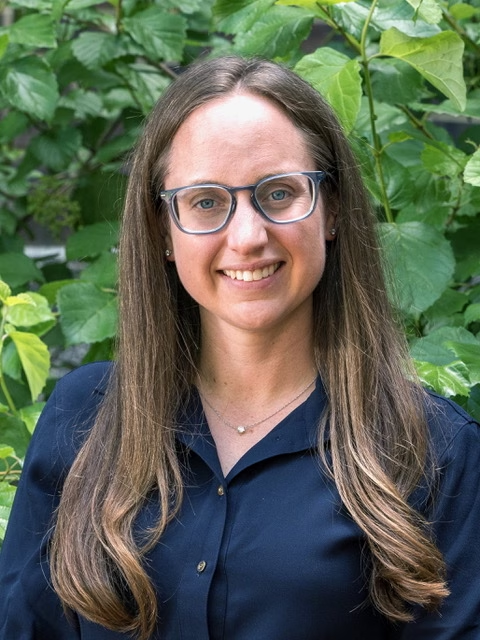
Alexandra Bayles
Chemical and Biomolecular Engineering
University of Deleware
Newark, Delaware
Advective processing strategies for architecting functional soft materials
Natural and engineered soft materials often derive their functionality from the hierarchical arrangement of chemically distinct building blocks. Self- and directed-assembly strategies that organize nano- and microscale elements into mesoscopic architectures have transformed our ability to realize materials with macroscopic properties superior to those of their individual components. However, challenges associated with adapting these processes across diverse chemistries and production volumes can limit their practical utility and deployment in advanced manufacturing. In this context, our research group leverages principles of chaotic advection to continuously architect functional soft materials.
In this talk, I will describe how we design modular fluidic devices to sculpt the spatial distribution of building blocks along laminar streamlines. Inspired by static mixers optimized to layer polymeric melts, these devices incorporate junctions that split, rotate, and recombine serpentine flows. We demonstrate the ability to assemble an extensive library of geometric patterns by ordering junctions in deliberate sequences. Serial combinations of certain junctions multiply patterns while preserving their relative spacing and orientation. This implementation of the baker’s transformation rapidly thins the characteristic feature size in layered, fibrous, and dendritic architectures. Combining junctions in parallel breaks symmetry, providing access to previously unattainable voxelated structures. Because organization is primarily governed by rheology rather than chemistry, these advective assembly processes provide an adaptable framework for patterning long-range order in extruded materials with rheologically similar precursors. We illustrate this versatility by processing viscoplastic materials to advance emerging applications. For extrusion-based 3D printing, we sculpt multimaterial filaments in advective assembly nozzles prior to deposition. Preassembling lower levels of the hierarchy in flow circumvents challenges of layer-by-layer deposition, including maintaining high throughput while preserving resolution. For soft actuator fabrication, we organize contrasting polymer solutions in flow and secure distributions after extrusion via UV polymerization. Including specific moieties induces swelling in response to light, temperature, and salt stimuli, while the mesoscale arrangement directs motion without delamination. For synthetic tissue engineering, we exploit the gentle laminar flows organize mammalian cells in biomimetic, fine architectures while mitigating shear-induced damage. Overall, the modular extrusion platform expands the assembly toolbox, unlocking new opportunities in designing functional soft and living materials.