March 24
@
4:00 PM
–
5:00 PM
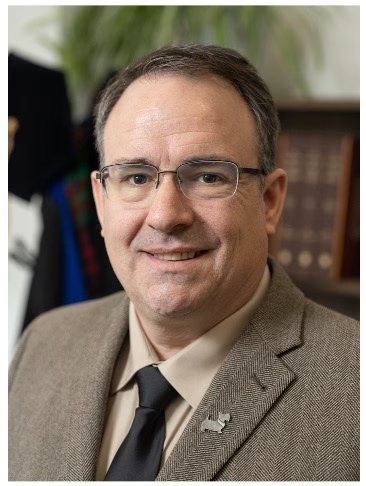
Carl D. Laird
John E. Swearingen Professor and Department Head
Carnegie Mellon University
Pittsburgh, Pennsylvania
Systems, Surrogates, Solutions: Optimization and Machine Learning for Decision-Making at Scale
Emerging global challenges are pushing the limits of today’s scientific computing tools. To overcome these barriers, our group develops open-source solutions for large-scale optimization problems. At the intersection of data science and mathematical programming, new capabilities support optimization-based decision-making with embedded machine-learning and data-driven models. Leveraging high-level languages like Python, we are democratizing these capabilities, placing powerful tools in the hands of a broader research community. Two vignettes illustrate the effectiveness of these capabilities to tackle challenging science and engineering problems at scale.
The first vignette highlights our rapid-response work during COVID-19. The pandemic exposed significant challenges in mitigating emerging infectious diseases. I will discuss our work to efficiently estimate county-level transmission parameter dynamics using a fully-coupled, national-scale model. With full spatio-temporal transmission parameter profiles, we were able to estimate the impact of non-pharmaceutical interventions on the spread of COVID-19. Our current work focuses on developing accessible, advanced optimization capabilities that enable inference on very large-scale, nonlinear dynamic systems.
Machine learning (ML) models are increasingly used as surrogates for complex processes within engineering. Here, I will discuss the need for surrogates in large-scale decision-making and introduce the Optimization and Machine Learning Toolkit (OMLT), a Python framework developed in collaboration with Imperial College London and Sandia National Laboratories. This package supports solution of mathematical programming problems with embedded ML models. I will showcase several applications that illustrate the use of machine learning surrogates, including for example, process design and operations, bioprocess modeling, and process family design. We will discuss our most current work on the use of conformal methods for optimization under uncertainty and advanced decomposition approaches for training hybrid models.