October 7, 2025
@
4:00 PM
–
5:00 PM
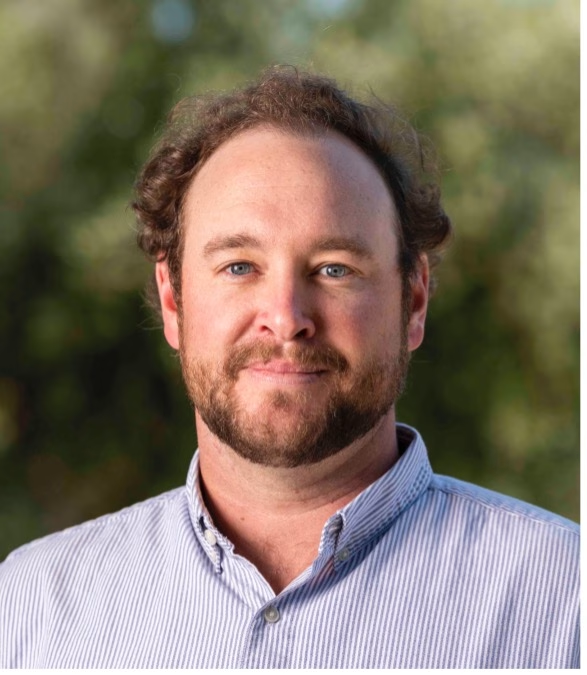
Phil Christopher
University of California, Santa Barbara
Santa Barbara, CA
Catalyst deactivation: Mechanisms, stability by design, and pathways to machine-learned models
Supported metal catalysts are used ubiquitously in industrial applications for energy conversion, material/chemical manufacturing, and pollution mitigation. Fundamental research often focuses on elucidating structure-function relationships that connect active site structures and compositions to their reactivities. Relationships that connect active site structure to stability are less well developed. Such insights require appreciation of dynamic structure changes, longer term experimentation, and reactors characterized by gradients in temperatures and chemical potentials. I will highlight two recent research efforts studying the deactivation of supported metal catalysts. First, I will discuss the deactivation of supported coinage (Cu and Ag) metal catalysts which occurs via sintering due to the low melting points of these metals. We found that the addition of < 1:100 mol fraction of certain dopant metals results in drastic stability enhancement under methanol synthesis reaction conditions A model was developed that proposes the role of dopants as local stabilizers of highly mobile metal atoms. Secondly, I will discuss the deactivation of Rh/TiO2 catalysts under CO2 hydrogenation conditions. Mechanistic studies suggest that deactivation occurs through competing mechanisms as a function of catalyst composition and reaction conditions, motivating the use experimentally trained machine learnt models to predict deactivation behavior. A round robin style experimental campaign was performed across 4 institutions to generate data for this effort. I will discuss our learnings in terms of the drivers of catalyst deactivation and experimental uncertainty in studies of catalyst deactivation.