April 10
@
12:00 PM
–
1:00 PM
Learning to See, Adapt, and Forget: From Computational Imaging to Trustworthy
Multimodal AI
Abstract: A central challenge in modern AI is that the world at test time does not match what was assumed at training time. Physical sensors operate under constraints, modalities go missing, data shift out of distribution, and models retain information they were never meant to keep. Building systems that remain robust and reliable under incomplete, shifted, or misaligned information is the organizing question of my research program.
In this talk, I will present our research spanning physically grounded inverse problems to large-scale trustworthy AI, showing how robust behavior across different applications can be achieved through principled, low-dimensional representations and adaptations. I will begin with computational imaging, where we seek robust recovery of multidimensional data from indirect or incomplete measurements. I will discuss domain expansion and wavefront sensing, showing how principled algorithmic innovations lead to robust models for challenging inverse problems. I will then discuss multimodal learning, where we seek robustness against missing and imbalanced modalities at train or test time via parameter-efficient adaptation, proxy token generation, and model merging across modalities. Finally, I will discuss targeted adversarial attacks and unlearning, where we seek to exploit model vulnerabilities or remove targeted information (e.g., identities, concepts, unsafe content) without affecting unrelated capabilities.
I will close with a discussion of ongoing work and open problems spanning robust multimodal AI at scale, continual learning with efficient unlearning, and AI-guided sensing for medical, agricultural, and scientific applications.
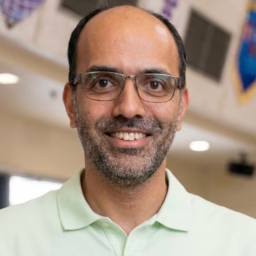 Salman Asif
Bio: M. Salman Asif is an Associate Professor in the Department of Electrical and Computer Engineering at the University of California, Riverside. Dr. Asif received his Ph.D. from the Georgia Institute of Technology, Atlanta, Georgia. He worked as a Senior Research Engineer at Samsung Research America, Dallas (2012–2014) and as a Postdoctoral Researcher at Rice University (2014–2016). He has received an NSF CAREER Award (2021), Google Faculty Research Award (2019), Hershel M. Rich Outstanding Invention Award (2016), and UC Regents Faculty Fellowship (2017) and Faculty Development (2021) Awards. Dr. Asif currently serves as Senior Associate Editor for the IEEE Transactions on Computational Imaging and as Area Chair for several top-tier venues including CVPR, NeurIPS, ICLR, and AAAI. His research interests lie at the intersection of machine learning, signal processing, and computational imaging, with a focus on building robust and trustworthy AI systems that perform reliably under incomplete, shifted, or misaligned information. Current research directions include robust multimodal learning, model editing and unlearning, and domain adaptation and generative models for computational imaging and inverse problems.
Location details: Discovery Building – Room 2329, 2nd floor of Discovery Building (access through glass doors behind information desk)