April 9
@
12:00 PM
–
1:00 PM
Toward efficient inference in complex systems
Abstract: I will present a line of work on efficient inference in complex systems, spanning both the foundations of machine learning and applications to brain imaging data. The talk is organized around two complementary directions.
In the first part, I will study modern algorithms for sampling, estimating normalizing constants, and estimating likelihoods. These methods often rely on a probability path that connects a complex target distribution to a simple base distribution, such as a Gaussian. I will highlight fundamental limitations of classical approaches, and show how path-guided algorithms can substantially improve efficiency. I will also discuss principled strategies for designing these probability paths, explaining when and why such methods succeed.
In the second part, I will turn to machine learning algorithms that are applied in neuroscience, presenting recent results on learning representations and discovering causal structure from brain imaging data. This line of work is a step toward using machine learning to obtain new scientific insights.
I will conclude with open questions in the field and future directions at the intersection of generative modeling, sampling, and their scientific applications.
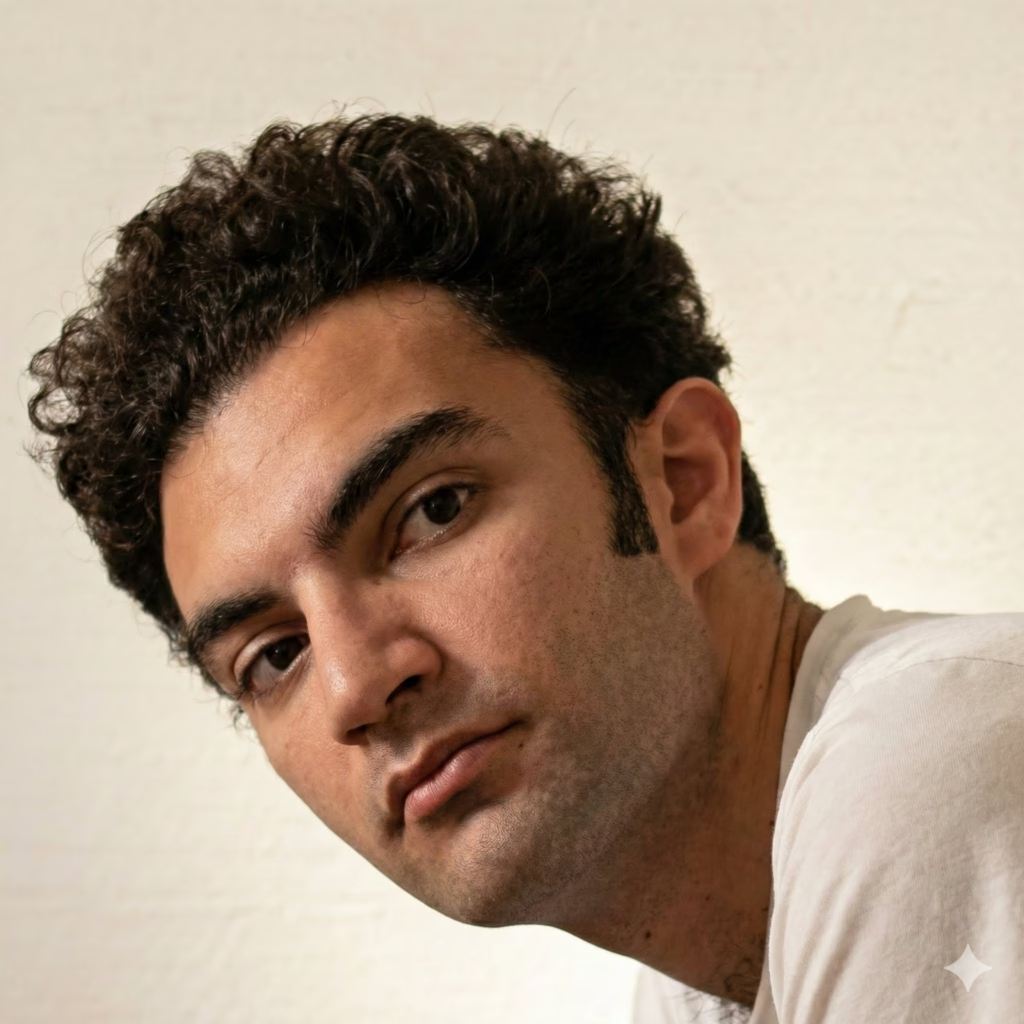 Omar Chehab
Bio: Omar Chehab is a postdoctoral researcher in the Machine Learning Department at Carnegie Mellon University. He completed his graduate training in France, earning a PhD in Mathematical Computer Science at Inria under the supervision of Aapo Hyvärinen and Alexandre Gramfort, followed by a postdoctoral position in the Statistics Department of ENSAE/CREST with Anna Korba.
His research focuses on principled methods for efficient inference from complex probability distributions. This includes estimating likelihoods from data, generating samples from unnormalized densities, as well as learning representations and discovering causal structure from brain imaging data. His work draws on a range of modern methods, including diffusion models, annealed MCMC, score matching, multi-view independent component analysis, and noise-contrastive estimation. More broadly, he studies these algorithms through the lens of computational and statistical efficiency, aiming to understand their fundamental limits and guide their design.
He regularly publishes at leading machine learning conferences such as NeurIPS, ICML, and ICLR, where his work has been recognized with a spotlight and top reviewer awards.
Location details: Discovery Building – Research’s Link, 2nd floor of Discovery Building (access through glass doors behind information desk)