March 23
@
3:00 PM
–
4:00 PM
Closing the Loop: Shrinking Materials Discovery Cycles for the Quantum Era
Abstract: As utility-scale quantum computing appears on the horizon, the field faces a scaling challenge comparable in magnitude to the pursuit of artificial general intelligence. Success in this endeavor hinges on reducing decoherence by improving materials systems at the fundamental electronic device scale — the single-qubit level — and, crucially, developing tools that enable rapid experimental feedback. This talk explores two paradigms where shrinking the characterization loop has catalyzed breakthroughs in quantum materials as well as materials for quantum hardware.
The first part focuses on the development of high-mobility III-V semiconductor quantum wells and quantum wires (nanowires). By optimizing the integration of superconductors with these low-dimensional electron systems, we have realized the high-quality hybrid interfaces necessary for topological quantum computing. I will highlight how rapid feedback was the primary driver for achieving proof-of-concept devices.
In the second part, I will address the “imaging bottleneck” in 2D moiré heterostructures. While these systems offer a rich playground for correlated quantum physics, the inability to rapidly visualize moiré superlattices has historically limited materials optimization. I will present the development of Torsional Force Microscopy (TFM), a technique that enables the visualization of moiré landscapes in minutes, bypassing the need for weeks-long cryogenic transport measurements.
Finally, I will put forward a vision for improved materials, device geometries, and rapid feedback techniques that can be ported to superconducting qubit platforms, with the hope of providing a boost to bridge the gap between laboratory prototypes and useful quantum computers.
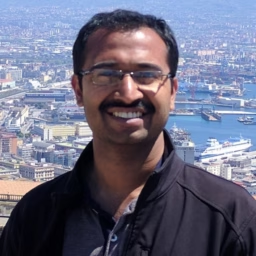 Dr. Mihir Pendharkar
Bio: Mihir Pendharkar is a researcher at Stanford University, where he works with Prof. David Schuster on advancing materials for superconducting qubit-based quantum computing. As a Q-FARM Bloch Postdoctoral Fellow working with Prof. David Goldhaber-Gordon, Mihir developed Torsional Force Microscopy (TFM) to image moiré superlattices and atomic lattices in 2D materials. This imaging technique has since been adopted by four major AFM manufacturers and dozens of research institutions worldwide. Mihir earned his MS and PhD in Electrical and Computer Engineering from University of California, Santa Barbara working with Prof. Chris Palmstrom, where his doctoral research specialized in Molecular Beam Epitaxy (MBE) of superconductor-semiconductor hybrid heterostructures for Majorana Zero Mode-based topological quantum computation.