January 26
@
12:00 PM
–
1:00 PM
Technology is evolving rapidly, and human interaction with autonomous technologies is no longer confined to one-to-one decision-support settings. Intelligent agents are increasingly working alongside groups of people in diverse contexts such as defense, transportation, and manufacturing. Consequently, there is a growing need to design trust- and behavior-aware adaptive agents that allow humans and autonomous systems to leverage their complementary strengths, while promoting values unique to human society. To this end, our research focuses on modeling human trust and behavioral dynamics over time across various teaming scenarios. In this seminar, I will first introduce our work on classifying and predicting trust dynamics profiles using individuals’ personal characteristics, uncovering who exhibits which trust trajectory and why. I will then present a study examining individual variability in trust bias (contrast versus assimilation) and its effects on coordination and decision-making when humans collaborate with multiple autonomous agents simultaneously. This work further extends to understanding distinct perceptions and teamwork strategies in hierarchical mixed human-agent teams. Time permitting, I will also discuss our research on the design of AI-supported emergency navigation systems that promote human altruism and trust.
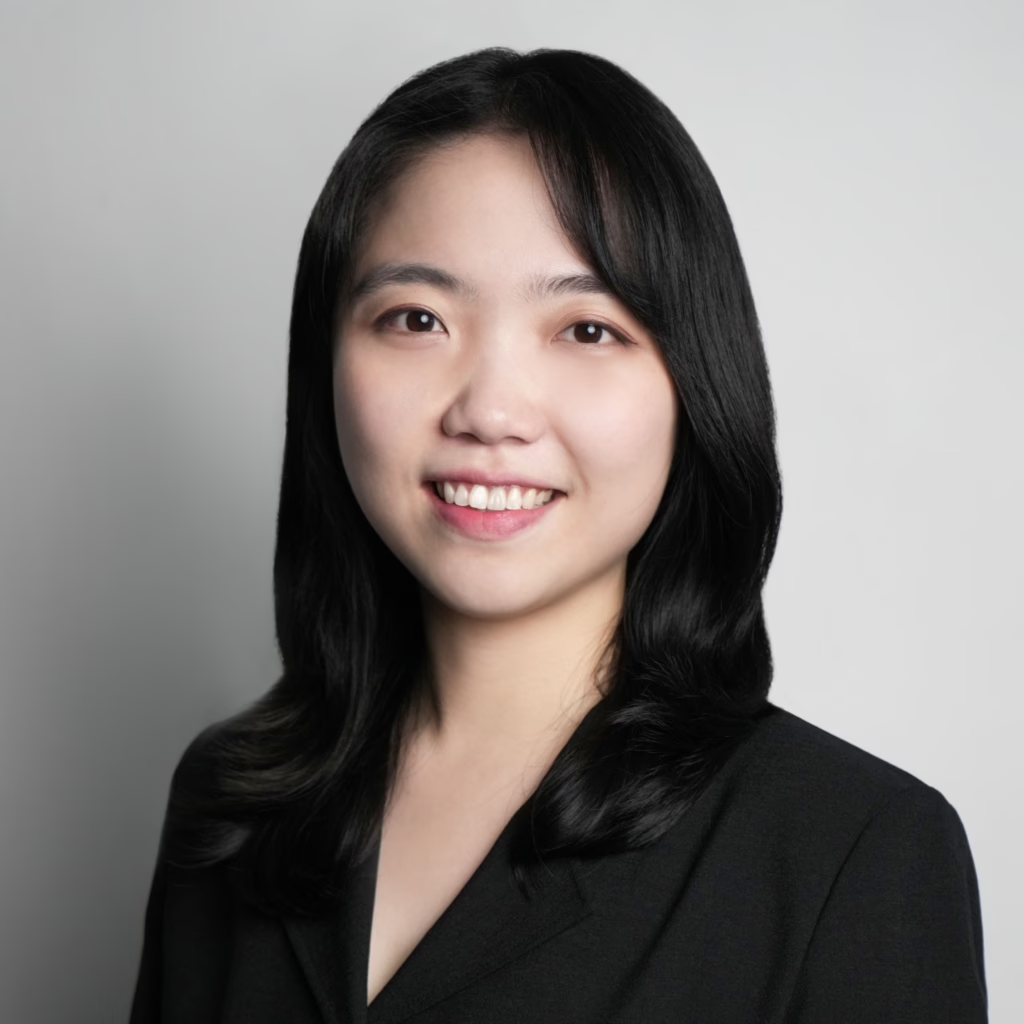
Bio: Hyesun Chung is a final-year Ph.D. candidate in Industrial and Operations Engineering at the University of Michigan. She was recently named a Barbour Fellow and received the Student Member with Honors Award from the Human Factors and Ergonomics Society (HFES). Prior to joining the University of Michigan as a doctoral student, she earned three bachelor’s degrees in Industrial Engineering, Business, and Industrial Design, as well as an M.S. in Industrial Engineering, all from Seoul National University in South Korea. Building on her interdisciplinary background, she is a human factors engineer and human-computer interaction researcher who integrates computational and statistical methods with psychological theory to better understand and design human-AI interaction and teaming.