February 19
@
1:00 PM
–
2:00 PM
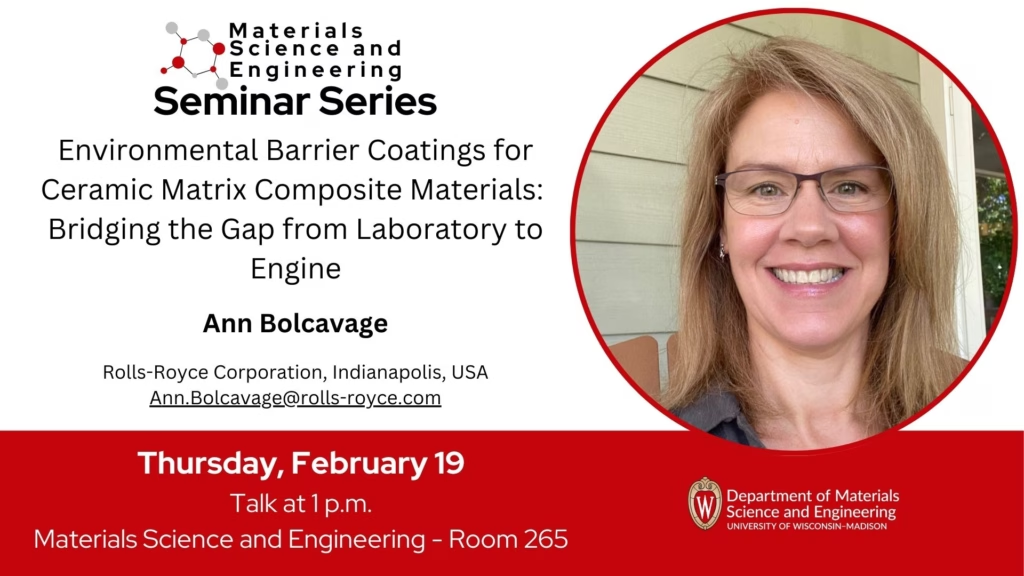
UW-Madison Department of Materials Science and Engineering welcomes Ann Bolcavage. Her seminar, “Environmental Barrier Coatings for Ceramic Matrix Composite Materials: Bridging the Gap from Laboratory to Engine”, will take place on Thursday, February 19, from 1-2 p.m. in MS&E 265.
Bio
Dr. Ann Bolcavage is the Engineering Fellow for Coatings at Rolls-Royce plc., a global manufacturer of propulsion solutions for civil aerospace, defense, and power systems markets. She is responsible for the strategic development of critical coating materials and manufacturing technologies for surface engineering to provide through-life support for all products. Over the course of her career, Ann has focused on developing metallic and ceramic coatings and thin films, and her expertise includes the measurement of process-structure-property relationships leading to optimized thermal spray, chemical vapor deposition, and physical vapor deposition processing methods for new and repaired aerospace and industrial gas turbine engine components.
Ann joined Rolls-Royce Corporation in 2006 as a Senior Engineering Specialist in Indianapolis, IN and subsequently held roles as Surface Engineering Manager (UK) and Chief of Materials Capability Acquisition before her appointment to the Rolls-Royce Engineering Fellowship in 2014. She was also the Corporate Technical Liaison for key research programs in surface engineering at the Commonwealth Center for Advanced Manufacturing (Disputanta, VA) and at the University of Virginia / Rolls-Royce UTC for Advanced Materials Systems. Prior to joining Rolls-Royce, Ann worked at Praxair Surface Technologies (now Linde AMT) in Indianapolis.
In recognition of her technical achievements and leadership, Ann was appointed Fellow of ASM International in 2011. She has been active in ASM for 40 years, including leadership positions in the Indianapolis Chapter, Board member of the Thermal Spray Society, and ASM International Board of Trustees member. Ann was also elected to the TSS Hall of Fame in 2025.
Ann received her B.S. with honors in Materials Science and Engineering from Lehigh University and her M.S and Ph.D. in Metallurgical Engineering from the University of Wisconsin-Madison. She has remained active in writing technical publications, giving conference and workshop presentations (9 invited), and has 23 patented inventions.
Abstract
Environmental barrier coatings (EBCs) with rare-earth silicate-based compositions have increasingly become a preferred solution for the protective system to prevent accelerated degradation of silicon carbide-matrix / silicon carbide fiber ceramic matrix composite (CMC) components. Within the harsh conditions of the gas turbine engine, an EBC system must maintain thermophysical and thermomechanical stability and withstand degradation from the high gas velocities, high temperatures, high pressures, and high-water vapor levels from combustion products. Increasingly, EBCs must also be resilient to the effects of ingested dust and siliceous debris (CMAS) from operation in arid, volcanic, or polluted regions. The overall effects of these conditions on the coating materials system life and degradation rate are complex, with multiple damage mechanisms in play over the course of the component lifecycle.
Laboratory / rig testing to assess EBC performance for any one property or damage mechanism is not wholly predictive and scalable to the likely performance of the coated component in the actual engine, due to the complex interactions between them. Often, environmental testing cannot simulate the low concentration of species over many cycles, specimen geometry is kept simple to facilitate rig design or simplify analysis, and the relative severity of multiple degradation mechanisms can’t be accurately replicated. As engine demonstration tests are extremely expensive, it is desired to gain important data and insights about EBC systems earlier in the development lifecycle while staying grounded as close to operational reality as possible. Examples and results are presented from laboratory and rig testing that demonstrate the materials and functional property gaps in understanding and what a recommended approach must incorporate to ensure robust learning is gained from concept to demonstration.