October 1
@
1:00 PM
–
2:00 PM
UW-Madison Department of Materials Science and Engineering welcomes Dr. Enyuan Hu. His seminar, “Making Redox Reactions Reversible: From
Fundamental Chemistry to Battery Design”, will take place on Thursday, October 1 from 1-2 p.m. in MSE 265.
Bio
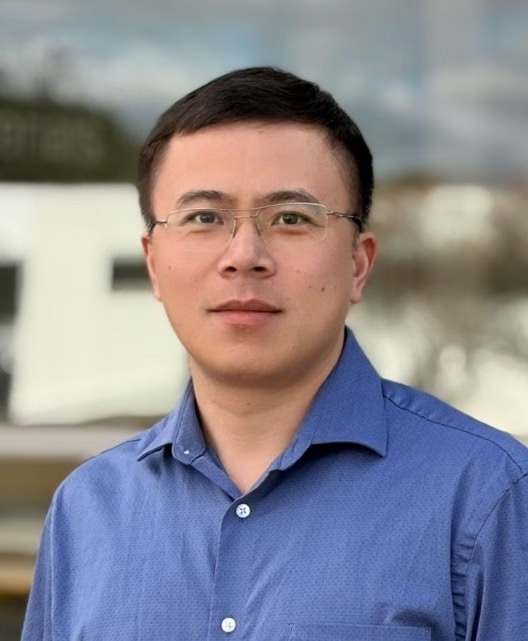
Dr. Enyuan Hu is a Chemist and Principal Investigator in the Chemistry Division at Brookhaven National Laboratory and an Adjunct Professor in Materials Science and Chemical Engineering at Stony Brook University. He earned his Ph.D. in Mechanical Engineering from Stony Brook University. His research spans battery materials design, synthesis, and characterization, with particular emphasis on synchrotron X-ray and neutron techniques for understanding electrodes and interphases. His group studies lithium- metal, sodium-ion, lithium–sulfur, and solid-state batteries. He was named a Clarivate Highly Cited Researcher from 2022 to 2025 and received the 2023 International Battery Materials Association Early Career Award and the Materials Today Rising Star Award.
Abstract
Reversible redox reactions underpin rechargeable batteries, yet electron transfer is often accompanied by structural rearrangements, bond cleavage, and parasitic reactions that prevent full recovery of the initial chemical state. Understanding these coupled processes is essential for designing batteries with greater efficiency and longer lifetimes.
This seminar will examine three interconnected challenges: structural and bonding changes, interphase
reactions, and chemical crosstalk between electrodes. Examples from copper-containing sodium cathodes will illustrate how coordination geometry and cation migration connect atomic structure with electronic structure and redox behavior. Studies of sulfurized polyacrylonitrile will reveal how synthesis-dependent bonding and residual hydrogen influence first-cycle irreversibility. At lithium-metal interfaces, identifying hidden reaction products and estimating component-resolved electron consumption provide insight into degradation beyond what Coulombic efficiency alone can reveal. Polysulfide shuttling will illustrate how mobile intermediates couple reactions across a cell.
Throughout the seminar, mechanistic understanding will be connected to strategies for improving reversibility, including compositional control of structural evolution, electrolyte and additive design, and separator coatings that regulate polysulfide transport while sustaining sulfur utilization. Together, these examples show how controlling local chemistry and interactions across a battery can help make redox reactions more reversible.