February 5
@
1:00 PM
–
2:00 PM
UW-Madison Department of Materials Science and Engineering welcomes Dr. Sam Zelinka. His seminar, “More uncertain than you might think… What 24 laboratories from around the world got wrong (and right) measuring sorption isotherms in an interlaboratory study”, will take place on Thursday, February 5 from 1-2 p.m. in MS&E Room 265.
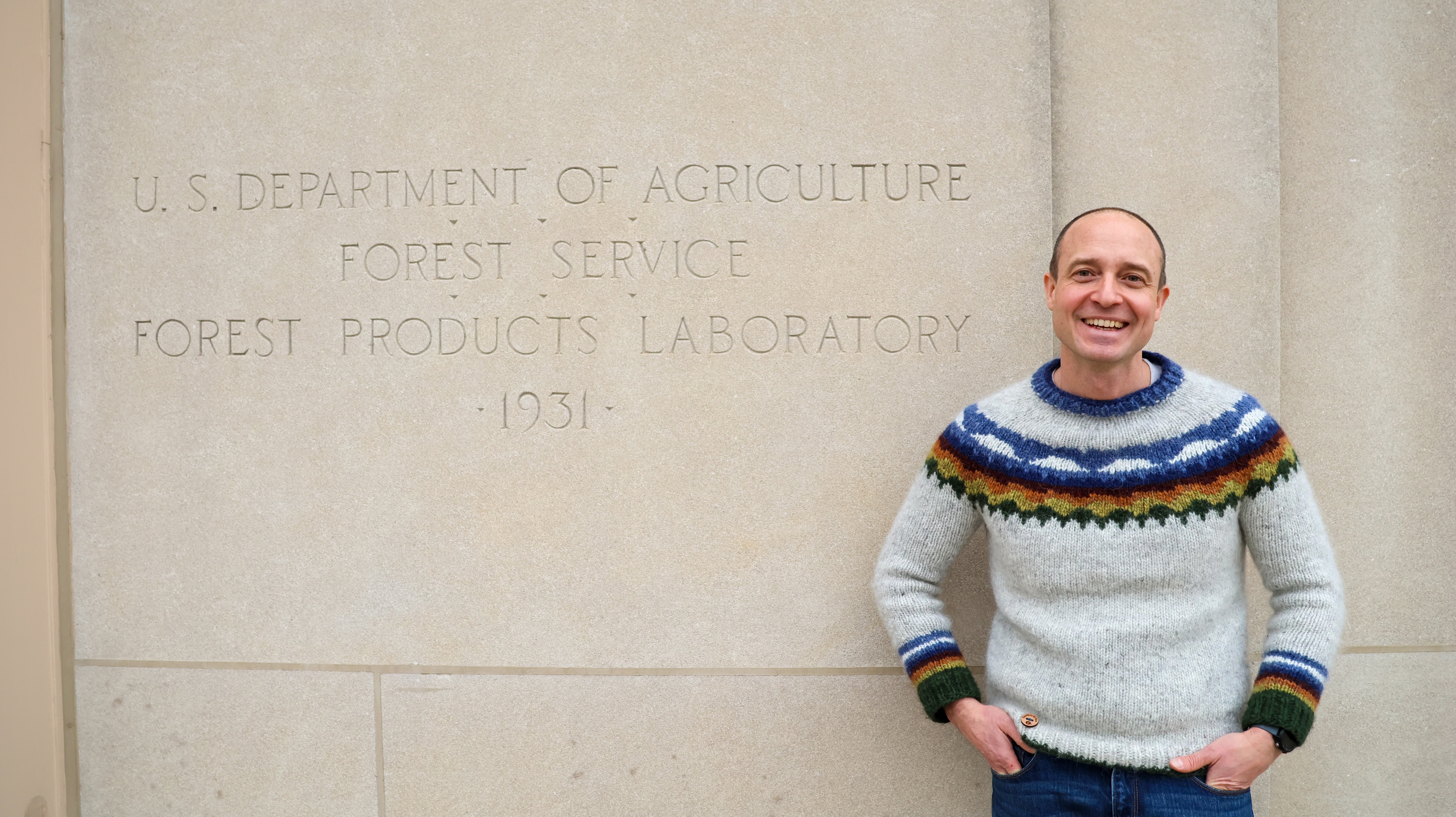 Samuel Zelinka, Supervisory Materials Engineer at the Forest Products Laboratory on February 5, 2025. USDA photo by Joshua Limbaugh.
Bio
For the past two decades, Dr. Sam Zelinka has worked at the US Forest Service Forest Products Laboratory where he has conducted research and led research teams that have explored how water and high temperatures (fire) modify the properties of wood, engineered wood composites and wood based materials. Dr. Zelinka’s work on the fire safety of wood buildings has been used to justify changes to the building code allowing the height and area limits of wood buildings in the United States to be increased from 6 stories to 18 stories. He also regularly partners with the wood industry in the United States to help new technologies meet fire safety requirements. Dr. Zelinka’s moisture research accomplishments have rewritten our understanding of many concepts in wood science including electrical conduction, diffusion through wood cell walls and the maximum amount of water that wood cell walls can hold (the “fiber saturation point”). In the past 10 years, Dr. Zelinka has shown that the previous sorption theories applied to wood were invalid and could not describe the physical changes the wood cell walls exhibit during absorption (often misunderstood as adsorption) of water vapor. He has further demonstrated that methods used to collection sorption data contain significant flaws and provided a new and robust framework to understand sorption kinetics. Dr. Zelinka is writing a book on wood moisture relations with an expected publication date of November, 2026 (Wood-Water Interactions, Elsevier).
Abstract
Over the past decade, we have shown that commonly used protocols for using automated sorption balances (often called dynamic vapor sorption or DVS analyzers) for collecting water vapor sorption isotherms in wood lead to unacceptably high errors and uncertainties in the data. However, our suggested protocols for acquiring high quality DVS data are still often not used because they require a long hold time at each relative humidity step. Our previous work has shown that a systematic correction factor can be applied to data collected with the commonly used short hold times to improve data quality, although this was only tested on a small amount of data from one laboratory. In 2021, we began a worldwide interlaboratory investigation on automated sorption measurements. The goal of this study was to gather data on matched wood samples from many different types of sorption balances and many different laboratories to develop a systematic correction factor that could be applied to sorption data collected with short hold times. However, along the way, we have learned many lessons about how these instruments are often used in practice raising further questions about the temperature, mass and relative humidity stability of these instruments in real-world applications (even with simple calibration weights). While this lecture focuses on lessons we learned about water absorption, these same lessons can be applied to many modern instruments commonly used for materials characterization.