October 22
@
1:00 PM
–
2:00 PM
UW-Madison Department of Materials Science and Engineering welcomes Professor Sang-Gook Kim. His seminar, “Structured Multi-Agent Architecture for Truly Smart Manufacturing”, will take place on Thursday, October 22 from 1-2 p.m. in MSE 265.
Bio
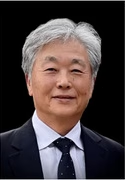
Sang-Gook Kim is a professor in the Department of Mechanical Engineering at MIT. He received his B.S. from Seoul National University (1978), his M.S. from KAIST (1980), and his Ph.D. from MIT (1985). He held positions at Axiomatics Co. in Cambridge, MA (1986) and at the Korea Institute of Science and Technology (1986–1991). He later served as a corporate executive director at Daewoo Corporation in Korea, where he directed the Central Research Institute of Daewoo Electronics before joining MIT in 2000. His research interests include piezoelectric MEMS energy harvesting and additive manufacturing, nano engineered energy conversion devices, ideal solar absorbers, and, more recently, AI for design and manufacturing. He is a Fellow of CIRP (International Academy for Production Engineering) and ASME (American Society of Mechanical Engineers), and an overseas member of the Korean National Academy of Engineering.
Abstract
The materials science tetrahedron, introduced by Prof. M. Fleming in 1989, links processing, structure, properties, and performance as a foundational framework for materials and manufacturing. Manufacturing activities span all four facets, transforming raw materials into functional products while meeting targets for quality, cost, and production rate at scale. This interconnected complexity makes the realization of agile, truly smart manufacturing systems inherently challenging. Advances in digitalization, automation, and cyber-physical systems—such as digital twins—have laid important groundwork. However, achieving truly smart manufacturing requires orchestration layer that seamlessly integrates human decision-makers (and their rationale) with machines, processes, and enterprise operations across the enterprise.
Agentic AI enables this transformation through autonomous reasoning and decision-making, with adaptive optimization currently focused on the unit machine and process levels. Without a structured architectural framework, however, individual AI agents soon risk severe fragmentation, with limited interoperability, explainability, and scalability across organizational silos. A structured reasoning and coordination layer is therefore essential to enable scalable and reliable agentic AI in manufacturing. It defines interfaces, constraints, decision rights, and coupling rules while ensuring transparency, robustness, and upgradability. Such a framework can transform numerous AI agents into auditable, reusable, and portable assets aligned with enterprise goals, including quality, cost, sustainability, resilience, and safety.
This talk addresses two key challenges: designing this coordination layer architecture and enabling reasoning–rationale elicitation. By capturing what agents (also human experts) decide, why, and with what evidence and uncertainty, organizations can preserve traceability, safety, maintainability, and strategic control while deploying agentic AI ecosystems effectively at scale over time.