October 9, 2025
@
12:00 PM
–
1:00 PM
Thursday, October 9
12:00 – 1:00pm
106 Engineering Research Building
Please contact office@neep.wisc.edu for assistance with remote participation.
Hierarchical Multiscale Modeling Framework to Predict Surface Morphology of Plasma Facing Components and Perspective on Technology Facilities & Research to Enable a Commercial Fusion Industry
Harnessing fusion energy requires materials that can cope in extreme environments, which is more challenging by a lack of representative laboratory-scale environments that mimic the harsh fusion reactor conditions. As a result, computational materials modeling is an important scientific tool to integrate research on fusion materials. For plasma facing components (PFCs) like tungsten, low-energy helium and hydrogen isotope plasma implantation is known to produce a drastic surface topology evolution referred to as fuzz. In this presentation, an atomistically informed predictive model is described. This model accurately predicts the formation and the early stage of evolution of the fuzz-like surface morphology mediated by dynamical processes that are characterized by disparate spatiotemporal scales. In our modeling framework, large-scale MD simulation results are used to parameterize constitutive equations required for the closure of the continuum-scale model for the surface morphological response of the plasma-facing material and compared to experimental measurements. Following the technical focus describing PFC surface evolution, the presentation will discuss grand challenges within fusion technology, which have been identified in recent reports from the National Academies of Science, Engineering and Medicine and the DOE Fusion Energy Sciences Advisory Committee. The numerous engineering and technical gaps that are at low technological readiness levels will be described, followed by a perspective on the facilities and research needed to enable a commercial fusion industry.
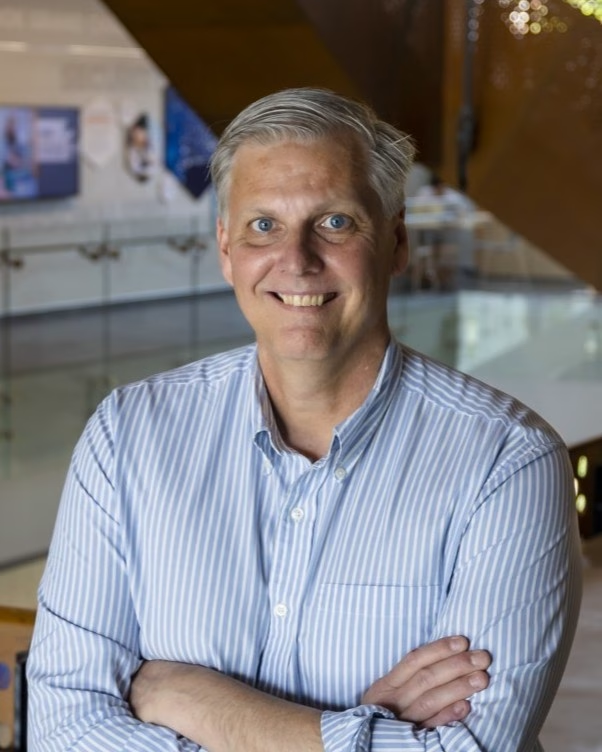
Brian Wirth
Brian Wirth is Department Head and Governor’s Chair Professor of Computational Nuclear Engineering in the Department of Nuclear Engineering at the University of Tennessee, Knoxville and Oak Ridge National Laboratory. Professor Wirth’s research investigates the performance of nuclear fuels, structural materials and plasma facing components in nuclear fission and fusion environments, utilizing computational materials modeling complemented by experimental investigation. Brian received a BS in nuclear engineering from the Georgia Institute of Technology in 1992 and a PhD in mechanical engineering from the University of California, Santa Barbara in 1998. Dr. Wirth spent four years at Lawrence Livermore National Laboratory. In 2002 he joined the faculty at the University of California, Berkeley as an Assistant Professor of Nuclear Engineering and was promoted to Associate Professor in 2006. In 2010, he moved to the University of Tennessee as a UTK-ORNL Governor’s Chair Professor. He has received many awards, including the 2014 U.S. Department of Energy Ernest O. Lawrence Award in Energy Science and Innovation, the 2016 Mishima Award from the American Nuclear Society for outstanding work in nuclear fuels and materials research and the 2003 Presidential Early Career Award for Scientists and Engineers (PECASE). Dr. Wirth is a Fellow of the American Association for the Advancement of Science (AAAS, 2016 Fellow, Physics Section) and the American Nuclear Society (ANS, 2017 Fellow).