October 2, 2025
@
12:00 PM
–
1:00 PM
Thursday, October 2
12:00 – 1:00pm
106 Engineering Research Building
Please contact office@neep.wisc.edu for assistance with remote participation.
Overview of the DOE NEAMS program and review of multi-scale simulations to inform nuclear fuel performance models
This presentation will first introduce the Nuclear Energy Advanced Modeling and Simulation (NEAMS) program, which develops predictive modeling and simulation tools to support the design, development, licensing, and operation of nuclear reactors. NEAMS activities span Light Water Reactors (LWRs), new LWR concepts, and next-generation systems such as High Temperature Gas Reactors, Fluoride Salt-cooled Reactors, Liquid Metal Fast Reactors, Molten Salt Reactors, and Micro-Reactors. Research is organized into five Technical Areas: Fuel Performance, Thermal Fluids, Reactor Physics, Structural Materials & Chemistry, and Multiphysics Applications. Selected accomplishments from each area will be highlighted.
The second part of the talk will focus on multi-scale simulations for nuclear fuel performance, with examples for uranium oxide in LWRs and, if time permits, other fuel types. A key element is understanding the thermodynamic and kinetic properties of point defects, which strongly influence creep, fission gas release, swelling, densification, and thermal conductivity. Density functional theory (DFT) enables prediction of defect properties and provides a foundation for mechanism-based, engineering-scale fuel performance codes.
Current applications of DFT to UO2 will be presented, including methods that incorporate dispersion corrections, spin–orbit interactions, and noncollinear magnetism. A point defect model informed by DFT energies and vibrational entropies predicts defect concentrations in UO2±x, validated against experimental data for deviation from stoichiometry and self-diffusion coefficients. The cluster dynamics code Centipede further connects defect behavior to in-reactor performance by modeling production, interactions, clustering, and kinetics under irradiation, with implications for fission gas behavior, fuel fragmentation and creep. The importance of these properties in extending fuel burnup limits and the role of uncertainty quantification in achieving qualification will be discussed. Similar approaches for other nuclear fuels, including UN, TRISO, and molten salts, will also be briefly mentioned.
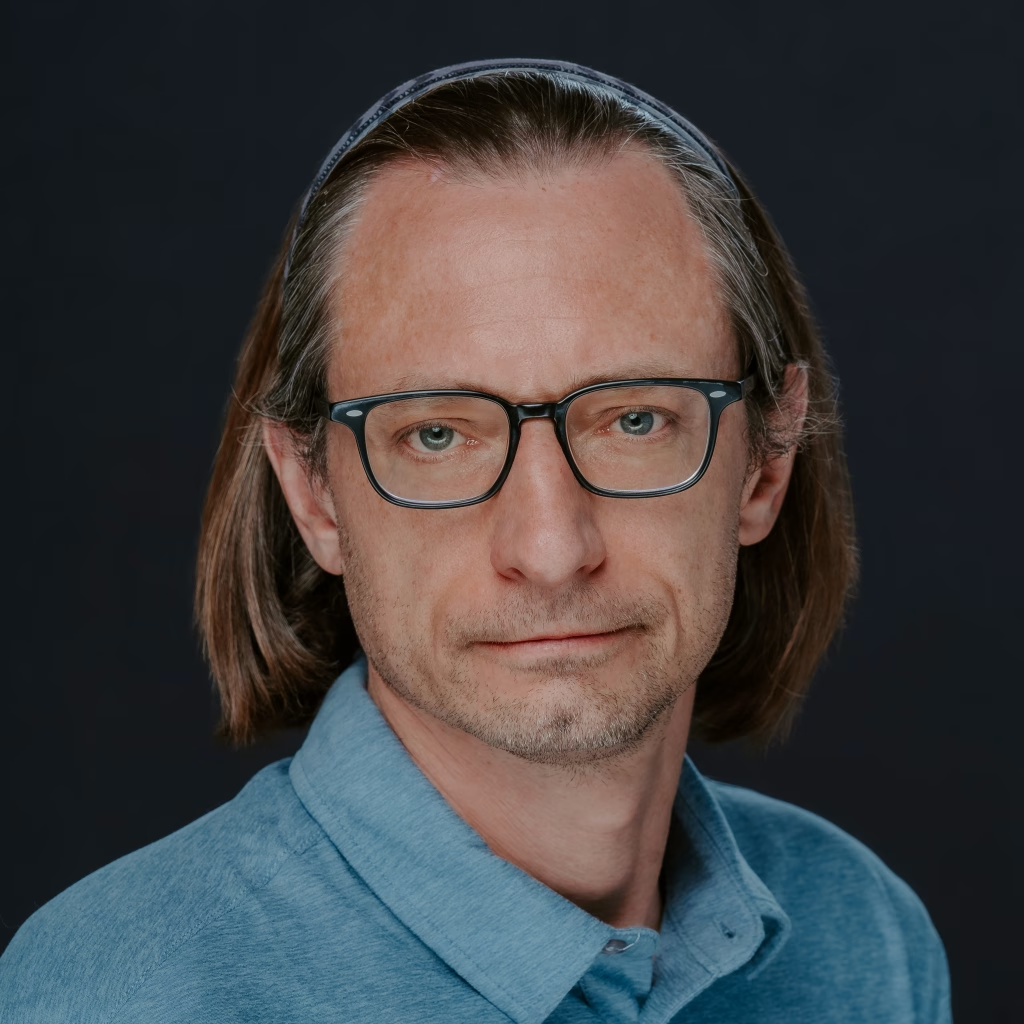
David Andersson, Los Alamos National Laboratory
David Andersson is the National Technical Director (NTD) of the Nuclear Energy Advanced Modeling and Simulation (NEAMS) program and the Deputy Group Leader of MST-8: Materials Science in Radiation and Dynamics Extremes. He joined LANL in 2007 as a Glenn T. Seaborg postdoc and was converted to technical staff member in 2009. Through the years he has made contributions to research on nuclear fuels (solids as well as molten salts) for NEAMS and other nuclear energy projects. Before becoming the NEAMS NTD in 2024, he was the Deputy National Technical Director for the Advanced Materials and Manufacturing Technologies (AMMT) program. David received his PhD in Materials Science and Engineering from the Royal Institute of Technology (KTH), Stockholm, Sweden. He was awarded the American Nuclear Society Mishima Award in 2023 for advancing understanding of nuclear fuel performance through fundamental studies of defect properties and their integration in performance models.