November 6, 2025
@
12:00 PM
–
1:00 PM
Thursday, November 6
12:00 – 1:00pm
106 Engineering Research Building
Please contact office@neep.wisc.edu for assistance with remote participation.
An electrochemical phase-field model for the corrosion of structural alloys by molten salts
Modeling and simulation must play a critical role in accelerating the development and qualification of materials for advanced reactors, such as molten salt reactors (MSRs). MSRs are an advanced reactor concept that uses molten salts as either the coolant or both coolant and fuel solvent. However, molten salts can corrode salt facing alloys, introducing corrosion products into the salt that can precipitate in the cold leg of the loop. To evaluate and improve alloy corrosion behavior, we have developed an electrochemical phase-field model for capturing the microstructure-dependent corrosion of structural alloys by molten salts. The model has been applied to the corrosion of nickel-based alloys and stainless steels by molten fluoride and chloride salts. It can represent impurity-limited corrosion in static corrosion experiments and includes the role of activity gradient corrosion with dissimilar alloys for the alloy coupon and salt capsule. We have also applied the model to investigate the impact of pure Ni coatings on the corrosion of Ni-Cr alloys. Working with Drs. Couet and Sridharan, we are adding the impact of radiation to the model. We are also working with them and Dr. Zhang on better understanding the impact of water vapor on corrosion.
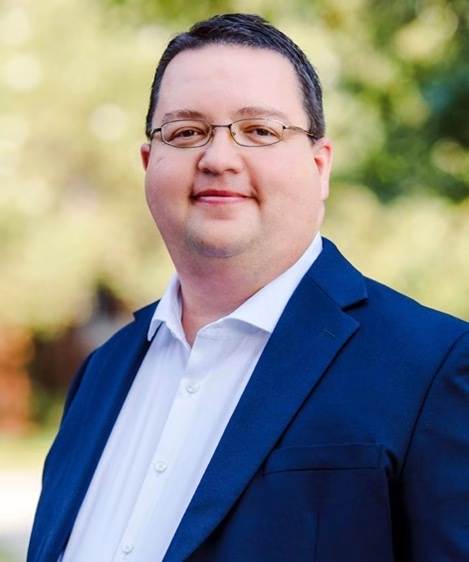
Michael R Tonks is the Interim Department Chair and Alumni Professor of Materials Science and Engineering and Nuclear Engineering at the University of Florida. Prior to joining UF in the Fall of 2017, he was an Assistant Professor of Nuclear Engineering at the Pennsylvania State University for two years and a staff scientist in the Fuels Modeling and Simulation Department at Idaho National Laboratory for six years. Prof. Tonks was the original creator of the mesoscale fuel performance tool MARMOT and lead its development for five years. He helped to pioneer the approach taken in the DOE Nuclear Energy Advanced Modeling and Simulation (NEAMS) program to use multiscale modeling and simulation to inform the development of materials models for the BISON fuel performance tool that are based on microstructure rather than burn-up, and he won the NEAMS Excellence Award for that work in 2014. He also won the Presidential Early Career Award for Scientists and Engineers in 2017 and the TMS Brimacombe medal in 2022. His research is focused on using mesoscale modeling and simulation results coupled with experimental data to investigate the co-evolution of microstructure and properties in materials in harsh environments.