December 4, 2025
@
12:00 PM
–
1:00 PM
Thursday, December 4
12:00 – 1:00pm
106 Engineering Research Building
Please contact office@neep.wisc.edu for assistance with remote participation.
Experimental Nuclear Thermal Hydraulics: Experimental techniques and applications in advanced reactors
Nuclear Engineering requires an understanding of fundamental thermal-fluid phenomena and the application of those phenomena to complex nuclear systems. In conventional light water reactors and water-cooled small modular reactors, two-phase boiling heat transfer has been one of the main research targets for both efficiency and safety. In non-water-cooled reactors such as gas-cooled reactors, liquid-metal reactors, and molten-salt reactors, the importance of turbulent flow needs to be emphasized as their primary system operates in a single-phase condition. Interestingly, heat-pipe microreactors use liquid metal phase change. This seminar will cover experimental techniques that Dr. Saya Lee has been working on to contribute to nuclear thermal hydraulics and their applications from fundamental phenomena to various reactor designs.
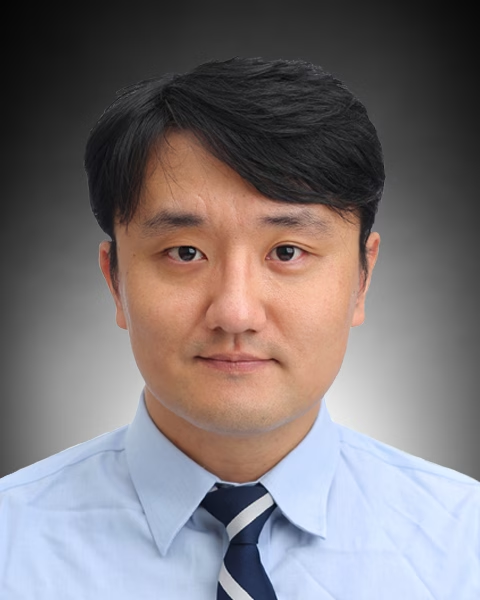
Dr. Saya Lee is an Assistant Professor at Pennsylvania State University, with a research focus on nuclear reactor thermal-hydraulics. He earned his Ph.D. in Nuclear Engineering from Texas A&M University and M.S. in Mechanical Engineering and B.S. in Mechanical and Electrical Engineering with a minor in Computer Science from Handong University in South Korea. He has extensive experience in diverse nuclear thermal-fluid applications to maintain the safety and operability of the current LWR fleet and to support the design and development of advanced reactors, including a SMR heat exchanger, a VHTR upper plenum, a SFR wire-wrapped fuel rod bundle, and a pebble bed HTGR. Also, he has expertise in the development and use of advanced measurement techniques. Recently, Dr. Lee has been actively working on heat-pipe-cooled microreactors.