October 3, 2025
@
12:00 PM
–
1:00 PM
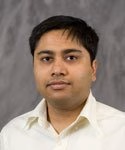
UW-ISyE looks forward to welcoming Dr. Santanu Dey, Professor at H. Milton Stewart School of Industrial and Systems Engineering at Georgia Institute of Technology.
We develop two general-purpose strong dual formulations for binary MINLPs, motivated by sensitivity analysis and distributed computation. For mixed binary quadratic programs (MBQPs), we show that the copositive dual of Burer’s completely positive reformulation has no duality gap when the feasible region is bounded or the objective is convex. Since the right-hand side of the original MBQP appears only in the dual’s objective, this formulation enables sensitivity analysis. For nearly decomposable nonlinear mixed binary programs, we propose a hierarchy of relaxations that preserve decomposability. The first level coincides with the classical Lagrangian relaxation, while higher levels yield progressively tighter bounds, culminating in a strong dual. We analyze the quality of these bounds for various types of MILPs. This is joint work with Diego Cifuentes and Jingye Xu.
Bio: Santanu S. Dey is an Anderson-Interface professor and director of doctorial recruiting and admissions in the H. Milton Stewart School of Industrial and Systems Engineering at Georgia Institute of Technology. Dr. Dey’s research interests are in the area of non-convex optimization, and in particular mixed integer linear and nonlinear programming. His research is partly motivated by applications of non-convex optimization problems arising in areas such as electrical power engineering, process engineering, civil engineering, logistics, and statistics. He currently serves on the editorial board of Mathematical Programming A, Mathematics of Operations Research and SIAM Journal on Optimization. He has previously served as an area editor for Mathematical Programming C and associate editor of INFORMS Journal on Computing. He has won the INFORMS Nicholson student paper competition, IBM Faculty Award, the Class of 1969 Teaching Fellow at Georgia Tech, the NSF CAREER award, the INFORMS Energy Natural Resources and Environment best paper award, and the INFORMS optimization society Balas Prize.