October 10, 2025
@
12:00 PM
–
1:00 PM
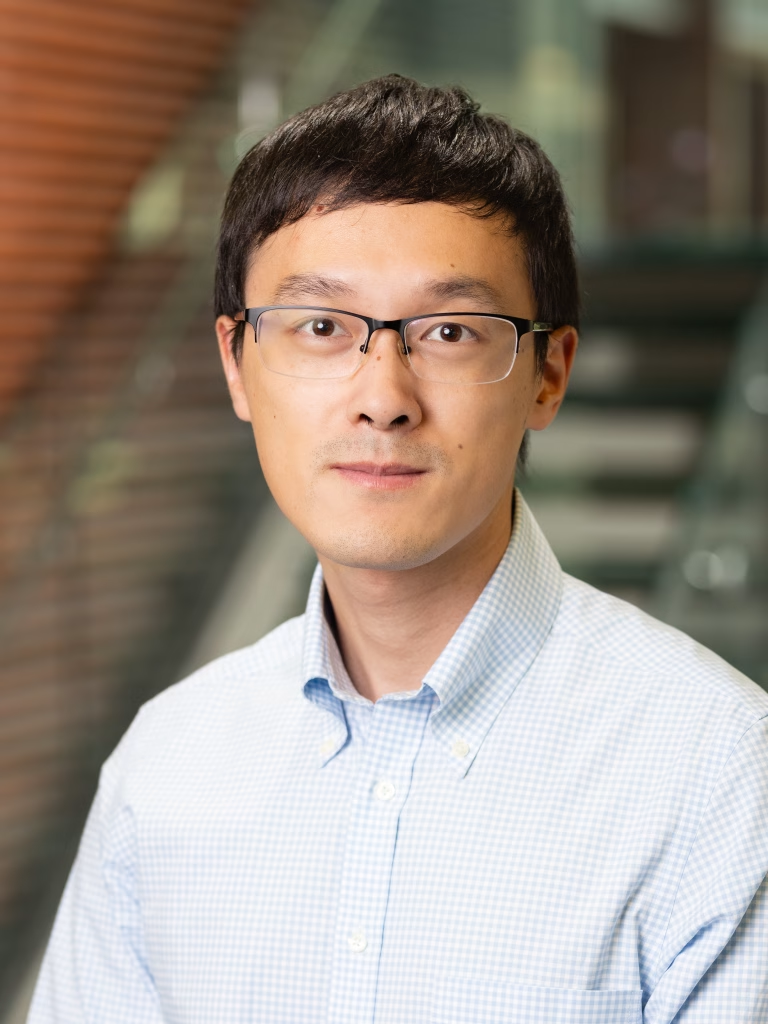
UW-ISyE looks forward to welcoming Minshuo Chen, assistant professor with the Department of Industrial Engineering & Management Sciences at Northwestern University
Diffusion models achieve state-of-the-art performance in various high-dimensional data modeling tasks. These empirical successes challenge conventional wisdom while raising critical concerns. On the one hand, in high-dimensional applications, diffusion models’ strong performance appears to circumvent the curse of dimensionality. On the other hand, memorization emerges as an unwanted byproduct, limiting creativity and raising safety and privacy issues. In this talk, we theoretically decipher these observations. The first part develops statistical learning guarantees of diffusion models for low-dimensional manifold data—an assumption aligns well with many practical datasets. We prove that diffusion models can learn data distributions at rates governed by the intrinsic dimension and curvature of the data. The second part establishes separation in memorization and generalization through the statistical learning and network approximation lens. Building on these insights, we propose a pruning-based method that reduces memorization while maintaining generation quality.
Bio: Minshuo Chen is an assistant professor with the Department of Industrial Engineering & Management Sciences at Northwestern University. He was an associate research scholar with the Department of Electrical and Computer Engineering at Princeton University from 2022 to 2024. He completed his Ph.D. from the School of Industrial and Systems Engineering at Georgia Tech, majoring in Machine Learning. His research focuses on developing principled methodologies and theoretical foundations of deep learning, with a particular interest in 1) generative models including diffusion models, 2) foundations of machine learning, such as optimization and sample efficiency, and 3) reinforcement learning.