Few times in modern history has a technology emerged and evolved so rapidly as artificial intelligence. So it’s no wonder that people across society are struggling not only to wrap their heads around its enormous potential and consequences, but they’re also grappling with how and when (or whether) to apply it without stifling the very human ingenuity that led to its development in the first place.
And, faced with tech-savvy students armed with their own notions about AI, educators at all levels are trying to determine how to weave the tool into their teaching so that it’s a partner and not a crutch.
As a first step in creating a vision for education in the AI era, the University of Wisconsin-Madison College of Engineering convened partners from industry, K12 and academia at its AI-Ready Engineer summit, Nov. 9 and 10, 2026, on the UW-Madison campus. The work of a committee chaired by Laura Albert, engineering senior associate dean for faculty affairs and development, the summit supports a college priority to advance a future-ready engineering education grounded in strong fundamentals, AI fluency and ethical professional judgment so that every Badger engineer is prepared to lead, adapt and make an impact throughout their careers.
Approximately 150 people converged in the DeLuca Form in the Discovery Building for the summit’s first day of expert talks and panel discussions. Several themes emerged; among them: AI can be a partner in students’ learning and thinking, with the right guidelines and guardrails. In an AI era, critical thinking, sound judgment and ethical responsibility are even more important, and engineers continue to need deep technical foundations, along with adaptability and learning agility. Applied learning is important. And educators must intentionally cultivate human relationships.
One important underlying summit theme was that learning is fundamentally human and social—and even as we embrace increasingly powerful artificial intelligence tools, it’s important to preserve the human relationships and experiences that make learning, discovery and innovation possible. Talks mentioned community, the social experience of a college education, office hours, in-person “theory labs,” teamwork, communication, group discussion, applied projects, and big challenges—like the Engineering Moonshots—that bring people together.
The conversation, in brief
Massachusetts Institute of Technology professors Eric Klopfer and Sam Madden highlighted lessons learned via the institute’s committee on AI use in teaching, learning and research training—among them, rather than viewing the challenge of AI as “cognitive surrender,” treat AI as a partner in gathering data that enables people to make decisions. A panel consisting of Wisconsin K12 leaders Cory Kulig, Mike Beighley, Britni Walz and Adriana Plach fielded questions about how K12 educators are adopting AI in their teaching while ensuring students have opportunities to be curious, think critically, work together and apply their learning to real challenges.
In their conversation, Peter McClone of Plexus, Laura Leonard of Worley and Steve Nackers of Sub-Zero Group also focused on the importance of “soft,” or human skills: Companies need engineers who are curious, adaptable, systems thinkers, problem-solvers, team players, good communicators and lifelong learners. The engineer of the future, they said, should understand not only the fundamentals, but also can combine that expertise with judgment, ethics and adaptability to solve problems in an AI-enabled world.
In contrast, UW-Madison industrial engineering alum Jeremy Kranz shared a decidedly different take. As founder and managing partner of the Silicon Valley venture capital firm Sentinel Global, he invests in companies building technologies that reshape how organizations operate. Prompting summit attendees to ponder what happens when organizations treat AI as a new layer in their workforce structure, he shared visions of a corporate world populated by digital twins, bots and AI-enabled workflows—essentially one in which human workers create and manage the work of AI agents.
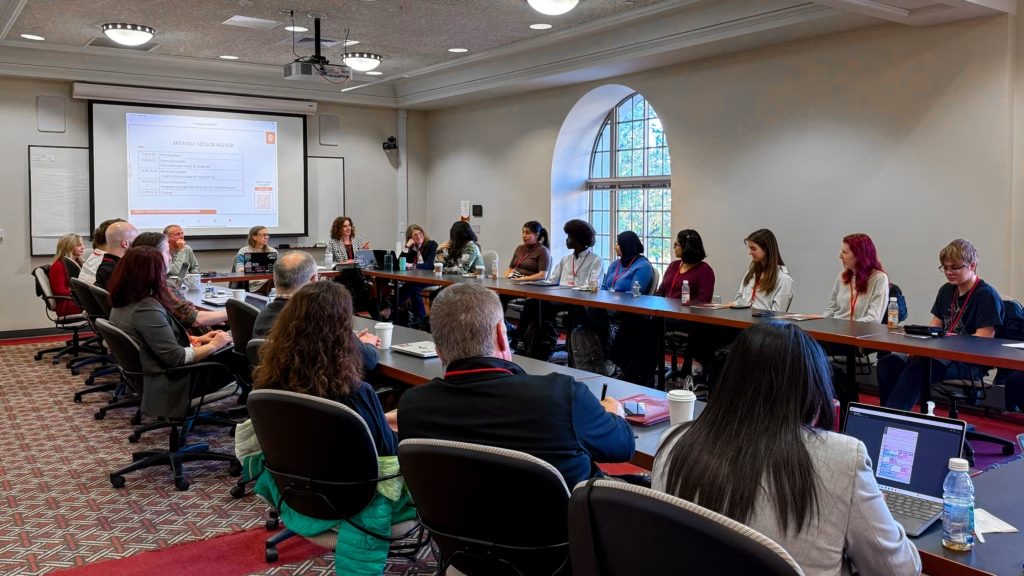 Inspired and brimming with ideas from day 1 of the summit, participants collaborated in three breakout tracks on day 2 to determine concrete next steps.
One through-line of the summit was that engineering decisions impact society. Ethics keynote speaker Zach Pirtle—a former NASA engineer who’s now deputy director for the Arizona State University Consortium for Science, Policy and Outcomes—encouraged engineers to shape a culture that considers the ethical, legal and societal implications of their innovations.
The UW-Madison leaders panel—consisting of College of Computing & Artificial Intelligence Dean Remzi Arpaci-Dusseau, UW-Madison Vice Provost for Information Technology and CIO Didier Contis, College of Engineering Grainger Dean Devesh Ranjan and UW-Madison Vice Provost for Lifelong Learning Jeffrey Russell—echoed others’ emphasis on learning and judgment, lifelong learning and ethical responsibility, connecting the university’s commitment to serving society through the Wisconsin Idea.
And lightning talks showcased concrete examples of how six educators have already designed courses, assignments, assessments and teaching tools to incorporate AI intentionally. The speakers emphasized transparent AI use, verifying AI outputs, authentic problem-solving and preserving student thinking while using AI to enhance student learning, creativity and engagement. In other words: Focus on creating learning experiences that help students think better, solve harder problems and understand when and how AI adds value to their work.
On Day 2 of the summit, participants joined one of three working breakout tracks, with conversations centering around how to integrate AI into teaching and learning from kindergarten through higher education, how to develop students’ professional judgment and ethical reasoning, and what skills, experiences and tools students need now to thrive in an AI-enabled workforce.
Featured image caption: Featuring conversations with and talks given by K12, campus, industry and national experts, the AI-Ready Engineer summit drew more than 150 people to explore what’s needed to prepare future engineers for success in an AI-driven world.