More than 3,000 years ago, members of a Native community built a network of six monumental earthen mounds and six concentric C-shaped ridges in a northeastern Louisiana floodplain.
The site, now called Poverty Point, is a UNESCO World Heritage Site and home to some of the largest earthwork mounds in North America. Little is known about how and why the culture, which predates modern Native tribes, built the mounds.
Soon, that could change. William Likos, a professor of civil and environmental engineering at the University of Wisconsin-Madison, is part of an ambitious project to study the site’s soil, aiming to unearth information about the people who created and lived at Poverty Point thousands of years ago.
Tristram Kidder, a professor of anthropology at Washington University in St. Louis, is leading the project, which is now in its second year. He tapped Likos, an expert in geotechnical engineering, to explore what Poverty Point’s builders might have known about soil engineering, and how they could have built soil structures that endured for thousands of years in an environment prone to heavy rains and flooding.
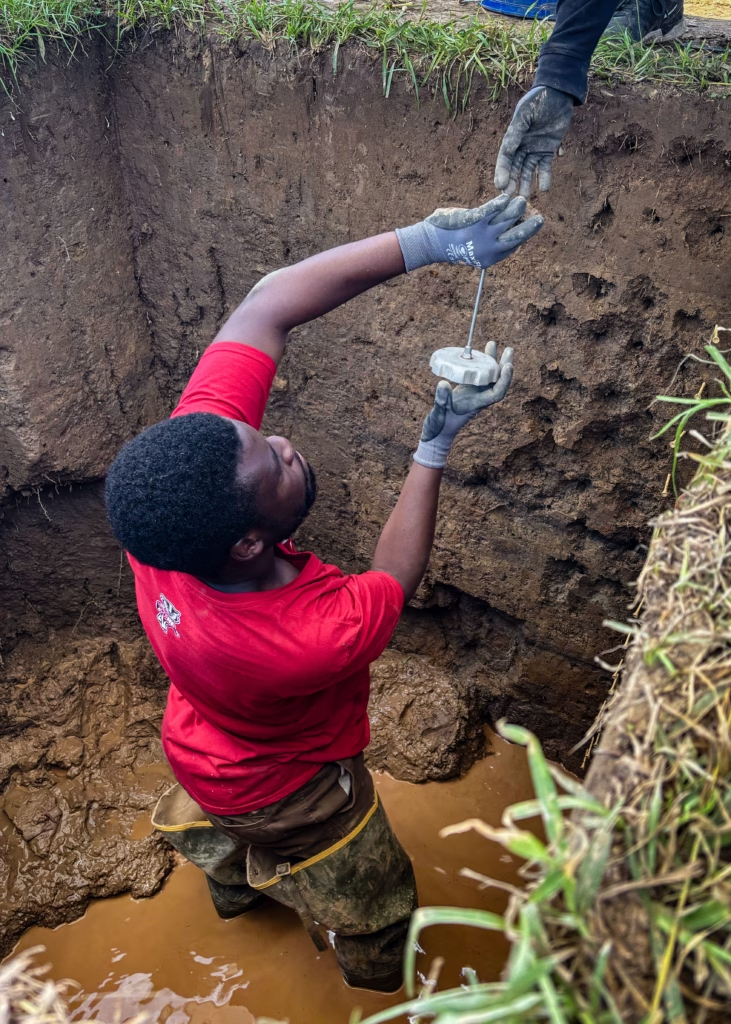 Patrick Nyarkoh, a geological engineering graduate student, conducts on-site soil strength testing during a site visit to Poverty Point in Louisiana. Nyarkoh is part of Professor William Likos’ group, and is studying how Poverty Point’s builders may have compacted the soil used to build massive earthwork mounds.
Likos and two of his graduate students visited Poverty Point in June 2025. While there, they conducted soil property tests at six locations across the site. The researchers measured the soil’s strength in intervals going down from the surface to see how much it had been compacted. They also collected samples for further testing in the lab.
The site contains locally-sourced soils and various types of stone that came from many sources, some hundreds of miles apart. “An interesting point is that the soils in the mounds and ridges appear to come from very different sources across the landform, some of which are deeply buried,” Kidder says. “Also, the builders selectively ‘mined’ specific soils and deposited them in particular places. For example, they used E-horizon soils (a type of soil that has lost minerals and nutrients and is grey or white in color) to mark the base of several mounds, so the mounds were basically built on a light-colored blanket.
Patrick Nyarkoh, a graduate student under Likos, is conducting additional lab tests with samples from the site to measure the soil’s water content and plasticity. That information may help in future research to uncover how the Poverty Point culture compacted soil for the mounds.
“Even today, doing soil compaction can be very difficult, and we have machine compactors to help us,” says Nyarkoh. “We don’t know how they were able to manage compaction in the field. But it’s important because compaction increases soil strength, helps keep out water, and decreases how much soil settles.”
Determining soil compaction density could help in future experiments. For example, Nyarkoh says that researchers can test how people jumping on soil compacts it by using the estimated force a certain number of people would generate and applying it to soil. With those calculations, they could determine if that might produce similar results to the samples from Poverty Point.
The research teams hope to answer long-unresolved questions—for example, what technical know-how Poverty Point’s builders may have possessed and what the society might have looked like—through the lenses of anthropology and engineering. Even just looking at breaks, or the lack thereof, in the site’s soil layers could provide insight into how fast the mounds were built, says Likos. That, in turn, could offer clues about how many people were reasonably involved in their construction, and, more broadly, if a larger community existed around Poverty Point.
The work has also been a great opportunity for his and Kidder’s students to get exposure to fields that don’t often intersect. “While we were there, there were about 15 anthropology students who hadn’t really had the chance to talk to engineers in this sort of capacity,” Likos says. “They were really interested in the soil measurements we were taking. And for my students to have the chance to talk to those students about what they were doing and hear their perspective on the project was a really unique experience.”
The National Science Foundation is supporting the project.
Featured image caption: One of the mounds at Poverty Point is pictured. The site is home to some of the oldest and largest earthwork mounds in North America and is the subject of ongoing study. Submitted photo.