It’s easy to think of concrete buildings as some of the strongest structures around. Yet in earthquake-prone regions, they need the right structural reinforcement to avoid serious damage or failure.
After more than 20 years of research, engineers at the University of Wisconsin-Madison are finding that tiny steel fibers embedded in concrete may offer a cost-effective solution to help high-rise concrete structures withstand more earthquake-driven movement before sustaining serious damage.
Gustavo Parra-Montesinos, a professor of civil and environmental engineering at UW-Madison, is leading the project. At just 2.5 inches long and 0.03 inches in diameter, the fibers are small but mighty: In bulk, they may help reinforced concrete members deform more without failing.
“Walls made of fiber-reinforced concrete may still require repairs,” Parra-Montesinos says. “But because of how the material behaves, damage may occur at larger deformations, so they will likely require fewer repairs compared to a regular concrete wall. This project addresses several aspects of concrete construction and could help make buildings perform better and more safely in earthquakes.”
High-rise construction projects use coupling beams, or heavily reinforced concrete beams that connect structural walls to help them withstand the repetitive side-to-side forces and displacement that can occur during earthquakes. They’re designed to deform and to dissipate energy so that a building does not collapse suddenly when subjected to an earthquake.
The challenge is in the material: Concrete is exceptionally strong under compression (when it is being squeezed), but weaker in tension (when it is being pulled or stretched). Steel, on the other hand, has excellent tensile strength and ductility—meaning it can resist major bending, pulling or stretching without breaking.
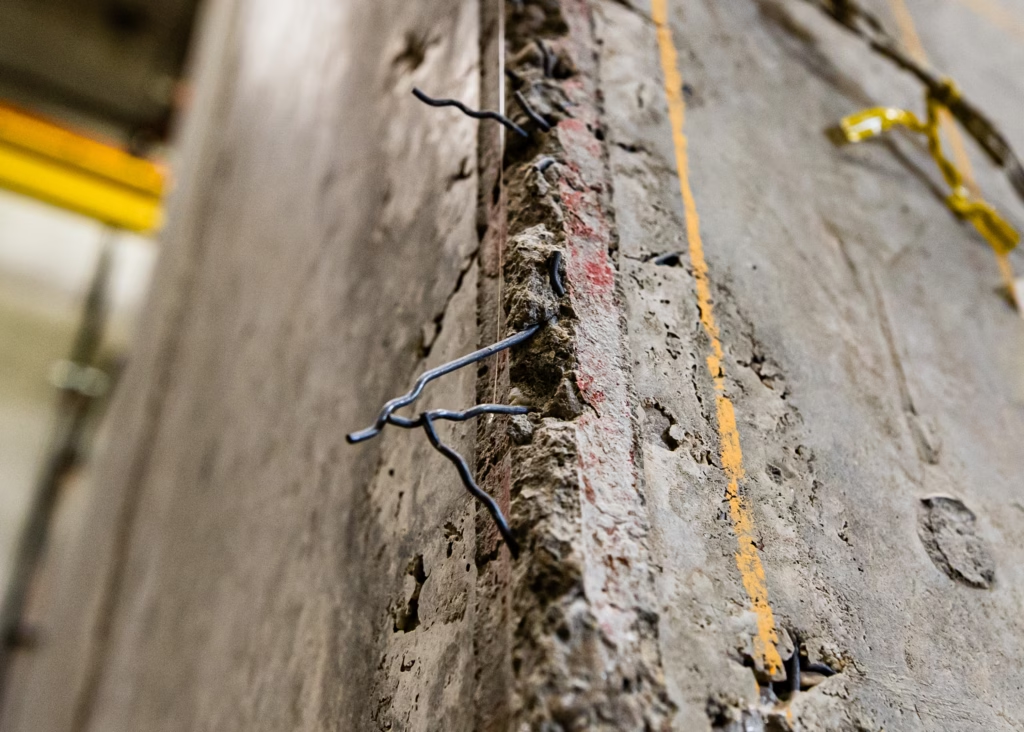 Tiny steel fibers protrude from the corner of a wall specimen. CEE Professor Gustavo Parra-Montesinos is researching how embedding steel fibers may make concrete more resistant to the forces unleashed during an earthquake. Credit: Joel Hallberg.
While coupling beams are often effectively reinforced with diagonal steel, Parra-Montesinos says they are difficult to design and build, and can be a costly and time-consuming part of construction. So, he’s spent years studying another option: mixing tiny steel fibers directly into concrete. The fibers distribute reinforcement throughout the concrete, allowing for reductions in traditional steel and simplifying construction.
Parra-Montesinos began researching applications of fiber-reinforced concrete for earthquake-resisting structures in the early 2000s. Today, he and collaborators are testing how it will perform when used in structural walls. The American Concrete Institute and several corporate partners are supporting his research.
The research team conducted a series of experiments in the Jun and Sandy Lee Wisconsin Structures and Materials Testing Laboratory at UW-Madison during the past two years. They built four 16-foot-tall, 60-inch-long, 10-inch-thick wall specimens using fiber-reinforced concrete. Then, to simulate an earthquake, they applied lateral displacements with the lab’s powerful hydraulic actuator, pushing and pulling the specimens to see whether they’d move, bend or break.
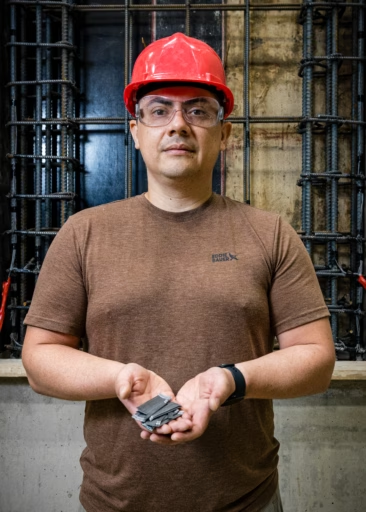 PhD student Osman Carrillo holds steel fibers. The fibers are less than 3 inches long but may significantly reinforce concrete. Credit: Joel Hallberg.
Osman Carrillo, a civil and environmental engineering PhD student working under Parra-Montesinos and José A. Pincheira, an associate professor of civil and environmental engineering at UW-Madison, says the group made 10 smaller-scale models to select the most suitable steel fiber types and dosages before making the four large wall specimens. The full-scale specimens took about two months each to build and set.
Carrillo says the College of Engineering’s facilities have enabled research at a scale that is not possible in most labs. “It’s not common to see tests of this size,” he says. “If you review the literature, you often see tests of walls that are 4, 6, or 8 inches thick because it’s so hard to test at this scale.”
So far, Parra-Montesinos says, the results have been very promising.
“There is a concept called drift ratio, which is the horizontal displacement at the top of the wall divided by the height,” he says. “Typically, if you can get to 3%, that is considered adequate to resist the displacements we associate with an extremely powerful earthquake: one with a return period of approximately 2,500 years. We consistently got 3.5%.”
In other words, the fiber-reinforced concrete tests exceeded a common benchmark used for severe earthquake performance.
Traditional reinforced concrete construction uses a dense grid of transverse steel bars. That reinforcement helps hold a concrete wall together when it moves laterally, or side to side, especially when one side is under compression and the other is under tension. In their tests, the researchers increased the spacing between the transverse steel bars in their fiber-reinforced concrete walls while maintaining their seismic performance.
Concrete often has to be pumped from the ground to higher floors during construction, and steel fibers in the mix could change how the material flows. Parra-Montesinos says the team’s first challenge was proving the mix could be pumped—a true test of its practicality on real-world construction sites. Early tests showed some mixes could be pumped to at least 200 feet.
“It’s a big gain for simplifying construction,” he says. “Part of this is also about making concrete construction easier, faster and safer.”
Featured image caption: University of Wisconsin-Madison civil and environmental engineering PhD student Osman Carrillo works on a wall specimen in the Jun and Sandy Lee Wisconsin Structures and Materials Testing Laboratory. Credit: Joel Hallberg.