September 21
@
12:00 PM
–
1:00 PM
Building Human Microvasculature for Regeneration and Disease Modeling
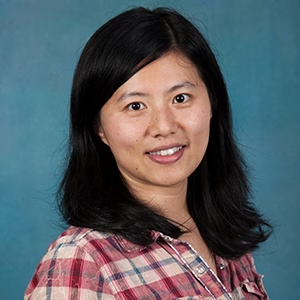
Ying Zheng, PhD
Associate Professor
Department of Medicine
Stanford University
Abstract:
Microvasculature helps define the tissue microenvironment. These vessels are highly heterogeneous in size and geometry, spanning three orders of magnitude in diameter, and their dysfunction is a systemic hallmark of many diseases. Yet studying them remains difficult because they are buried deep in tissues and are hard to access, visualize, and manipulate in patients. In this seminar, I will present engineering strategies that bring these “invisible” microvascular compartments into view. Using native collagen matrices, microfabrication, and multiphoton laser sculpting, my group builds perfused human microvessels across scales, including capillary‑like networks with realistic 3D geometry and hemodynamics. I will show how vascular architecture combined with perfusion reshape luminal flow and endothelial responses, and how these microvessels can be integrated with hiPSC‑derived vascular organoids to enhance survival. Together, our work establishes a path toward perfusable, scalable, long‑lived human vascular tissue models that complement animal studies and enable mechanism‑driven regeneration and disease modeling.
Print PDF