October 23
@
12:00 PM
–
1:00 PM
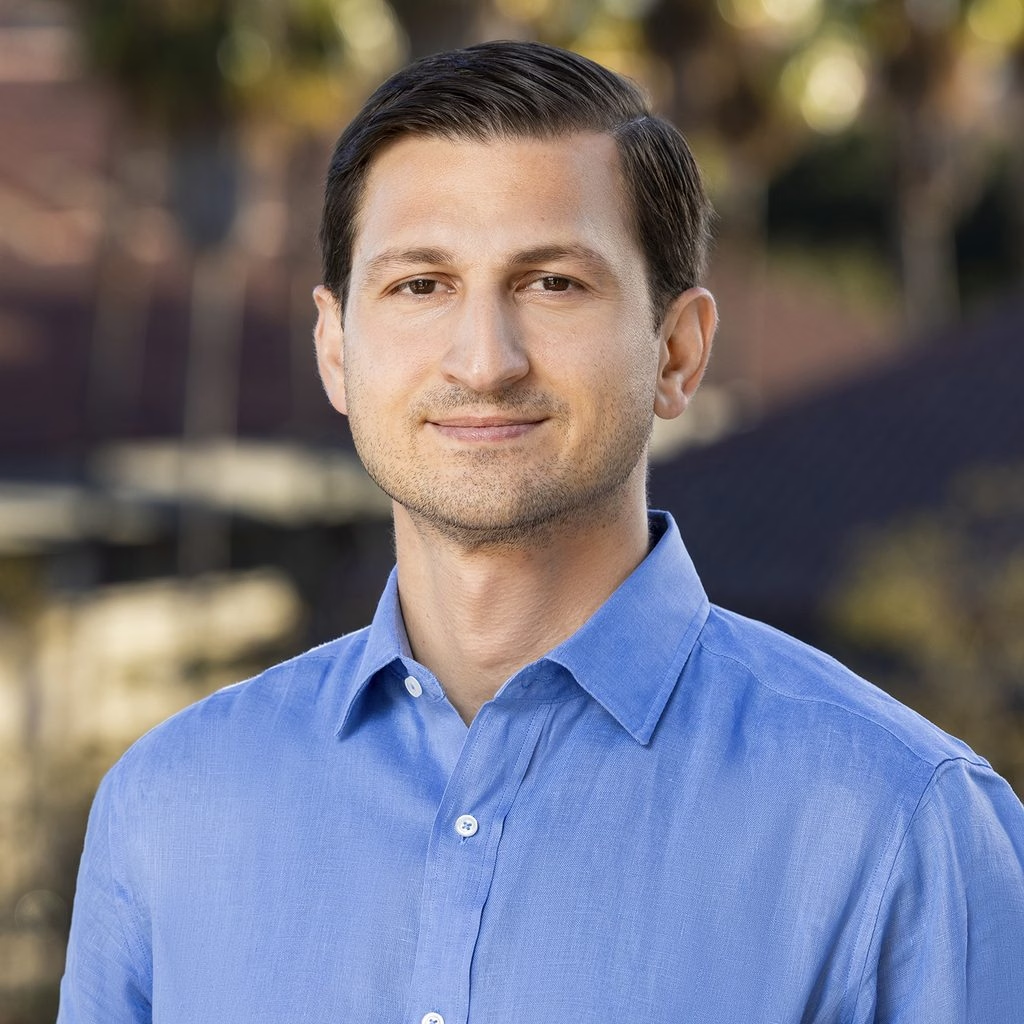
UW-ISyE looks forward to welcoming Vasilis Syrgankis from Standford Universirty.
Causal Inference and Generative AI
This talk explores the interplay between causal inference and generative AI. I will first discuss our efforts to automate causal analysis and theoretical research in causal inference using large language models, emphasizing the challenges of evaluating causal reasoning and verifying theoretical results. Next, I will examine how language models can expand the practice of causal inference by enabling “text as treatment,” allowing us to study complex interventions expressed in natural language. I will highlight the biases that learned treatment representations can introduce and discuss how to align representation learning with downstream causal estimation. Finally, I will briefly reverse the perspective, showing how causal inference can help us understand language models by uncovering their latent capabilities and the causal relationships among them.
Bio: Vasilis Syrgkanis is an Assistant Professor of Management Science and Engineering and (by courtesy) of Computer Science and Electrical Engineering at Stanford University. His research interests lie in the areas of machine learning and artificial intelligence, causal inference, econometrics, online and reinforcement learning, game theory, mechanism design, and algorithm design. Until August 2022, he was a Principal Researcher at Microsoft Research, New England, where he was a member of the EconCS and StatsML groups and co-led the project on Automated Learning and Intelligence for Causation and Economics. He received his Ph.D. in Computer Science from Cornell University. His research has received best paper awards at several top-tier machine learning and artificial intelligence conferences (ACM EC, NeurIPS, and COLT). He is the recipient of a 2022 Amazon Research Award, a 2023 Google Research Scholar Award, the 2023 Bodossaki Distinguished Young Scientist Award, a 2024 NSF CAREER Award, a 2025 Balakrishnan Early Career Award, and a 2026 Intuit Faculty Research Award.