September 17
@
12:00 PM
–
1:00 PM
NEEP Seminar Series
Thursdays
12:00 – 1:00 PM
106 Engineering Research Building
Please contact office@neep.wisc.edu for assistance with remote participation.
The Strategic Revival of Nuclear Engineering at the University of Missouri
The national landscape of nuclear engineering education and research is undergoing a profound transformation driven by surging demands for clean energy and a secure domestic supply of critical medical isotopes. Amid this resurgence, the University of Missouri (MU) has embarked on a strategic revival and expansion of its nuclear engineering infrastructure and academic curriculum. This presentation outlines the vision, existing capabilities, and ambitious future roadmap guiding MU’s nuclear engineering ecosystem.
At the foundation of this revival is MU’s current competitive advantage: the University of Missouri Research Reactor (MURR). Operating continuously at 10 megawatts, MURR stands as the highest-power university research reactor in the United States and serves as a vital national anchor for the production of lifesaving cancer theranostics and radiopharmaceuticals. Building upon this decades-long expertise in radiation sciences and isotope production, MU’s vision bridges the gap between foundational nuclear science and next-generation reactor technology. Looking forward, MU is translating this momentum into massive infrastructure expansions.
Central to these future plans is the NextGen MURR initiative, a project to construct a new, state-of-the-art 20-megawatt research reactor designed to expand advanced materials testing, secure the domestic radioisotope supply chain, and serve as a premiere workforce development platform. Complementing this is the newly broken ground on the Radioisotope Science Center in May 2026 and the Engineering Innovation Center in September 2026. By integrating these world-class facilities with an energized academic curriculum, the University of Missouri aims to cultivate the highly skilled nuclear workforce required to propel the next generation of fission technology, medicine, and the nuclear fuel cycle.
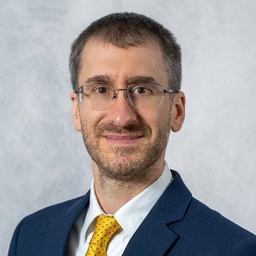
Braden Goddard is an associate professor and the director of the Nuclear Engineering Program in the John J. Boswell Department of Mechanical and Aerospace Engineering at the University of Missouri. In his current position he teaches undergraduate and graduate courses on multiple topics in mechanical and nuclear engineering and performs applied research. He is also responsible for overseeing all nuclear engineering programmatic activities. The primary focus of his research is on radiation measurements, nuclear nonproliferation and isotope production. This effort has resulted in teaching and co-teaching 18 different courses and supervising 112 researchers (high school students though visiting faculty), funded by 19 external grants totaling $5.2M to just Goddard’s research group.
Prior to joining the University of Missouri, Goddard worked at domestic and international industries, national laboratories and academia. These locations include TXU Energy where he updated the fidelity of the pressurized water reactor plant simulator; the University of Tokyo where he performed experiments with two phase fluid flow; Oak Ridge National Laboratory and Los Alamos National Laboratory, where he developed new methodologies for quantifying actinide compositions for international safeguards applications; the Nevada National Security Site, where he served as an emergency responder developing radiation detection and identification techniques and deploying to national events to survey for radioactive materials; Khalifa University, where he trained the next generation of Emirati nuclear engineers and set up and managed multiple radiation measurement-based laboratories; Abu Dhabi Customs, where he served as an emergency reachback scientist, adjudicating radiation alarms created when shipping cargo entered the country through Khalifa Port; and Virginia Commonwealth University, where he established a world-renowned research group focused on radiation measurements, simulations and nonproliferation, controlling 5 different laboratories that spanned 3,250 sq. ft. of laboratory space with an annual research expenditure of $1.3M.
He received his BS MS and PhD in Nuclear Engineering from Texas A&M University. He is a senior member of the Institute of Nuclear Materials Management (INMM), founding faculty advisor for the INMM-VCU student chapter, INMM deputy chair for the materials control and accountability division and associate editor for the Journal of Nuclear Materials Management. He is also a World Institute for Nuclear Security (WINS) Certified Nuclear Security Professional (CNSP) and served as a mentor for the 2022 World Nuclear University Summer Institute. His research has been published and presented in over 200 international journals and conference papers.