October 29
@
12:00 PM
–
1:00 PM
NEEP Seminar Series
Thursdays
12:00 – 1:00 PM
106 Engineering Research Building
Please contact office@neep.wisc.edu for assistance with remote participation.
In Situ and operando X-ray imaging of microstructural evolution in nuclear materials
X-ray imaging techniques including tomography, and diffraction-based mapping offer powerful, non-destructive means to probe the structural evolution of nuclear fuels and reactor materials under the extreme conditions relevant to their service life, including high temperature, irradiation, and corrosive environments. This talk will discuss the application of synchrotron-based X-ray methods to visualize microstructural changes in fuels and structural alloys during fabrication, hightemperature exposure, irradiation, and corrosion, capturing phenomena such as porosity evolution, phase transformations, crack initiation and propagation, swelling, and corrosion-induced degradation. By enabling in situ and operando observation, often coupled with complementary techniques such as thermal and mechanical loading, these approaches provide direct insight into degradation mechanisms and performance-limiting behaviors that are difficult to access through post-irradiation/corrosion examination alone. Examples will highlight how time-resolved and spatially-resolved X-ray imaging is advancing the understanding of microstructure-property relationships in nuclear materials, informing both fundamental materials science and the development of improved, more radiation- and corrosion-tolerant fuel and structural material designs for current and next-generation reactor systems.
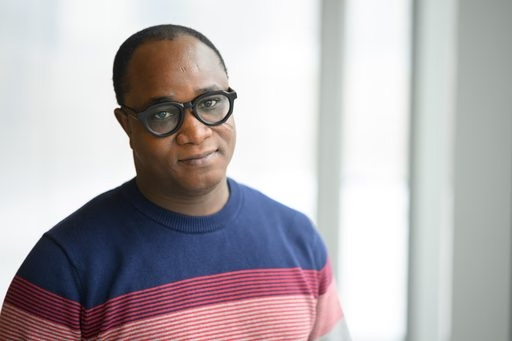
Ericmoore Jossou is the John Clark Hardwick (1986) Professor in Nuclear Science and Engineering, and Electrical Engineering and Computer Science at MIT, where he leads the Materials in Extreme Environments Group. Before joining MIT, he was a staff scientist at Brookhaven National Laboratory. He received his PhD in Mechanical Engineering, with a concentration in Materials Science, in 2019 from the University of Saskatchewan. Jossou is a recipient of the 2026 NSF CAREER Award and the 2026 Ruth and Joel Spira Award for Excellence in Teaching, recognizing his contributions to research and engineering education, respectively. Jossou’s lab combines experiments with computational methods to establish structure-properties-performance relationships in materials for nuclear energy applications. His current research includes machine learning–assisted fabrication and evaluation of U-Zr alloys under normal and off-normal reactor conditions using real-time X-ray imaging; machine learning–assisted quantum mechanical modeling of aliovalent dopant effects on UO2 fuel sintering kinetics; development of machine learning interatomic potentials for variable charge states in actinide oxides; and in situ/operando monitoring of irradiation-assisted corrosion in light water reactor chemistry.