Building a future powered by fusion energy. Delivering individualized therapies tailored to each patient. Feeding a growing global population. Making quantum technologies practical. Developing autonomous systems that enhance human capability. Securing the resources needed to sustain modern society.
Solving challenges like these requires people who can bring together expertise, ideas and resources from across disciplines and sectors.
That belief is at the heart of the College of Engineering’s “Engineering Moonshots.”
To help turn that vision into reality, the college has named faculty in engineering and in UW-Madison partner schools and colleges as co-leaders of each moonshot. Together, these leaders will build the teams, partnerships and momentum needed to transform ambitious ideas into meaningful impact.
“The challenges that will define the future cannot be solved by a single researcher, a single discipline or a single organization,” says Devesh Ranjan, Grainger Dean of the College of Engineering. “The moonshots are not simply research priorities: They are an opportunity to align expertise from across—and beyond—UW-Madison around challenges that matter most to society, and to create the conditions for meaningful progress.”
Engineering Tomorrow’s Cures: AI-powered precision health and therapeutics
For Engineering Tomorrow’s Cures co-leads Biomedical Engineering Professor Krishanu Saha and Biomolecular Chemistry Professor Anjon Audhya, the challenge is not simply discovering new therapies. It is fundamentally reimagining how therapies are designed, tested, manufactured, regulated and delivered so that every patient can receive the right treatment at the right time.
Their moonshot seeks to create a next-generation precision therapeutics ecosystem powered by artificial intelligence and spanning the entire innovation pipeline. By bringing together researchers, clinicians, regulators, industry partners, entrepreneurs and patient advocates, the initiative will develop the technologies, infrastructure and collaborative frameworks needed to accelerate development of cell therapies, gene therapies, biologics, radiopharmaceuticals and other advanced therapeutics.
Why Wisconsin? Few places possess the breadth of expertise required to transform the future of therapeutics. Wisconsin uniquely integrates strengths across the university—in stem cell science, biomanufacturing, artificial intelligence, genetics, genomics, ethics, precision medicine, clinical research, radiopharmaceutical development, regulatory science and technology commercialization—within a single collaborative ecosystem. By connecting world-class discovery science with clinical care, manufacturing capability and entrepreneurial leadership, Wisconsin is positioned to become a national model for how next-generation therapies are developed, scaled and delivered to patients.
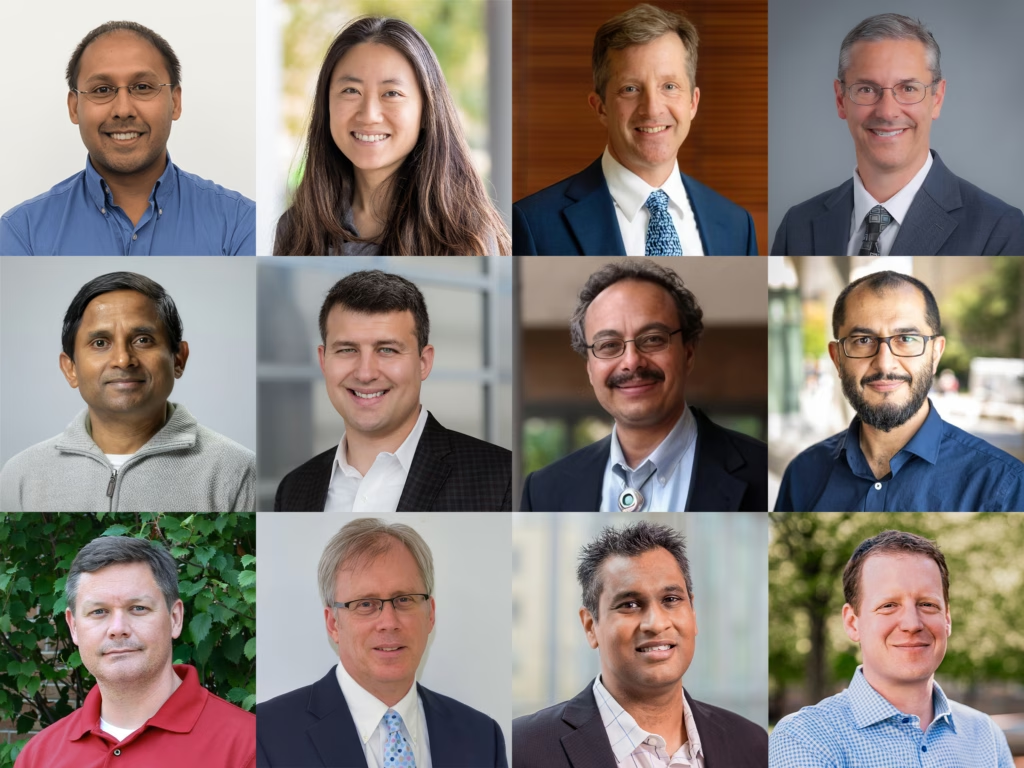 Engineering Moonshots leads and co-leads in alphabetical order, left-right: Anjon (Jon) Audhya; Jennifer Choy; Mark Eriksson; George Huber; K.G. Karthikeyan; Tony McDonald; Alfonso Morales; Bilge Mutlu; Brian Pfleger; Scott Rankin; Krishanu Saha; Oliver Schmitz.
Limitless Distributed Power: Fusion-driven energy with transport at terawatt scale
Meeting the world’s growing energy demands will require transformative advances in how power is generated, stored and distributed. Oliver Schmitz, the Thomas and Suzanne Werner Chair, professor of nuclear engineering and engineering physics and college associate dean for corporate engagement and entrepreneurship, envisions a future powered by fusion energy alongside renewable technologies and advanced energy systems. He and a future co-lead aim to overcome critical barriers to fusion deployment—in particular, the materials challenges that have long limited progress—while building partnerships among researchers, industry leaders and policymakers to accelerate innovation.
Why Wisconsin? UW-Madison’s fusion community spans more than 60 faculty members across the entire campus and builds on decades of internationally recognized leadership in fusion science and technology research. Schmitz believes that combination of technical expertise, cross-disciplinary collaboration and industry engagement positions Wisconsin to help shape the future of energy generation and distribution.
Embodied AI: Engineering autonomous systems to enhance human capability and quality of life
As artificial intelligence increasingly moves into workplaces, hospitals and factories, co-leads Industrial and Systems Engineering Associate Professor Tony McDonald and Bilge Mutlu, the Stephen Wright Professor of computer sciences in the College of Computing & Artificial Intelligence (CAI), believe the biggest challenges are often human rather than technological.
Their moonshot focuses on ensuring autonomous systems are designed around the people who use them. To do that, they’ll bring together experts from engineering, computer sciences, medicine, nursing, education, agriculture and industry to better understand how humans and AI systems can safely and effectively work together. Their aim is to ensure AI technologies enhance human capability, improve quality of life and succeed in real-world environments.
Why Wisconsin? Embodied AI has wide-ranging applications, from manufacturing—a historic Wisconsin strength—to healthcare, agriculture and scientific discovery. As home to the nation’s first college of computing and AI, more than 20 faculty working in robotics and embodied intelligence across engineering and CAI, and globally recognized leadership in human factors engineering, UW-Madison is uniquely positioned to shape not only what AI can do, but how it works alongside people. That’s where UW-Madison can make its greatest overall contribution: combining strengths in artificial intelligence, engineering and human-centered design to ensure autonomous systems deliver meaningful real-world impact.
Making Quantum Practical: Engineering the manufacturing backbone to take quantum technology from lab to world
Quantum technologies hold enormous promise in computing, sensing and communication, but significant engineering hurdles remain before they can be deployed at meaningful scale. Co-leads Jennifer Choy, the Jay and Cynthia Ihlenfeld Associate Professor of electrical and computer engineering, and John Bardeen Professor of Physics and Wisconsin Quantum Institute Director Mark Eriksson will lead efforts focused on building the manufacturing capabilities, workforce pipelines and technical infrastructure needed to move quantum innovations from the laboratory into real-world applications in computing, fusion, agriculture, biohealth and navigation.
Why Wisconsin? With more than 40 faculty members affiliated with the Wisconsin Quantum Institute, UW-Madison is a national leader in quantum computing. Wisconsin also is a key player in a growing Midwest quantum ecosystem, while also offering strengths in engineering, manufacturing and application-driven research. For Choy and Eriksson, that combination creates the conditions needed not only to advance quantum science, but also to make quantum technologies useful in industries and sectors that matter to Wisconsin and the nation.
Securing Critical Resources: Engineering access to clean water, rare minerals and sustainable chemicals
Economies around the world depend on reliable access to water, chemicals, fuels, advanced materials and other essential resources—yet often those resources are scarce or challenging to source. For co-leads George Huber, the Richard L. Antoine Professor of chemical and biological engineering, and Biological Systems Engineering Professor KG Karthikeyan, the challenge is ensuring those resources can be produced sustainably and reliably, while strengthening domestic supply chains and driving economic growth.
Working across industry, academia, national laboratories, government agencies, economic development organizations and venture capital, they aim not only to invent new technologies, but also to develop the scientific, engineering, economic and deployment frameworks needed to transform Midwest resources into globally competitive industries.
Why Wisconsin? Located in a region rich in agricultural, forestry, freshwater and manufacturing assets, UW-Madison is uniquely positioned to help build a more resource-secure economy. Huber and Karthikeyan see an opportunity to connect engineering, agriculture, sustainability and entrepreneurship to strengthen existing industries, develop new manufacturing opportunities and expand economic growth across the Midwest.
Feeding the Planet: Engineering food production systems and their nutritional quality
Global food security will require innovations that reach far beyond the farm. Co-leads Brian Pfleger, the R. Byron Bird chair of chemical and biological engineering, Karen and William Monfre Professor and Vilas Distinguished Achievement Professor; Food and Nutritional Sciences Campbell-Bascom Professor and Chair Scott Rankin; and Planning and Landscape Architecture Professor, Vilas Distinguished Achievement Professor and Division of Extension State Specialist Alfonso Morales envision a moonshot that connects engineering, agriculture, manufacturing and nutrition to address the growing demand for high-quality, low-cost sustainable food.
Building on Wisconsin’s longstanding leadership in agriculture and food production, they plan to leverage colleagues in engineering, as well as in agricultural areas like botany, plant and agronomical systems, agricultural economics, food science and dairy research while creating closer ties with industry. Their aim is to develop technologies that improve food production, storage, distribution and nutritional quality.
Why Wisconsin? As a global leader in agriculture, dairy, food science and manufacturing, Wisconsin offers a unique opportunity to develop and deploy technologies across the entire food system. For the co-leads, that makes the state an ideal proving ground for innovations that can strengthen food security, improve nutrition and support a growing world population.
While the Engineering Moonshots each focus on different challenges, they share a common goal: turning UW-Madison’s strengths into meaningful progress on some of society’s most pressing problems. Over the coming months, the six moonshot leads will work on assembling teams, engaging partners and charting strategic directions for each initiative.
Photo of W crest banner by Jeff Miller/UW-Madison