An interdisciplinary team’s research may deepen our understanding of how ocean waves wear away massive ice sheets—and how that activity can influence climate around the world.
Nimish Pujara, an assistant professor of civil and environmental engineering at UW-Madison, says waves can erode sections of ice near the waterline, where wave action is strongest. This erosion forms indentations called “wave-cut notches.”
“Wave erosion acts at the top, near the waterline,” he says, “but you still have a lot of ice under the water. That underwater ice is less dense than the surrounding water, so it wants to “float” to the surface—which creates torque that can eventually break pieces of ice (icebergs) off of an ice shelf.”
Understanding how, and how quickly, wave notches form in ice can help scientists understand how icebergs form from larger ice formations, or even wear down over time. “This wave erosion is one of the main ways icebergs get smaller,” Pujara says. “We want to know where they end up. Not only can they be a danger to shipping vessels, but they also can spread meltwater around the oceans—which can influence how ocean currents behave. There are also nutrients locked up in land ice, so as icebergs melt, they distribute those nutrients and can affect ocean ecology.”
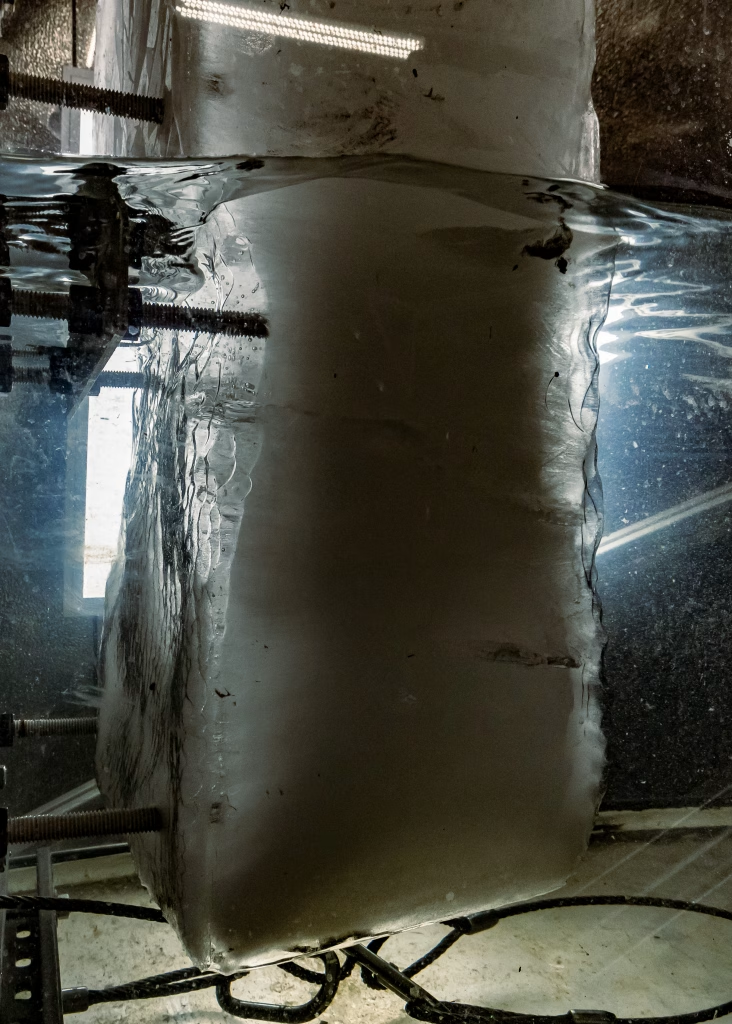 A block of ice in a cry-wave tank began eroding as waves ate wore at it. A UW-Madison research team is studying the phenomenon to better understand how sea waves carve notches into enormous ice sheets. Photo by Joel Hallberg.
For its research, the team conducted several experiments on ice blocks—ranging from about 60 to several hundred pounds—placed in specialized wave tanks to closely monitor the notches as they form. Their experiments culminated in a new cryo-wave tank set up in a freezer in the UW Surface Processes Lab, which is led by geosciences associate professor and project collaborator Lucas Zoet. The setup allows the team to mimic cold conditions in which ice sheets form. Pujura and Zoet agree it’s likely the only facility of its type.
The researchers converted their findings into mathematical formulas that are detailed in a paper submitted to the Journal of Fluid Mechanics. Collaborator Till Wagner, an assistant professor of atmospheric and oceanic sciences at UW-Madison, says it’s the kind of data that can ultimately feed into large-scale climate models.
He says that as researchers recently have learned more about the active role ice sheets play in the environment, it’s also become critical to understand how they can fit into climate models, which are typically ocean- and atmosphere-based.
“From a physics perspective, climate models—complex, high-resolution computer simulations of the planet—are our main tools for how we understand the future of the earth,” Wagner says. “The crucial way to bring ice sheets into our climate models is by resolving the boundaries between the oceans, ice sheets and atmosphere. In this project, we’re looking at the boundary between oceans and ice sheets, and that will be critical for our future predictions of climate change and sea level rise.”
Pujara says the research could also improve what the team believes may be a 1980s-era oversight in a popular formula used to assess how waves erode ice. If it does, the team’s research could ultimately improve models that include that formula.
“The formula that’s used in a lot of the climate models is based on work that hasn’t been looked at carefully in 45 years,” Pujara says. “This is the first time it is getting modern attention, and we’re finding that there is a lot more to it than those 1980s papers considered at the time.”
The team is conducting many more experiments to support its work. Anya Wolterman (MSCEE ’25) oversaw those experiments before they graduated. They made ice by freezing water in coolers—it took about two weeks at a time for the ice blocks to freeze all the way through—then tested the blocks in a wave tank in Engineering Hall.
“There was a body of data that was missing from our collective knowledge,” Wolterman says. “Since 1977—before me—there had only been seven experiments with ice blocks in a wave tank subjected to waves. In total, I did about 20 experiments, and used eight for my final data series. So even in the final report, that’s more than has been done in the last 50 years.”
Featured image caption: Assistant Professor Nimish Pujara and a student set up a small camera outside of a wave tank before lowering in a block of ice. Their interdisciplinary research team uses the camera to monitor how waves erode ice. Photo by Joel Hallberg.