For five summers, computer engineering senior Brooke Weiss worked at Sunrise Day Camp, a camp that serves children with cancer and their siblings. What began as an opportunity to combine her interests in technology and working with children ultimately helped Weiss discover the kind of engineer she wants to become: one who uses technology to make a meaningful difference in people’s lives.
Growing up in New York, Weiss was strong in math and science but hadn’t identified a specific career or area of engineering to study after high school. When she learned about a STEM specialist position at Sunrise Day Camp, she saw it as a great opportunity to pursue her interests. “At camp, I saw how technology, accessibility and thoughtful design could directly affect a child’s daily experience,” Weiss says. “I also became more aware of the medical devices and accommodations that some campers relied on.”
During her first three summers as a STEM specialist at the camp, Weiss designed and taught more than 50 hands-on projects involving Python, block-based coding, robotics and engineering design. “Because the campers had different ages, experience levels and physical needs, I learned how to adapt each activity so that every child could participate and feel successful,” she says.
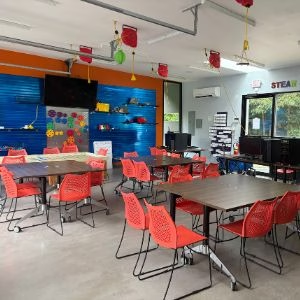 The STEAM (Science, Technology, Engineering, Arts and Mathematics) Shack at Sunrise Day Camp.
After being promoted to a specialist management position for her last two summers, Weiss created staff training programs focused on topics such as adaptive lesson planning, medical-device awareness, group management and making activities accessible to children with different needs. She saw firsthand how technology, accessibility and thoughtful design could directly affect a child’s daily experience and quality of life.
When Weiss began studying computer engineering at UW-Madison, she found the technical foundation to pursue the kind of work she had become interested in at camp. Specifically, she found that she was drawn to courses involving digital systems, embedded systems and hardware design. Her experience at camp helped her understand why she wanted to make a difference in the lives of others, and her Department of Electrical and Computer Engineering (ECE) courses helped her understand how to build the technology that could make that impact.
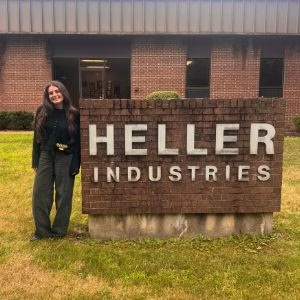 Computer engineering major Brooke Weiss worked as an intern with Heller Industries.
In summer 2026, Weiss expanded her technical experience through a hardware engineering internship with Heller Industries. There, she worked on electrical systems, PCB design, hardware testing, electrical schematics and computer-controlled equipment. The experience allowed her to apply the concepts she has learned through her ECE coursework to physical systems and has further confirmed her interest in hardware engineering. “Together, my camp experience and technical education have made me interested in hardware systems design, and I hope to create medical devices that can improve people’s lives,” she says.
After graduating in May 2027, Weiss hopes to work in digital logic design, FPGA, embedded systems or another hardware-focused engineering role. Long term, she wants to apply those skills to medical devices or other technologies that positively impact the daily lives of people who need them.
Weiss entered camp looking for a summer opportunity that combined technology and working with children—and over five summers, she developed a clear understanding of the kind of engineer she wants to become. “I don’t want to design hardware solely because it’s technically interesting; I want to help create devices that improve a person’s safety, comfort, independence or quality of life,” she says. “A career in medical-device hardware would allow me to combine my interest in computer engineering with my desire to work on technology that has a meaningful human impact.”