Many undergraduates attending large research institutions like the University of Wisconsin-Madison have a moment when they look at all of the busy graduate students and world-class laboratories surrounding them and wonder if graduate school is the right next step.
But for students without a foundation in research, it can be risky to spend time, energy and money applying to graduate school and moving to a new city if they’re not sure they’ll actually enjoy the day-to-day routine of working in a laboratory.
That’s one of the many reasons the Department of Electrical and Computer Engineering at UW-Madison launched the Summer Program for Advanced Research and Knowledge, otherwise known as SPARK. The pilot program supported motivated undergraduates who worked full time in a research lab for 10 weeks during summer 2026. The idea was to give students a feel for what it’s like to work in a lab setting on real research projects and offer them a chance to interact with current graduate students and faculty.
In summer 2026, 32 undergraduates—from rising sophomores to seniors—joined the program. Each student worked 20-40 hours a week in labs across the 8 ECE research areas, from computer architecture, fusion stellarators and advanced semiconductor design to quantum thin films and other cutting-edge topics.
Students were assigned graduate student mentors who helped them adjust to life in the lab and develop a research project or goal. The program provided participating undergrads a stipend—making the prospect of hosting a student long-term more appealing for labs. Once a month, the SPARK group came together for a seminar and chance for students and their mentors to meet researchers in other labs and chat about their experiences.
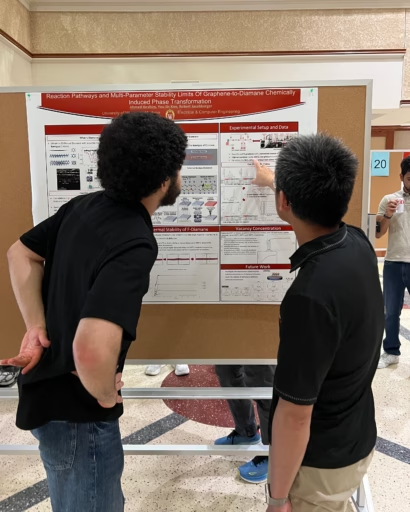 Ahmed Ibrahim (left) discusses the research project he conducted as part of the ECE SPARK program in summer 2026. Credit: Allyson Crowley.
The program was conceived as an in-house version of an REU, or research experience for undergraduates. Many universities, including UW-Madison, host REUs, in which students from high school or colleges and universities without graduate-level research programs visit for part of the summer and work in a lab. The idea is to give the students a taste of lab life to help them decide whether to pursue graduate school and which areas of research they are most passionate about.
The problem, however, is that many REUs are competitive, restricted to students from non-research universities, and have a cost associated with them. That’s why the ECE department decided it should offer a similar experience to its own students. It seemed like a no-brainer; not only would students get the same experience as an REU, they wouldn’t have to move to another city or sublet their apartments. And, if things went well, they could continue to work in the lab during the school year.
Most importantly, the program could help them move forward in their academic career knowing whether they were on the right path. “Sometimes knowing what you don’t like and being able to cross it off the list is just as important as knowing what you do like,” says Carly Andrew, an academic program specialist in ECE who helped administer the program. “We want to make sure everybody has the opportunity for an experience like this and know for sure whether they like working in a lab.”
Another goal of the of the program is making lab work more accessible to students who may be excluded by the current system. In many cases, getting a job in a lab means cold-calling a researcher and asking for a position, and sometimes contacting multiple labs. That can be intimidating for many students, and some populations, like first-generation students, may not realize this informal system of finding lab work is even an option for them until late in their college career.
In contrast, ECE shared information about the SPARK program to all undergraduate students and instructors and allowed students to apply to the program, which then helped match students with participating labs based on their research interests.
Interest in the program was high. One SPARK student was Ahmed Ibrahim, a rising senior. In fall 2025, Jay and Cynthia Ihlenfeld Associate Professor Jennifer Choy discussed the program during class. Ibrahim says he applied as soon as he could. He had worked a few hours a week in Choy’s lab and with Charles Ringrose Assistant Professor Bobby Jacobberger during the semester. But working full time in the lab was a completely different beast.
“It was enlightening. It unlocked a completely new perspective for me. During the academic year, I prioritized classwork, so I’d never really taken the time to slow down and look at the scientific method behind what I was doing and ask questions,” he says. “Having more time in the lab, you get more exposure to graduate students and the way they think. You get immersed in that culture.”
Ibrahim says the experience confirmed his desire to attend graduate school, where he hopes to study quantum computing and sensing.
Gwenyth Severson, a junior in ECE, says she had no experience with research before joining the program. She was looking for a summer internship when she learned about the SPARK program and thought it could be an interesting experience.
She worked with Associate Professor Joshua San Miguel, researching unique computer architectures. “I knew nothing about research before going into this, but it gave me confidence in doing work on my own outside class. I was able to talk a lot with my graduate student mentor Paridhi Gupta and Professor San Miguel and learn what grad school is like,” she says. “And I figured out I really do want to go to grad school to study computer architecture and get a master’s and hopefully a PhD. I loved working in the lab so much that when I was given the opportunity to continue in the lab, I took it right away. It’s incredibly fun, challenging, and worth every minute.”
Without SPARK, Severson says it’s unlikely she ever would have worked in a lab. “As an undergrad, it’s not always easy. It’s nerve-wracking to ask a professor to work in their lab,” she says. “This program made it incredibly accessible to younger students and not quite as intimidating. I don’t think I would have ever tried for research if I didn’t find out this was a possibility for undergrads.”
In the 2026 pilot session, the majority of students in the SPARK program had at least some experience working a lab. Next year, ECE hopes that more time and outreach will help attract more students like Severson with little to no research experience.
The culmination of ECE SPARK 2026 was an end-of-program poster session where students shared what they worked on over the summer. Severson, who won an award for most research passion, says the session was key to making the program truly spark. “It was a really big moment for everybody to share their research and it gave people an end goal,” she says. “So instead of just leaving on your last day, saying ‘Okay, bye, that was fun,’” we had this capstone. It felt like, instead of just being hired to do something small, we were built up as researchers and gained important new skills.”
Featured image caption: Gwenyth Severson (right) discusses the research project on computer architecture she undertook in the lab of Associate Professor Joshua San Miguel as part of the ECE SPARK program in summer 2026. Credit: Allyson Crowley.