Inside the University of Wisconsin Nuclear Reactor Tuesday morning, Wisconsin Governor Tony Evers peered over the shoulders of student operator Nick Tierney, a senior majoring in nuclear engineering, to eye the array of instrumentation on the reactor control panel, then climbed the stairs to look down into the reactor’s cooling pool.
Later, Evers and State Representative Renuka Mayadev (Madison) listened to graduate students Sophie Redd and Riley Trendler, undergraduate Will Gergen and Assistant Professor Stephanie Diem explain their work on the Pegasus-III experiment.
Both facilities showcase research taking place around nuclear fission and fusion, both happening a short walk apart on the UW–Madison campus.
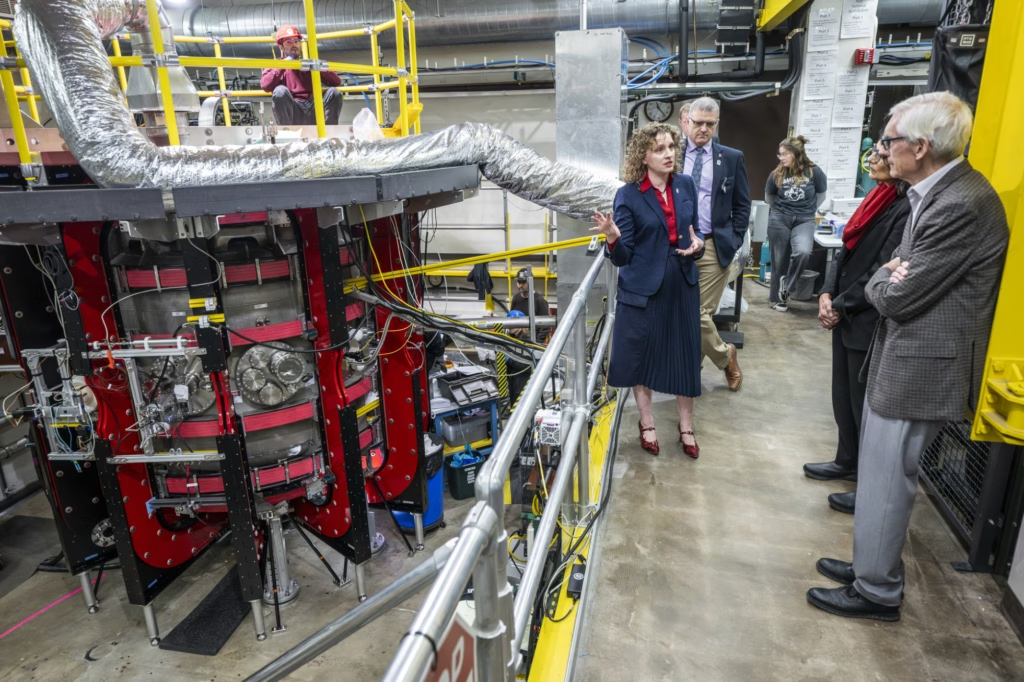 Assistant Professor Stephanie Diem (center) explains research taking place with the Pegasus-III experiment. Photos: Taylor Wolfram, UW-Madison.
Evers’ visit came one week after he announced a partnership between the state’s Public Service Commission and the UW–Madison Department of Nuclear Engineering and Engineering Physics to study nuclear energy opportunities in the state. Paul Wilson, Grainger Professor of nuclear engineering and chair of the department, will serve as director of the study, which will also leverage UW–Madison students, faculty and staff in geography, science communications, law and more.
While Point Beach Nuclear Plant in Two Rivers is the only nuclear power plant currently operating in Wisconsin, steps to expand the industry in the state have received bipartisan support in the state legislature during its 2025-26 session. That renewed interest in nuclear energy dovetails with longstanding strengths in nuclear fission and fusion research at UW–Madison. (Nuclear fission, in which an atom’s nucleus splits and releases energy, is the traditional kind of nuclear power that’s been in operation since the 1950s. Fusion, the process of combining two nuclei that occurs in the sun, continues to loom as the holy grail of clean energy.)
Across the College of Engineering, the Department of Physics and beyond, UW–Madison researchers are pursuing both paths: from building experimental-scale reactors, to developing the materials needed to withstand the harsh environments of reactors, to manufacturing technologies to produce components, to informing the public policy guidelines around implementing a more diverse energy buffet. They’re also working on technologies to support safely expanding the operating capacity of current U.S. nuclear power plants while also laying the groundwork for next-generation nuclear reactor designs.
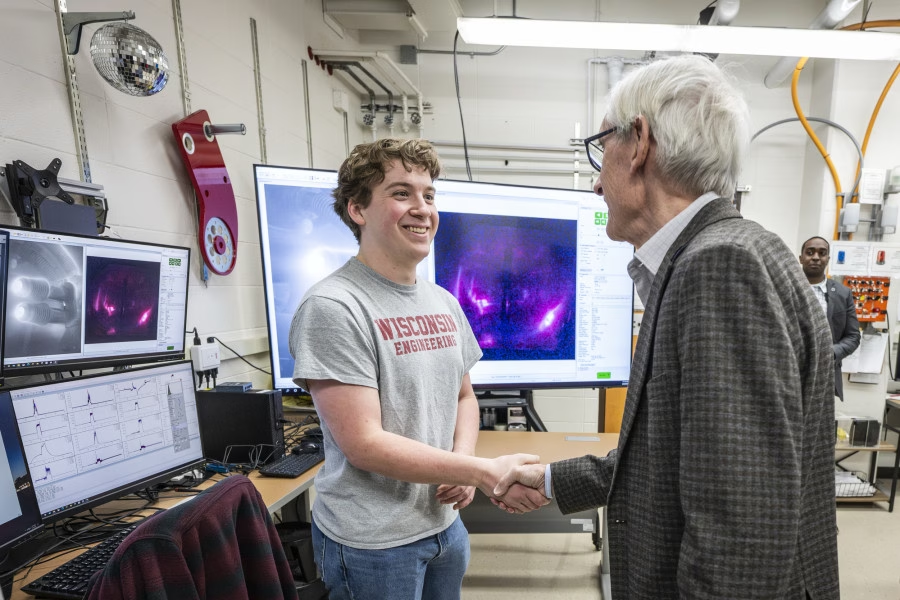 On the tour, Governor Evers meets undergraduate students like Will Gergen who work on the Pegasus-III experiment. Students have been actively involved in the design, construction, and operation of Pegasus since its inception.
While commercial fusion energy remains aspirational, scientists at UW–Madison have been studying the fundamental plasma physics behind it since the 1960s. Four fusion experiments—the Pegasus-III, the Helically Symmetric eXperiment, the Madison Symmetric Torus and the Big Red Ball—operate on campus, with another, the Terrestrial Reconnection Experiment, under construction. UW–Madison researchers also operate the Wisconsin HTS Axisymmetric Mirror Project at the university’s Physical Sciences Lab in nearby Stoughton.
Amid a broader surge in private investment in fusion energy startups, three fusion companies have spun out of campus labs—Realta Fusion, Type One Energy and SHINE Technologies—while UW–Madison is the founding university partner of the Great Lakes Fusion Energy Alliance, a public-private partnership to galvanize the industry in the Midwest.
Through the RISE-EARTH initiative, the university continues to recruit faculty researchers with expertise in sustainable and clean-energy technologies.
The UW Nuclear Reactor, one of about 30 operating at universities across the country, is roughly one-three-thousandth the size of a commercial reactor but still on the larger end of university-based reactors. In addition to its utility for conducting research, it enables valuable opportunities for students, who can be trained as licensed reactor operators and enter the job market with a unique credential. Companies from around the country also contract with the reactor, which has operated since 1961, to test materials, generate small quantities of promising isotopes, and more.
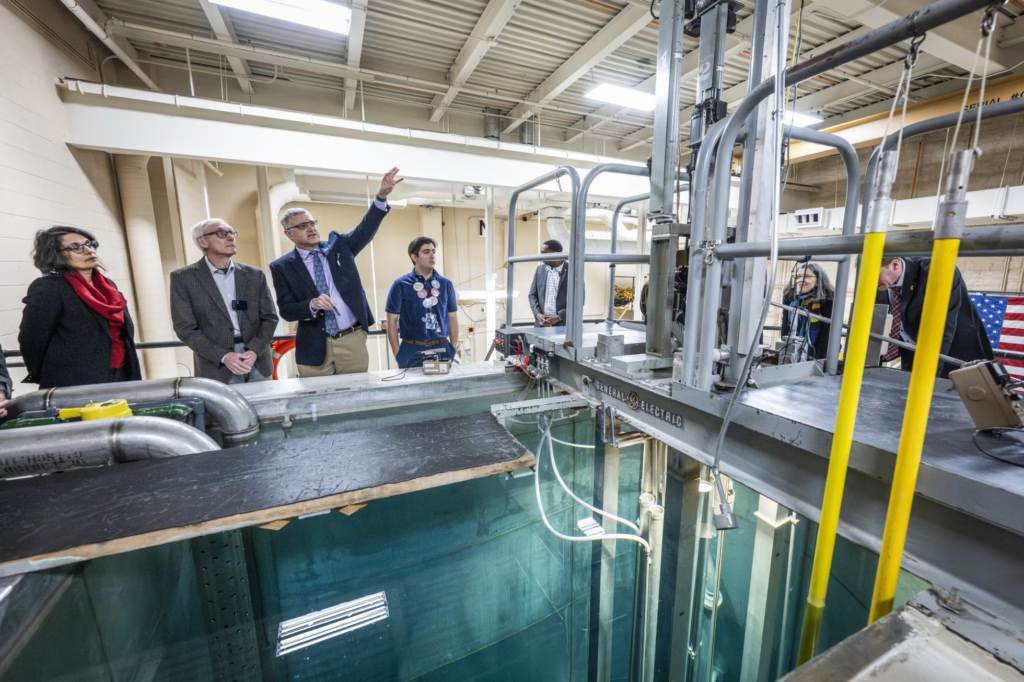 As chair of UW–Madison’s Department of Nuclear Engineering and Engineering, Paul Wilson (third from left) shares details about the one-megawatt open-pool nuclear reactor.