The cells in our bodies move in groups during biological processes such as wound healing and tissue development—but because of resistance, or viscosity, those cells can’t just neatly glide past each other.
Or can they?
Using a pioneering method they developed to directly measure viscosity in a group of cells, University of Wisconsin-Madison engineers have made a surprising discovery that upends understanding of how cells move.
It’s called “negative viscosity,” and it propels cells, rather than impedes them.
“This advance can enable researchers to develop better models for cell motion, which could lead to future applications for human health, such as ways to speed up wound healing or facilitate essential processes in tissue development,” says Jacob Notbohm, an associate professor of mechanical engineering who led the research with PhD student Molly McCord.
Notbohm and McCord detailed their findings in a paper published Dec. 4, 2025, in the journal PRX Life.
Cells generate forces that cause them to move, but how the forces balance among groups of cells to create motion is not clear. That’s why McCord and Notbohm wanted to find a way to measure the viscosity in the system; the magnitude of the viscosity was a missing part of the equation for understanding collective cell motion.
In experiments, the researchers used optical imaging to analyze how a single layer of epithelial cells deformed a soft gel surface as they migrated across it. This allowed them to calculate how much force the cells produced.
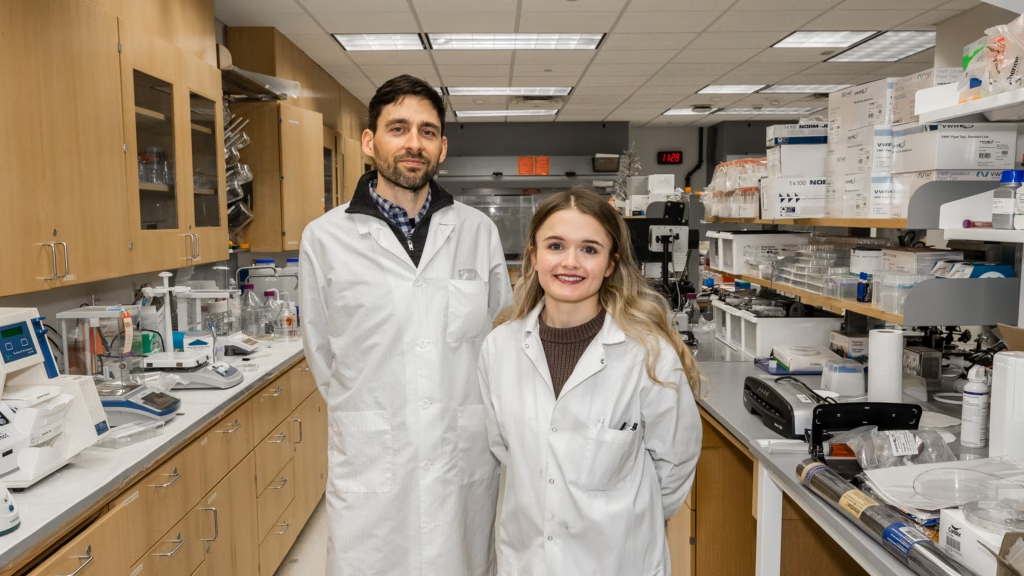 Using a pioneering method they developed to directly measure viscosity in a group of cells, Associate Professor Jacob Notbohm and PhD student Molly McCord have made a surprising discovery that upends understanding of how cells move. Credit: Joel Hallberg.
Then McCord developed a new approach for analyzing the data that involved looking at various multicellular regions, or cell groups. Her analysis revealed there were regions of cells where the viscosity, unexpectedly, was negative.
“This surprising discovery of negative effective viscosity implies injection—rather than dissipation—of energy into the flow,” Notbohm says. “For example, if you were driving a car and the air had a negative viscosity, the air resistance would be propelling the car forward instead of resisting it, which goes against standard physical rules.”
However, Notbohm says negative viscosity is possible for systems with an energy source—like cells that convert nutrients into energy. And he and McCord did find that regions of cells with negative viscosity had elevated metabolic activity—reflecting an increased energy demand in these cells.
“When we started this project, our question was how big is the number for viscosity,” says Notbohm. “But we’ve now learned that we should be asking a different question: Is this number positive—or negative? This discovery reframes the problem and shows that it’s meaningful to treat this viscosity as being either positive or negative, which hadn’t been considered before.”
Notbohm is the Harvey D. Spangler Associate Professor.
This work was supported by the National Science Foundation (grant no. CMMI-2205141) and the National Institutes of Health (grant no. R35GM151171).
Featured image caption: Biophysics PhD student Molly McCord works in the lab. Credit: Joel Hallberg.