Mid-infrared spectroscopy can identify the molecular composition of unknown samples by their “fingerprints” at different wavelengths, allowing scientists to look beyond visible light’s band within the electromagnetic spectrum. The resulting compositional data is valuable for analyzing chemical and biological samples; however, the technology is generally confined to large instruments in research laboratories—limiting its accessibility and reach.
Researchers at the University of Wisconsin–Madison have taken a major step toward miniaturizing biochemical sensors with a new type of tunable metasurface: an ultrathin optical material that can dynamically scan for the molecular “fingerprints” of chemicals using infrared light.
In a new paper in the journal Light: Science and Applications, Filiz Yesilköy, an assistant professor of biomedical engineering at UW-Madison, and an international team of collaborators detail a new, dynamically tunable metasurface for use in mid-infrared spectroscopy.
Yesilkoy and members of her lab had already developed thin silicon membrane metasurfaces—roughly 100 times thinner than a human hair—that they could geometrically pattern to selectively filter specific wavelengths when analyzing samples in solid and gas phase. However, once the team fabricated a metasurface with a particular pattern, it couldn’t modify the component to hunt for other molecules at different wavelengths —similar to a radio permanently locked to a single station.
Until Furkan Kuruoglu, who spent a year at UW-Madison as a visiting faculty member from Istanbul University, brought a new approach.
“Silicon has some features that we can tune with temperature,” says Kuruoglu. “By switching the metasurface temperature gradually from room temperature to high-temperature range, we can dynamically manipulate the optical resonances of the metasurface.”
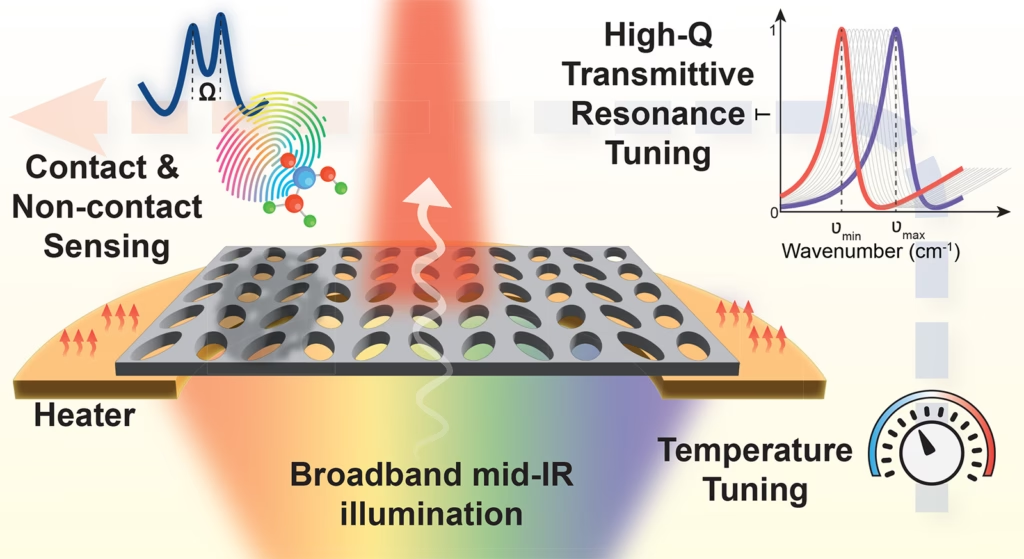
Postdoctoral researcher Samir Rosas (PhDBME ’25), co-first author on the paper with Kuruoglu, compares the process to tuning an analog radio sweeping across stations to isolate a specific radio channel: “The integrated microheater in our metasurface device continuously tunes the optical resonance of the metasurface across the infrared spectrum. That lets us selectively search for different molecular fingerprints using the same device.”
The team’s method also doesn’t require samples under analysis to come into direct contact with the metasurface and its variable temperature. That’s especially important when working with temperature-sensitive biological samples.
The group fabricated its metasurfaces at Argonne National Laboratory’s Center for Nanoscale Materials in Lemont, Illinois. Yesilkoy also enlisted longtime collaborator Yuri Kivshar, a distinguished professor from the Australian National University, to tease out the physics at play in the process. Mikhail Kats, a professor of electrical and computer engineering at UW-Madison and a frequent Yesilkoy collaborator, contributed access to and expertise in mid-infrared instruments.
Moving forward, Yesilkoy envisions future portable sensors capable of monitoring hospitals for airborne pathogens, detecting hazardous gases, identifying contaminants such as microplastics in biosamples, or performing rapid biochemical analysis outside of traditional laboratories.
“Essentially, right now mid-infrared spectroscopy is done in the lab using very large instruments,” says Yesilkoy. “But wouldn’t it be great if it was more like a compact device that you could put in your bag and take out for onsite testing and analysis?”
Filiz Yesilkoy is a Vilas and Grainger assistant professor. Mikhail Kats is the Antoine-Bascom Professor and Jack St. Clair Kilby Professor.
Other authors on the paper include UW-Madison electrical and computer engineering PhD students Yihong Chen and Shenwei Yin, UW-Madison electrical and computer engineering research associate Jin-Woo Cho; Brijesh Kumar, a researcher from the Indian Institute of Technology Bombay; and David A. Czaplewski, a scientist at Argonne National Laboratory.
Funding for the research came from the Scientific and Technological Research Council of Turkey (project no. 1059B192300015); the Wisconsin Distinguished Graduate Fellowship, made possible by The Grainger Foundation; the Office of Naval Research (grant no. N00014-20-1-2297); the Australian Research Council (Grant No. DP210101292); the International Technology Center Indo-Pacific via Army Research Office (contract FA520923C0023); the National Science Foundation (grant no. 2401616) and the National Institutes of Health (grant no. R21EB034411).
Top photo: From left, Assistant Professor Filiz Yesilkoy, visiting faculty member Furkan Kuruoglu, electrical and computer engineering PhD student Yihong Chen and postdoctoral researcher Samir Rosas.