While Yinsu Zhang is a self-described car guy, his choice of vehicle will almost certainly surprise you. When the recent University of Wisconsin-Madison PhD graduate hit the road to relocate to the San Francisco Bay Area, he wasn’t driving an engine-roaring muscle car, a gadget-loaded electric vehicle or a flashy sports car.
No, Zhang prefers a station wagon made by the German automaker Opel.
“I’m always into cars that no one else has,” says Zhang (PhDIE ’26), who estimates there are less than 2,000 of the models across the United States.
Zhang inherited his love of cars from his father and brought that interest to Grainger Institute for Engineering Professor Ranjana Mehta’s research group. While researchers in her NeuroErgonomics Lab have typically studied the brain and human performance in the contexts of interactions with robotics, virtual reality and other emerging technologies, Zhang’s work expanded the group’s portfolio.
 Yinsu Zhang
In collaboration with Mehta and Associate Professor Tony McDonald, Zhang probed the neuroscience of trust—and distrust—around human takeovers of automated vehicles, identifying the relevant brain activation patterns. The UW-Madison trio detailed its work in a paper in the journal Association for Computing Machinery Transactions on Human-Robot Interaction.
While automated features such as Tesla’s autopilot and full self-driving capability continue to roll out, instances of misuse have been cited in deadly crashes. Despite their features’ provocative names, they’re Level 2 vehicles (partial automation) on the Society of Automotive Engineers automation tiers (as are the majority vehicles with automation in the United States).
“These kinds of systems require constant human monitoring, but people aren’t doing that,” says Zhang, who’s interned with the autonomous, driverless vehicle company Zoox (owned by Amazon). “So that’s when things go wrong and crashes happen.”
On the flip side, others are wary of—or outright opposed to—turning over driving control to automation (Mehta, for her part, is an admitted skeptic of fully autonomous vehicles). Clearly, trust plays a central role in public acceptance.
But the gold standard of trust assessment has long been surveys, which don’t allow for constant, real-time monitoring—imagine trying to repeatedly ask a driver how they’re feeling toward a car’s tech—or reveal the neural signatures at play in trust or distrust.
Bringing together McDonald’s previous work on driver behaviors in automated vehicles and Mehta and Zhang’s experience looking at the neurological and physiological signs of trust, the trio analyzed drivers during simulated events involving a vehicle’s automated crash avoidance and similar capabilities. In particular, the researchers explored the impact of “proactive takeovers”—where drivers opted for manual control—on drivers’ trust by examining eye-tracking gaze measurements and neural activation using functional near-infrared spectroscopy in addition to verbal surveys.
Unsurprisingly, drivers who proactively took over control of the vehicle reported lower trust ratings. They also showed great gaze fixation on the AV disengagement control and suppressed activation across four brain regions: the dorsolateral prefrontal cortex, intermediate frontal cortex, supplementary motor area, and secondary and tertiary visual cortex. Mehta says those neural results mesh with her lab’s work on human-robot interactions as well.
“We are finding convergence across different use cases,” she says. “The signatures we are finding are generalizable.”
Mehta says the study demonstrates the importance of observing end-users’ natural behaviors in realistic scenarios, rather than relying upon them to report hypothetical decisions. While the researchers couldn’t predict driver decisions based on their neural and gaze data, they plan to continue to pursue that question in future work.
And they will also test the effects of priming drivers with information that could influence their level of trust before they get behind the wheel.
“Automated vehicles are an amazingly powerful technology, but their promise will be undermined if we are unable to calibrate driver’s trust and AV capabilities,” says McDonald. “This calibration process requires accurately measuring trust and understanding how those measures lead to behavior.”
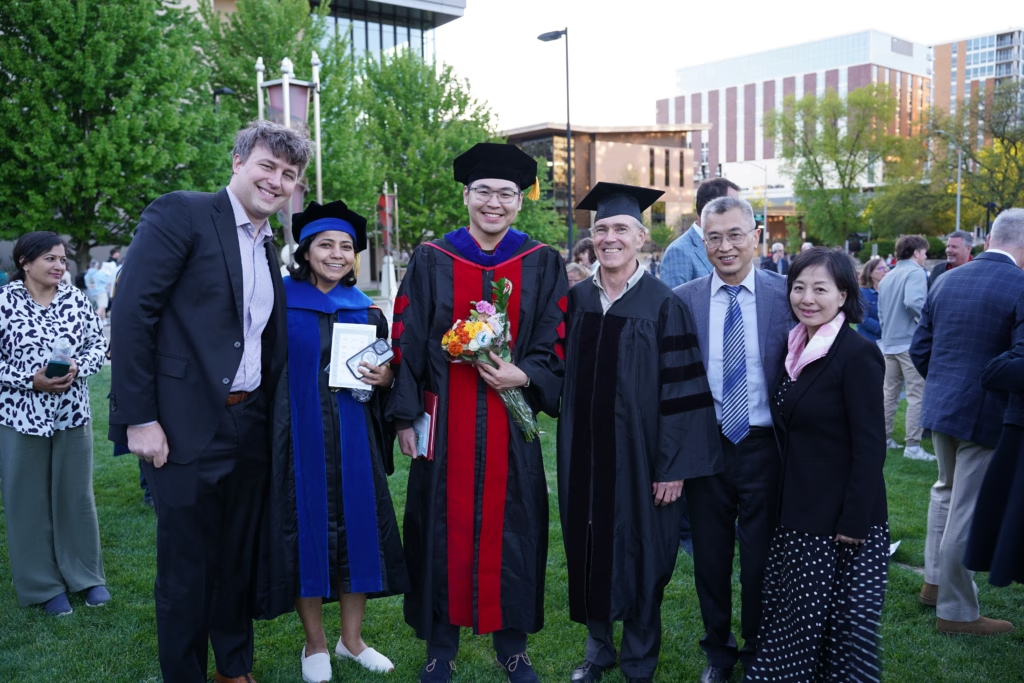 Yinsu Zhang (third from left) celebrates his graduation with, from left, Associate Professor Tony McDonald, Professor Ranjana Mehta, Professor John Lee and his parents. Submitted photo.
Support for this research came from the National Science Foundation Mind, Machine and Motor Nexus (M3X) program.