A team of University of Wisconsin-Madison engineers has designed a protective hybrid fiber-reinforced polymer composite “blanket” that could significantly reduce lightning strike damage and improve protective coverage for aircraft and other high-flying vehicles. The research published in the June 2026 issue of the journal Composites, Part B: Engineering.
Pavana Prabhakar, an associate professor of civil and environmental engineering and mechanical engineering, says the material integrates metal “yarn” within the carbon fiber fabric and can be used as a fiber-reinforced polymer composite near the surface of a structure to distribute electrical charge away from a lightning strike site.
Modern aircraft bodies increasingly include carbon fiber-reinforced polymer composite components due to the material’s high strength and light weight compared to their metal counterparts. “These composites are not very good at conducting electricity,” Prabhakar says. “When lightning strikes these surfaces, it can cause quite a bit of damage because excessive heat builds up from poor electrical dissipation. Integrating the metal yarn within that layer provides a path for improved electrical dissipation and reduces that heat buildup and hence, can mitigate the associated damage.”
Today’s aircraft employ conventional expanded metallic foil lightning strike protection systems that can delaminate, or chip off, polymer composite layers when a strike occurs. However, that delamination can further damage the fuselage, and the structure can be difficult and expensive to repair. These metallic foils also struggle to conform to complex shapes frequently found in emerging advanced air mobility vehicles such as air taxis. Prabhakar’s research team decided to look for solutions to this challenge. Their solution is a drapable fabric, similar to a t-shirt or jacket, meaning it can more easily conform to complex geometries than traditional expanded foil systems.
Carbon fiber-reinforced polymer composites are typically made from clothlike interwoven fibers that are solidified with a resin. In their innovation, Prabhakar and her students integrated stainless steel yarn into the carbon fiber fabric through weaving, which would be added as sacrificial layers on the top layer of a polymer composite, resulting in a mesh like protective layer made of two metal-infused weaves laid perpendicular to each other.
The two-layer structure creates a bidirectional path that more effectively dissipates electrical charge from a lightning strike. Prabhakar says manufacturers can integrate the protective layer to the exterior of aircraft or drones, spreading the electrical charge from a lightning strike across the material’s outer surface, like a fabric-based Faraday cage. This dissipation reduces the concentration of heat at the strike site, ultimately reducing damage and improving the functional life of a structure.
So far, testing bears that out.
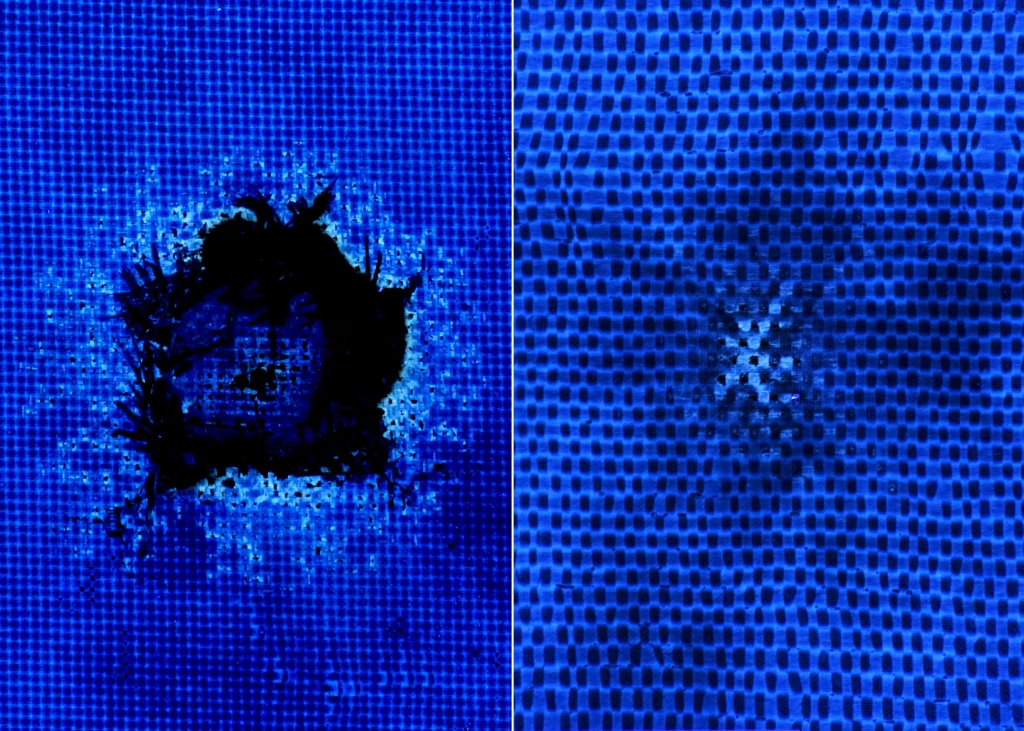 This image shows the damage a non-hybrid composite material sustained from a simulated lightning strike on the left, and the damage a protective hybrid fiber-reinforced polymer composite material sustained from a similar strike. The hybrid material, designed by Associate Professor Pavana Prabhakar’s group, could protect aerial vehicles from lightning strikes.
“This hybridization, with the metal yarns in the composite, led to better conductivity and reduced material degradation during a simulated lightning strike,” Prabhakar says.
She and her students measured degradation of their protective layer in the amount of weight lost from the test sample. Lower weight loss pointed to successful performance. “In one test case, we saw just 0.03% weight loss with this design,” Prabhakar says. “Without any hybridization, weight loss was up to 3%, especially due to excess heat buildup. That’s a reduction of several orders of magnitude in material loss. The hybridized material has also retained structural integrity quite well. We performed bending tests in our work to validate the structural integrity post-lightning strike exposure.”
She says the materials could be retrofitted to aircraft or used in repairs.
“This top layer can be an integral part of a structure from the get-go, or we can also apply this as a top sheet using different bonding methods, so it could also be used on existing aircraft,” she says. “The material has to extend across a structure for effective dissipation. Let’s say a lightning strike damages an aircraft. We would need to modify whatever existing system was already on the aircraft, but we can use these for patching them.”
While the new protective fabric shows promise, Prabhakar wants to do further testing. Stainless steel has good conductivity, but copper is better, and she’d like to see how it performs in the mesh. She also wants to test the mesh’s long-term durability and susceptibility to galvanic corrosion. Prabhakar may also further research metal coated carbon fibers.
The research began as a senior design project in the 2023-24 academic year under the leadership of PhD graduate Hridyesh Tewani. Four of Prabhakar’s former students—Vincent Scheere, Madison Owens, Emilio Cumbajin, and Camila De Leon—initiated the work, which grew into a full research project. Tewani is the paper’s lead author with the senior design team’s members listed as the second through fifth authors on the research.
“It was a great learning experience for us in the lab to involve these senior design students in research and then continue the work through completion,” Prabhakar says.
Prabhakar is the Charles G. Salman Associate Professor of Civil and Environmental Engineering and Mechanical Engineering.
Featured image caption: Associate Professor Pavana Prabhakar’s lab group used a loom to weave a metal “yarn” into a carbon fiber fabric. The resulting material can drape over airframes and better disperse the electric charge of a lightning strike than standard carbon fiber-reinforced polymer composite materials.