In their senior years, University of Wisconsin-Madison mechanical engineers apply four (or more) years’ worth of skills to a real design project. Historically, the ideas and support for those projects—designing a tool or devising a system, for example—have come via industry partners, faculty researchers or community organizations.
But for especially entrepreneurial mechanical engineers like recent graduate Frankie Iovinelli (BSME ’25), that approach exposed a gap: What about funding for novel projects emerging from the minds of students, rather than from a sponsor with available resources?
Through the support of alumnus Bjorn Borgen (BSME ’62), the Department of Mechanical Engineering has, for the past two years, held the Borgen Design Competition, providing seed money for promising student-imagined projects.
The competition is just one outgrowth of a $5 million gift from Borgen—itself part of a larger $25 million contribution that will also benefit the College of Engineering’s new building—to enable experiential, hands-on learning opportunities for all mechanical engineering students. That includes projects in courses such as introductory engineering courses, the senior capstone design, as well as for members of student organizations creating prototypes as part of national competitions.
“It unlocks their entrepreneurial and innovative spirit, and that extends across freshman through senior year,” says Darryl Thelen, the John Bollinger Chair of Mechanical Engineering and Bernard A. and Frances M. Weideman Professor. “If the students can pursue what they’re passionate about, whether it’s competition teams or a senior design project, they are really motivated to put in way more time and effort than if it’s just a project assigned to them.”
That was the case for Iovinelli, whose group built a sensing-and-dispensing device and accompanying software for automatically maintaining the proper chemical balance in swimming pools and hot tubs. No such system is widely available on the market.
“I wanted to see how much I could learn in one year,” says Iovinelli, who’s now a systems engineer at Honeywell Aerospace in Tempe, Arizona. “I didn’t know anything about electronics. I ended up designing the entire circuitry for the unit. I ended up soldering all of the connections. It’s just a testament of how much you can really learn here if you put your mind to it.”
Senior design students now have access to a laser cutter, rapid 3D printing equipment, instrumentation and an array of tools in the Borgen ME Design Lab on the second floor of the Mechanical Engineering building. But, beyond senior design, courses such as EMA 200: Introduction to Aerospace Engineering and ME 201: Introduction to Mechanical Engineering (which together serve more than 200 students each semester) have enhanced their design projects to provide students with deeper, more complex builds.
Meanwhile, more than 500 students annually participate in the college’s various design-competition teams, ranging from rockets to robotics to an array of vehicles that are autonomous, electric, solar and even human-powered. With Borgen Design Program support, for example, the SAE Aero UW team, which builds unmanned aircrafts, traveled to California in spring 2025 for a national competition.
“Being able to take what we learn in class and apply it to designing, building and flying an aircraft shows just how pivotal these concepts are,” says mechanical engineering senior Aiden Brion, president of SAE Aero UW. “I’ve learned a lot from school, and the club has taken my education to the next level by adding real-world challenges, teamwork and problem-solving into the mix.”
In May 2025, Borgen returned to his alma mater to attend the ME Spring Design Showcase, during which all seniors display their yearlong projects. He marveled at the array of technologies and met with students like Iovinelli.
“I was very impressed—just the imagination that some of these students have, the fact that they have to actually go and put these together, it’s a hands-on learning experience as opposed to sitting in a classroom or just listening to how things are done,” he says. “When I was at the University of Wisconsin, of course, we didn’t have a design lab or design requirement. So that’s something very, very important, in terms of developing engineers who have that entrepreneurial instinct.”
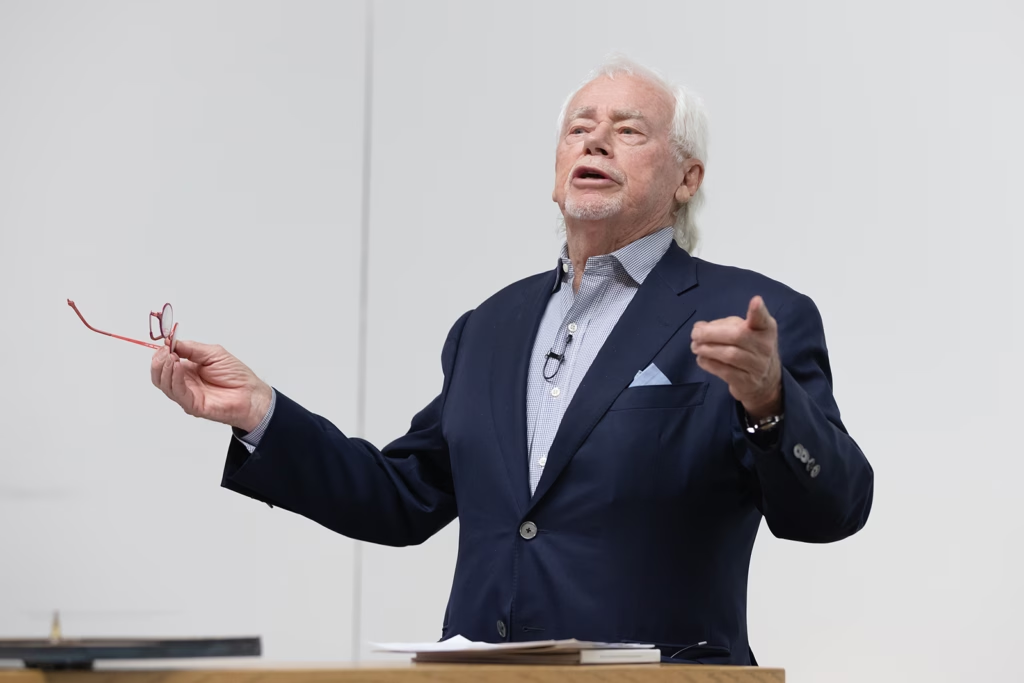 Alumnus Bjorn Borgen (BSME ’62) speaks to students during his visit to campus.
Top image caption: Mechanical engineering students talk with alumnus Bjorn Borgen (BSME ’62) during the department’s spring 2025 design showcase, which features the results of their yearlong, hands-on projects. Photos by Todd Brown.