The University of Wisconsin-Madison is leading a major multi-institution project to develop and test a critical fusion technology—research that will directly benefit commercial fusion power plant developers.
A $19 million Fusion Innovative Research Engine (FIRE) award from the U.S. Department of Energy is supporting the research. Ben Lindley, an assistant professor in nuclear engineering and engineering physics at UW-Madison, is leading the project, which brings together leading experts from academia, national laboratories and industry with the goal of bridging the DOE Fusion Energy Sciences program’s basic science research and growing fusion industries.
Fusion energy, the process that powers the sun and stars, is a long-sought-after way to produce limitless clean, safe and reliable energy. UW-Madison is one of the world’s top-ranked fusion energy research universities and has a strong track record of spinning off fusion companies. In fact, two key industry partners in this project—SHINE Technologies, based in Janesville, Wisconsin, and Madison-based Realta Fusion—are spinoffs from UW-Madison research.
“This research will significantly reduce deployment risks for commercial fusion reactor developers such as Realta Fusion, Type One Energy and Commonwealth Fusion Systems, and others,” Lindley says. “Our cutting-edge experimental facilities and capabilities at the university and our close proximity to the Wisconsin-based fusion companies make UW-Madison an ideal place to lead this effort.”
The project is focused on advancing a critical fusion technology called a “blanket” to meet the demanding conditions of future fusion power plants. A blanket is a multifunctional layer of material that surrounds a fusion power plant’s core. It needs to extract heat efficiently to generate electricity and produce tritium fuel to sustain the fusion reactions. In addition, the blanket must withstand intense heat and radiation, while providing shielding for other reactor components.
Within four years, the team aims to leverage state-of-the-art domestic facilities to conceive, manufacture and comprehensively test fusion blanket components. The team will conduct groundbreaking experiments to validate the performance of two leading blanket materials—lead-lithium and lithium-beryllium fluoride (FLiBe)—under intense irradiation and strong magnetic fields. The researchers will conduct tests at the SHINE Fusion Linear Accelerator for Radiation Effects (FLARE) facility, which will enable them to simulate the harsh environment inside a fusion power plant more accurately than ever before.
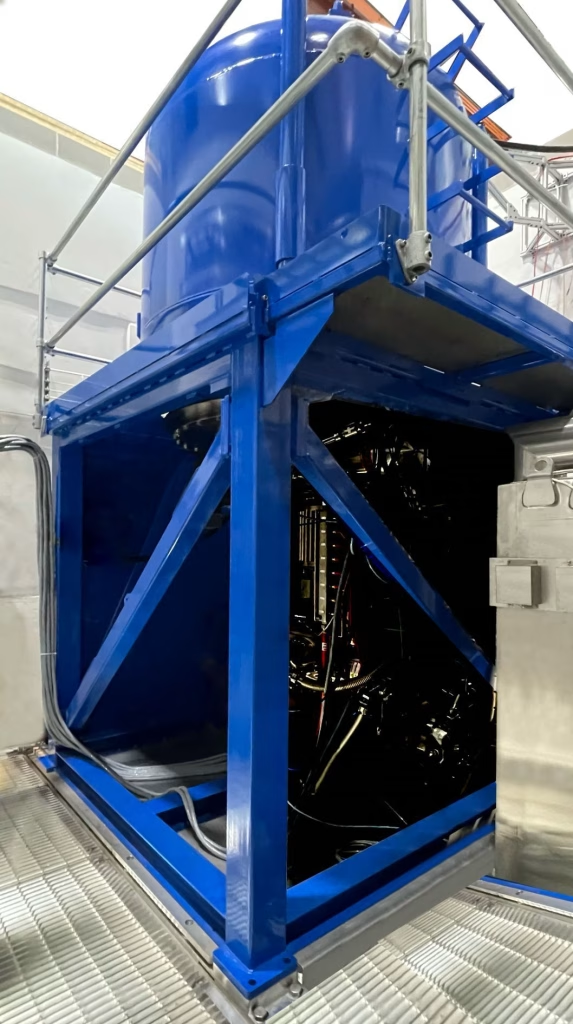 The neutron source at SHINE’s FLARE facility, which will enable the team to conduct groundbreaking experiments to validate the performance of blanket materials. Photo courtesy of SHINE Technologies.
“Fusion reactions produce high-energy neutrons, and SHINE’s FLARE facility will allow us to go to the highest neutron flux ever for these experiments, which will yield the best experimental data we can get to date under such conditions,” Lindley says.
When neutrons hit the blanket, they react with lithium within the blanket to produce tritium, which can then be extracted and used as fuel to keep the fusion system going. The team’s experiments will provide a better understanding of how much tritium is produced by the blanket, which is important knowledge for ensuring a fusion plant will be self-sufficient in tritium production.
“Our systems produce 50 trillion fusion reactions per second, making them the world’s brightest steady-state deuterium-tritium neutron sources,” says Ross Radel, CTO at SHINE and co-investigator on this project. “Through this partnership, we can collect real-time tritium breeding data to better understand how tritium is produced, transported and captured in blanket systems—critical insights the entire fusion industry needs.”
In addition, the researchers will explore the cooling performance of lead-lithium under the influence of powerful magnetic fields using the Wisconsin High-Temperature Superconducting Axisymmetric Mirror (WHAM) device, marking the first application of high-temperature superconducting magnets in a geometry relevant to future fusion power plants and de-risking the commercial use of lead-lithium. WHAM, located in UW-Madison’s Physics Sciences Lab in Stoughton, Wisconsin, operates as a public-private partnership between UW-Madison and Realta Fusion.
The team will use additive manufacturing to develop innovative blanket components, which will be tested under flowing coolant and ion irradiation conditions before being integrated into the FLARE and WHAM experiments.
This project will also pave the way for the development of a volumetric neutron source, a critical facility that mimics the neutron environment of a future fusion power plant and is essential for testing and qualifying blanket components at scale. This includes developing the technical and economic requirements for this facility through a process that incorporates stakeholder input, and that aims to ensure an abundant supply of affordable, safe and reliable energy is readily accessible to all Americans. A scaled-up version of the WHAM device would serve as a near-term volumetric neutron source option for targeted technology development and risk reduction activities.
To ensure that experimental efforts are aligned with real-world needs, the project employs a model-based systems engineering framework. Project partner Rockwell Automation is co-leading this approach, which connects experimental data to functional requirements, closes critical technology gaps, and integrates blanket technologies across multiple readiness levels.
“We’ve built a very strong team with experts from many different backgrounds, and I think we can really move the needle on blanket technology in a few years,” Lindley says.
Lindley is a co-founder of and technical advisor for Realta Fusion.
Members of the project’s faculty leadership team include engineers Juliana Pacheco Duarte, Dan Thoma and Hantang Qin, and physicist Cary Forest from UW-Madison; Sara Ferry, MIT; Ross Radel, SHINE Technologies; Craig Jacobson, Realta Fusion; Diana Grandas, Electrical Power Research Institute; and Chloe David, Rockwell Automation.
Other key personnel from UW-Madison include Laura Albert, Jay Anderson, Mark Anderson, Adrien Couet, Stephanie Diem, Rogerio Jorge, Kaibo Liu, James Luedtke, John Perepezko, Oliver Schmitz, Kumar Sridharan, Paul Wilson and Shiyu Zhou.
Other partnering institutions include University of Illinois Urbana Champaign, Lawrence Livermore National Laboratory, University of New Mexico, Argonne National Laboratory and Princeton Plasma Physics Laboratory.
Confirmed steering committee members include CFS, Type One Energy, Five Lakes Economic Development, UKAEA, Canadian Nuclear Laboratories, Kyoto Fusioneering, Proxima Fusion and Max Planck Institute for Plasma Physics.
Featured image caption: The Wisconsin HTS Axisymmetric Mirror Project (WHAM) experiment being conducted at the UW-Madison Physics Sciences Lab in Stoughton, Wisconsin. Photo by Bryce Richter/UW–Madison.