Filling a space shaped by history and shared pride, more than 700 people gathered in the soaring, light-drenched atrium at Lambeau Field in Green Bay. With banners of legendary Green Bay Packers as the backdrop, these attendees of the Wisconsin Drives Manufacturing Summit, June 1 and 2, 2026, came together with two goals: lead the nation in manufacturing (Wisconsin currently is No. 2), and work together to get there.
Spearheaded by the College of Engineering and co-created with more than 100 partners, the summit was about bringing the state’s strengths, resources and people into alignment so that all partners can work together to tackle today’s challenges and respond nimbly to future opportunities.
“We’re renewing our vows today to the Wisconsin Idea,” said UW-Madison Interim Chancellor Eric Wilcots.
Throughout the summit, speakers and attendees—among them, manufacturing leaders, educators, researchers, policymakers, government officials, advocates and innovators—underscored the importance of a strong ecosystem in Wisconsin’s overall success in manufacturing.
The event’s opening-day innovation showcase featured companies like Mercury Marine and Harley-Davidson with deep Wisconsin history, along with newcomers of all sizes.
In his welcome, Grainger Dean of the College of Engineering Devesh Ranjan told attendees Lambeau Field was a natural venue choice. “The Green Bay Packers are the only NFL franchise in America that can never be moved—because they belong to the people of Wisconsin,” he said. “Wisconsin manufacturing is the same. It is here because it is in our DNA. We are here because Wisconsin manufacturing is transforming. And we intend to lead that transformation—together.”
Perennially ranked among the nation’s top-three states for manufacturing, Wisconsin is a powerhouse in a wide range of sectors like food processing, energy and controls, paper and forestry products, biotechnology, and fabricated machinery and metals products. With nearly 9,000 manufacturing companies and some-470,000 manufacturing jobs, the state is positioned not only to compete, but also to elevate its visibility as a national manufacturing leader.
“This summit does not belong to UW-Madison,” said Ranjan. “It does not belong to any single company, or any single industry. It belongs to Wisconsin—to every person in this room who believes that making things still matters.”
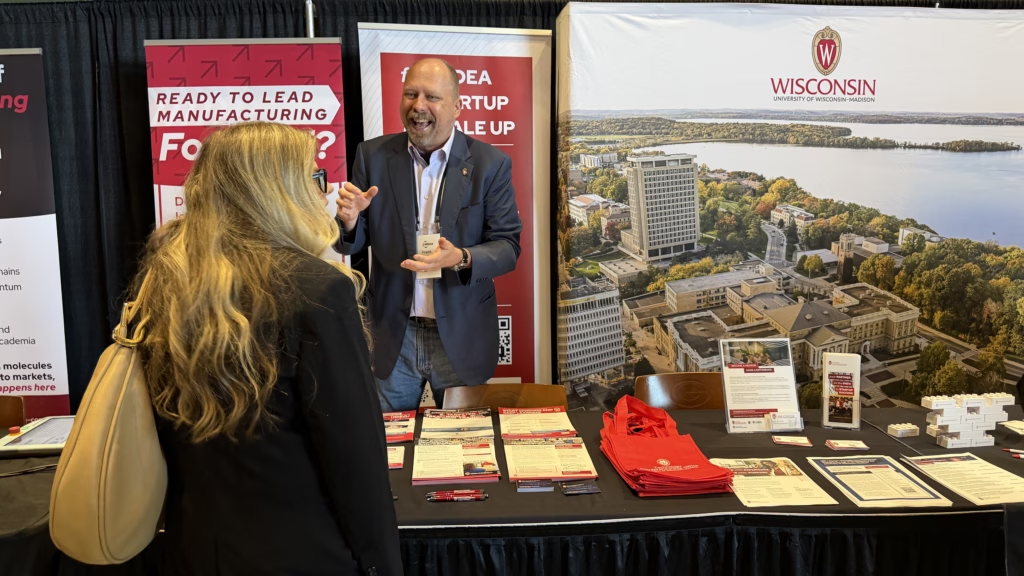 Mechanical Engineering Professor Frank Pfefferkorn’s work focuses on metal-parts manufacturing.
Wisconsin’s manufacturing roots run throughout the state’s history, dating as far back as the early 1800s. To this day, manufacturing not only makes up a large portion of Wisconsin’s economy—at the local, regional and state levels—but also forms the backbone of community life and livelihoods in towns across the state.
Structured to spark dialogue, the summit featured several keynote “conversations” and panel discussions that explored opportunities for small- and medium-size manufacturers—from AI and automation to supply chain strategy and technology adoption.
Founded in Milwaukee in 1903, Harley-Davidson is among the world’s most iconic, beloved brands. In the first of two morning keynotes, President and CEO Artie Starrs traced the company’s roots—from its humble beginnings in a tiny shed through its current headquarters on Juneau Avenue, a red-brick structure it constructed back in 1911. It’s a company that inspires deep pride—and “I sold my soul to Harley-Davidson” tattoos. One key to maintaining its brand affinity and long-term success: “Walk in the shoes of your customers,” said Starrs.
Rockwell Automation also was founded in 1903 in Milwaukee (first as Compression Rheostat Company; shortly after, as Allen-Bradley Company). Bob Buttermore, the company’s senior vice president and chief supply chain officer, highlighted how it is using automation and tools like digital twins to drive efficiency, transform manufacturing, build Rockwell’s factories of the future in Wisconsin and worldwide, and create a better experience for customers and partners. “This is applicable to manufacturers of all sizes,” he said.
In today’s supply chain, he said “never normal is the new normal,” noting a shift from resilient to adaptive supply chains that rely on redundancy and deep regional relationships with suppliers. And he said the shift from automation to autonomy is about supercharging the power of people to focus on more important work—not eliminating workers.
In fact, across sessions, speakers emphasized a common thread: Transformation must deliver real value, and human expertise remains central to making it work.
Discussions about workforce also bled into how to adopt technologies such as AI and automation. The state boasts a unique resource: As part of Microsoft’s $3.3 billion investment in southeast Wisconsin, UW-Milwaukee’s Connected Systems Institute houses the nation’s first manufacturing-focused AI Co-Innovation Lab.
Rather than replacing people, speakers emphasized ways to engage and elevate workers: redesigning their work, building new skills and a lifelong learning mindset, expanding access to careers across the state; leveraging resources like internships, co-ops and Wisconsin’s robust youth apprenticeship program to pique early interest in manufacturing careers; and working more closely with the state’s outstanding universities and technical college system to ensure higher education and technical skills development meet manufacturers’ needs. “As individual manufacturing companies, you do not stand alone,” said Tracy Pierner, president of Blackhawk Technical College.
Eight standing-room-only breakout sessions convened groups of presenters from across industries—among them, College of Engineering faculty—creating a journey through workforce, technology and American-made themes. Tracks explored topics ranging from upskilling and AI in production to PFAS, biohealth, fusion manufacturing and defense. “One thing stood out to me about the summit, thinking about this in the national security context: Every single topic we considered at the summit—workforce, education, upskilling, AI, quantum, fusion, space, supply chain, PFAS, biohealth—all of them also connect with national security and the defense of our nation, both on their own, and applied to national security customers,” said Dave Schroeder, UW-Madison director of national security initiatives who was a featured speaker in the “Defense Manufacturing 101” session.
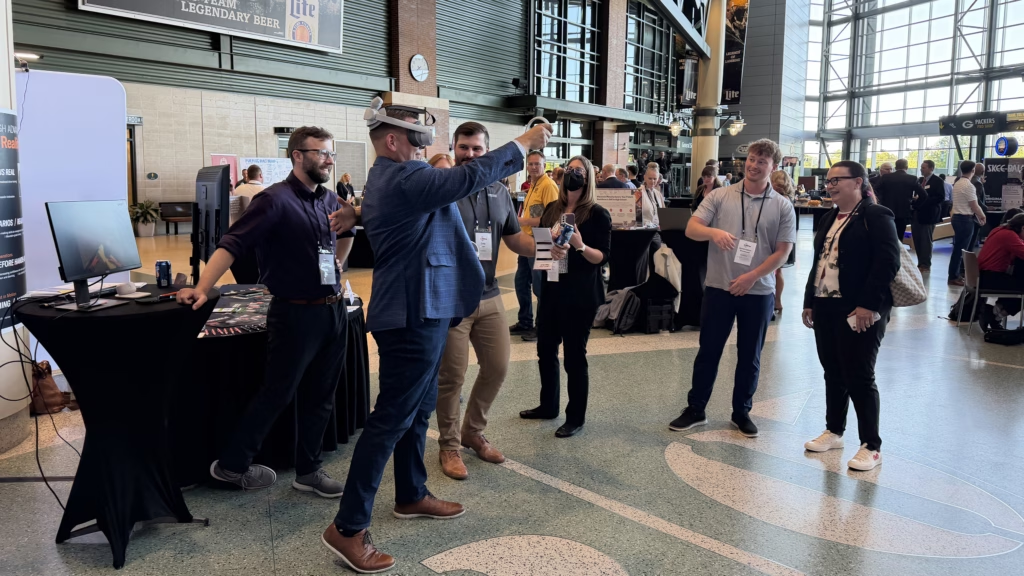 The Wisconsin Drives Manufacturing Summit was designed to showcase the state’s manufacturing breadth and strength, and to create opportunities for all stakeholders to work together to elevate and advance the industry. Photos: Renee Meiller
As they entered the Lambeau Field atrium, attendees received a logo pen and a spiral-bound “playbook,” a guide to navigating the summit with purpose—complete with space for notes that many attendees filled with ideas they’d gleaned from talks and conversations throughout the summit. The playbook also included a charge: “Draft your final play: Call one partner, set one meeting, share one idea or need with the Wisconsin manufacturing community.”
That next step is just the beginning. “We’ve got to do it better. Communicate, collaborate, challenge,” said Craig Dickman, managing partner with TitletownTech. “You can see the desire, feel the energy. Now turn this into action in a deep and meaningful way.”
In fact, there are many next steps already in place to help sustain the momentum. And what the summit made clear is that Wisconsin already has the pieces—talent, infrastructure and a deeply connected network—to lead. The opportunity now is to align them, amplify them and tell that story on a national stage.
In other words, says College of Engineering Associate Dean for Corporate Engagement and Entrepreneurship Oliver Schmitz: “Partnership wins.”
Also a professor of nuclear engineering and engineering physics and a co-founder of Realta Fusion, a spinoff company in one of the state’s nascent manufacturing opportunity areas, Schmitz drove the summit’s formation—convening a group of founding partners and an industry advisory board, and inviting the state’s manufacturing stakeholders to play an active role in designing every aspect of the summit.
Many organizations sponsored the summit; among them are TitletownTech, UW-Milwaukee, UW-Madison and the College of Engineering, Accenture, Wisconsin Economic Development Corporation, Findorff, Alliant Energy and the UW-Green Bay College of Science, Engineering and Technology.
Read more about the Wisconsin Drives Manufacturing Summit: Dean Devesh Ranjan’s blog post, Insight on Business and the Wisconsin Economic Development Corporation.