A team of University of Wisconsin-Madison engineers has received nearly $25 million from the U.S. National Science Foundation for an initiative that leverages AI to accelerate discovery and development of “super” materials that can withstand a proverbial perfect storm of extreme conditions.
The funding creates the NSF Materials AI and Transformation through Research Infrastructure for eXtreme environments Materials Innovation Platform (NSF MATRIX-MIP) as a national hub that expands capacity for materials innovation. As part of the NSF MATRIX-MIP, the UW-Madison College of Engineering will launch a major new user facility, the Hard Materials Lab.
Supported by the NSF Directorate for Mathematical and Physical Sciences, NSF Materials Innovation Platforms respond to the national need for user facilities that enable complex materials research, close collaboration of interdisciplinary and transdisciplinary teams, and access to cutting edge tools. UW-Madison is one of two universities to receive funding in 2026 to create a new NSF Materials Innovation Platform.
“The NSF Materials Innovation Platforms serve a broad national need as user facilities that provide access to some of the best equipment and expertise for materials science research,” says NSF Mathematical and Physical Sciences Directorate Head Tie Luo. “NSF wants researchers with great ideas, wherever they are in the U.S., to get their hands on this equipment and work together to pursue those ideas.”
The multidisciplinary center will engage researchers across academia, government and industry in advancing understanding of complex materials under extreme conditions. Its aim is to pave the way for users to speed translation of materials discoveries into technologies that benefit society in areas such as energy production, transportation, advanced manufacturing and national security, among others.
Providing open access to advanced tools and expertise, NSF MATRIX-MIP will offer materials synthesis, manufacturing, characterization, testing, modeling and artificial intelligence in a single user-centered platform—giving researchers access to capabilities typically distributed across multiple institutions and facilities.
By integrating AI data analysis, automation and advanced characterization tools, the platform will enable users to more rapidly identify, create and evaluate promising new materials.
Beyond simply access to existing tools, however, NSF MATRIX-MIP researchers will develop new instruments, workflows and capabilities to share broadly with the materials research community.
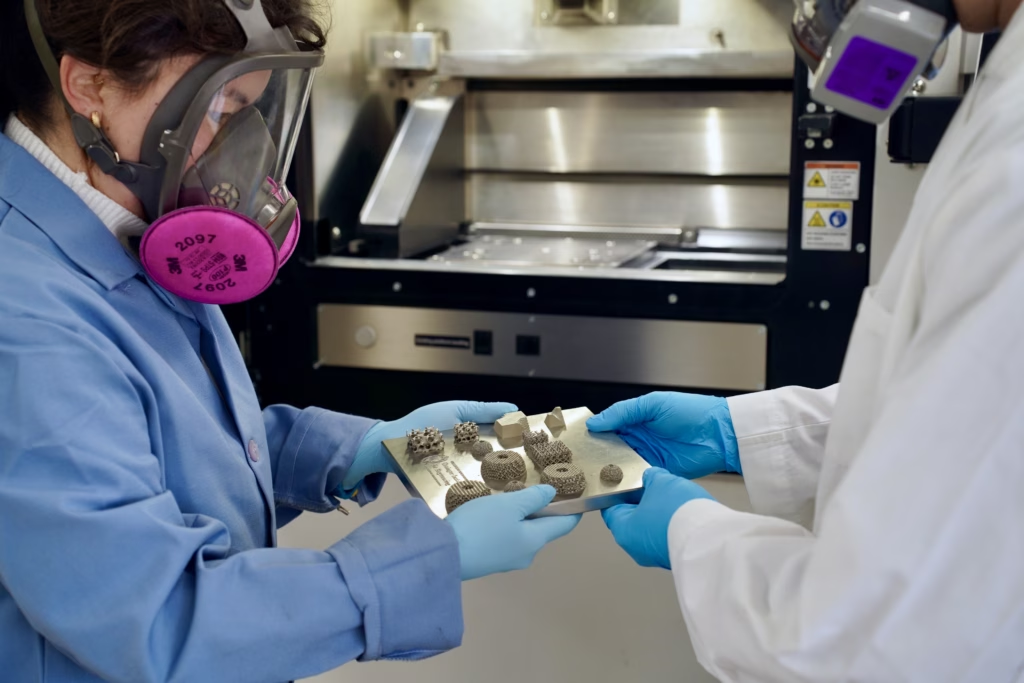 The new platform for materials innovation will rely on AI and automation to accelerate the discovery, synthesis, characterization and testing of materials used in extreme environments ranging from fusion energy to national security. Photos by the Grainger Institute for Engineering.
The materials needed for fusion energy, aerospace, national security and other extreme environments must withstand intense heat, radiation, corrosion and mechanical stress. Researchers increasingly address those challenges by intentionally designing complexity into materials at multiple scales, says Izabela Szlufarska, a professor of materials science and engineering at UW-Madison who will be the inaugural director of the new center. “Complexity is one of the most powerful tools we have for designing materials that can operate in extreme environments,” she says. “Whether we’re engineering materials at the atomic scale through ’compositionally complex’ ceramics and metals (those made up of many elements), at the microscale through composites, or at larger scales through additively-manufactured architecturally-hierarchical structures, the challenge is understanding how to tailor these complexities to move beyond the current limits of materials performance. This facility will give researchers unprecedented capabilities to design, create and evaluate those materials.”
Few institutions can bring together all of those capabilities in a single ecosystem. The NSF MATRIX-MIP user facility will build on the College of Engineering’s longstanding strengths in designing, manufacturing and characterizing materials for extreme environments, from fusion systems to high-temperature applications. It will become part of the Wisconsin Centers for Nanoscale Technology, one of the College of Engineering’s most significant shared-user research enterprises, which already serves scores of researchers in industry and academia. Building the facility within WCNT allows the NSF MATRIX-MIP to immediately leverage an established community of users, advanced instrumentation and technical expertise. The new facility will welcome the first users early in 2028 and it will be fully operational by 2030.
In addition to NSF funding, the center received support from both the College of Engineering and from UW-Madison. “UW-Madison is uniquely positioned to lead this effort because of our deep expertise in materials science, engineering, computation and data science, as well as the exceptional research infrastructure we have built across campus,” says Dorota Grejner-Brzezinska, UW-Madison vice chancellor for research and a professor of electrical and computer engineering. “This new facility will connect and amplify those strengths while serving researchers from across the nation. We are proud to support an initiative that expands access to cutting-edge capabilities, fosters collaboration across disciplines and sectors, and accelerates discoveries that are critical to our nation’s competitiveness, energy future and security.”
For the College of Engineering, NSF MATRIX-MIP also reflects a broader strategy to invest in areas where Wisconsin can lead nationally. “This center represents exactly the kind of bold investment we envisioned through our Engineering Moonshots initiative,” says Devesh Ranjan, Grainger Dean. “By combining AI-enabled discovery with world-leading capabilities in materials research, fusion and other extreme environments, we are creating a powerful engine for innovation that will accelerate the development of next-generation technologies. The new facility also creates even greater opportunities for companies to work alongside our researchers, strengthening the partnerships that transform breakthrough discoveries into solutions that advance manufacturing, energy security and economic competitiveness.”
Izabela Szlufarska is a Harvey D. Spangler Professor. NSF MATRIX-MIP’s leadership team includes materials science and engineering colleagues Harvey D. Spangler Professor Dane Morgan, Harvey D. Spangler Professor Dan Thoma and Harvey D. Spangler Professor Paul Voyles. Collaborators on the grant include the UW-Madison spinoff company CompuTherm and data scientist Kyle Chard of the University of Chicago. Argonne National Laboratory is a partner on the project.
Other UW-Madison participants—whose roles span tool development, in-house research, user facility operation, training and knowledge-sharing—include Lianyi Chen, the Kuo K. and Cindy F. Wang Associate Professor of mechanical engineering; Adrien Couet, a professor of nuclear engineering and engineering physics; Paul Evans, the Surface Science and Technology Bascom Professor of materials science and engineering; Jiamian Hu, an associate professor of materials science and engineering; Mikhail Kats, the Jack St. Clair Kilby Professor and Antoine-Bascom Professor in electrical and computer engineering; Sebastian Kube, an assistant professor of materials science and engineering; Hyunseok Oh, an assistant professor of materials science and engineering; Joel Paulson, the Gerald and Louise Battist Associate Professor of chemical and biological engineering; John Perepezko, the IBM Bascom Professor of materials science and engineering; Kumar Sridharan, Grainger Professor and Vilas Distinguished Achievement Professor of nuclear engineering and engineering physics; and Eric Tervo, the Dugald C. Jackson Assistant Professor of electrical and computer engineering.