A study conducted by University of Wisconsin-Madison and Princeton University nuclear engineers has identified a major blind spot in nuclear accounting with global nuclear security implications.
According to the researchers, large quantities of uranium have been extracted, concentrated and exported from the Democratic Republic of the Congo (DRC) over the past 20 years. This uranium has traveled through the DRC’s cobalt supply chain without being declared to the International Atomic Energy Agency (IAEA).
Published in the journal Nature Communications on July 30, 2026, the research also uncovers significant environmental and health risks to miners and surrounding communities from discarded uranium in mining waste streams.
The researchers used country-wide mineralization and geochemical data, mine-level trade records and a chemical model of cobalt processing to quantify the amount of uranium that has been dug up in the DRC and exported in cobalt-hydroxide shipments or left behind in the environment.
They estimate that 2,000 to 5,000 tonnes—approximately 4.4 million to 11 million pounds—of natural uranium were exported from the DRC, embedded in cobalt-hydroxide shipments between 2000 and 2024—even though there was no officially reported uranium production in the DRC in decades.
Less than 10% of this material appears to have been publicly declared and placed under international safeguards, according to study co-author Sébastien Philippe, a nuclear security expert and assistant professor of nuclear engineering and engineering physics at UW-Madison.
“This quantity of undeclared uranium could be used to produce fissile material for roughly 600 to 1,500 nuclear weapons or fuel a standard light-water nuclear reactor for 10 to 25 years, so it’s quite a large amount,” says Philippe, a 2025 MacArthur Fellow. “And because this uranium is undeclared and not officially reported as being mined and extracted, it has no limitation placed on its end use. It could end up in a civilian nuclear energy program or in a military program, because nobody is going to ask where this uranium is going. It’s not on the books.”
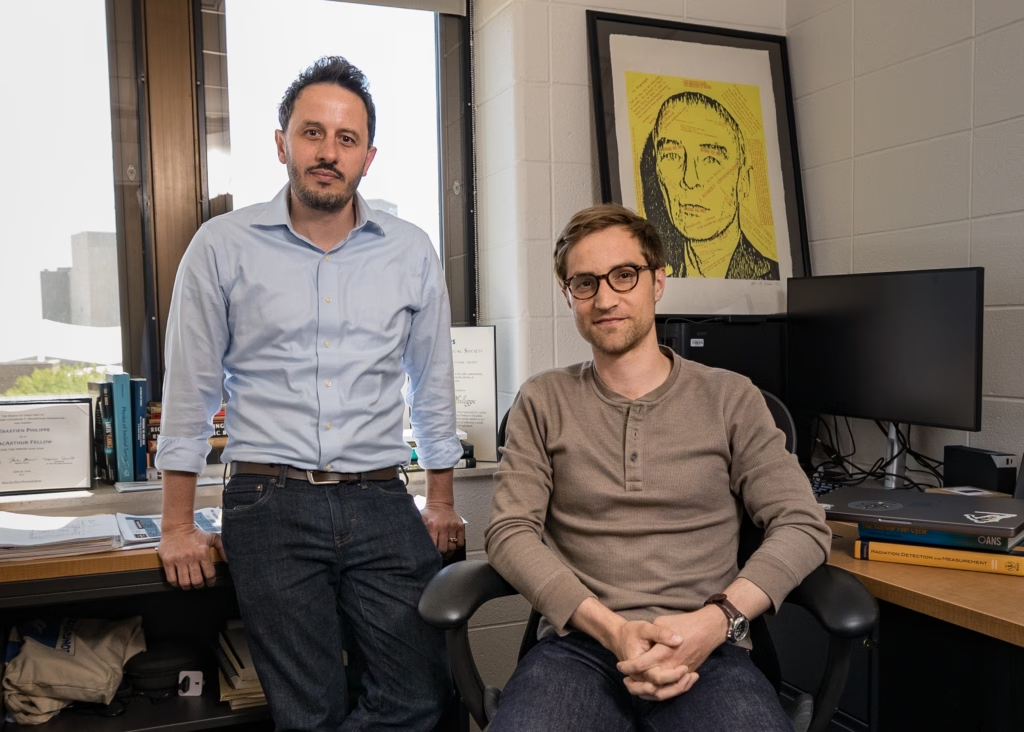 UW-Madison Assistant Professor Sébastien Philippe (left) and research fellow Ryan Manzuk used country-wide mineralization and geochemical data, mine-level trade records and a chemical model of cobalt processing to quantify the amount of uranium that has been dug up in the DRC and exported in cobalt-hydroxide shipments or left behind in the environment. Photo: Joel Hallberg.
Philippe says most of the shipments went to China, which is home to about 95% of the world’s cobalt refineries. During the process in which crude cobalt hydroxide is refined to produce cobalt metal, uranium must be removed—and becomes a highly valuable byproduct.
“Our scientific research doesn’t show this was done purposefully to get uranium out of the DRC,” says Philippe. “However, one of the things we’re concerned about is that the volumes of exported uranium we’ve quantified are beyond what is supposed to be declared to the IAEA, both by the DRC and China. So that’s an issue.”
The DRC’s Copperbelt is the world’s leading source of cobalt, a metal essential to the global energy transition. In recent years, surging demand from lithium-ion battery manufacturers, especially for electric vehicles, has driven a boom in cobalt mining in the DRC. In this region, uranium naturally co-occurs with cobalt ores. Due to its chemical composition, the mineral that cobalt comes from in the DRC is exceptionally good at getting other elements, such as uranium, to stick to it. And, unless deliberately removed, that uranium stays with the cobalt all the way though extraction, processing into cobalt hydroxide and being exported as an industrial raw material.
“In a lot of mining industries, when you’re targeting one specific element, there’s often other ones that come along with it,” says Ryan Manzuk, a research fellow in Philippe’s group at UW-Madison and at Princeton University, who is the paper’s first author. “So when companies are mining specifically for the cobalt mineral in this region, they’re also extracting relatively high quantities of uranium—more uranium than you would get in your average rock—because the uranium is hitching a ride on the cobalt. And when you’re mining cobalt ore near somewhere that used to be mined for uranium, which is the case in the DRC, you could have quite a lot of uranium associated with it.”
In addition, the researchers estimate that 1,000–4,000 tonnes of uranium were likely discarded to mine tailings, the waste stream from mining, in chemically mobile forms, posing environmental and health risks to miners and communities surrounding the mines.
Philippe and Manzuk say their findings point to an urgent need to address these risks. Important first steps include improved accounting of uranium extraction and shipment, systematic assay measurement of cobalt-hydroxide shipments and worker radiation monitoring. “Based on what we found, I think there needs to be an extensive national audit of mining in the DRC and new rules for separating uranium from the cobalt supply chain,” Philippe says. “There’s also a need for surveillance and monitoring mechanisms to ensure this is happening in an environmentally responsible way.”
Ultimately, preventing uranium exports requires refining cobalt to metal within the DRC, according to the researchers.
The project was built on an innovative partnership between scientists and investigative journalists working together on a public interest research investigation. Philippe and Manzuk collaborated with journalists and editors from Lighthouse Reports and the Financial Times. On July 30, 2026, the Financial Times published an in-depth investigation that expands on the findings reported in the accompanying Nature Communications paper through additional reporting, interviews and documentary evidence. Lighthouse Reports also published a behind-the-scenes account describing the methodology, collaborative process, original research and investigative techniques used throughout the project.
This research was supported by funding from the Carnegie Corporation of New York and from the Center for Policy Research on Energy and the Environment at Princeton University.
Featured image caption: A satellite image of the DRC from the researchers’ study. Image courtesy of Ryan Manzuk.