In the push to deploy clean fusion energy, several key engineering challenges remain. One of those challenges is designing viable “breeding blankets” for fusion energy systems.
Breeding blankets sit just outside the first wall of a fusion power plant and perform three essential functions: shielding sensitive components from radiation, producing new tritium fuel and absorbing energy from the fusion products to convert into heat to generate electricity.
This critical component isn’t easy to design for any magnetic fusion device, much less the highly complex geometry—like a twisted ring doughnut—of a stellarator.
To address this problem, Paul Wilson, a professor in the Department of Nuclear Engineering and Engineering Physics at the University of Wisconsin–Madison, is leading a project to accelerate the design optimization of stellarator blankets using artificial intelligence and machine learning.
This project is funded by the U.S. Department of Energy through the Genesis Mission. This national initiative is accelerating breakthroughs in energy, scientific discovery and national security through strategic collaborations and integrating AI in research workflows.
Breeding blanket design is informed by the shape of the plasma—an ultrahot, electrically charged gas that sustains fusion reactions. Stellarators confine plasma in complex shapes using magnets, and the space between the plasma and the magnets varies in three dimensions. Type One Energy, a UW–Madison spinoff company co-founded by NEEP Professor Chris Hegna, will provide the input plasma configurations for this project.
Wilson and one of his students, Connor Moreno, helped design the breeding blanket for Type One Energy’s Infinity Two fusion pilot plant. Moreno’s PhD thesis builds on that early work and provides the foundation for this project. While the current approach is an improvement, the process is still expensive and time consuming.
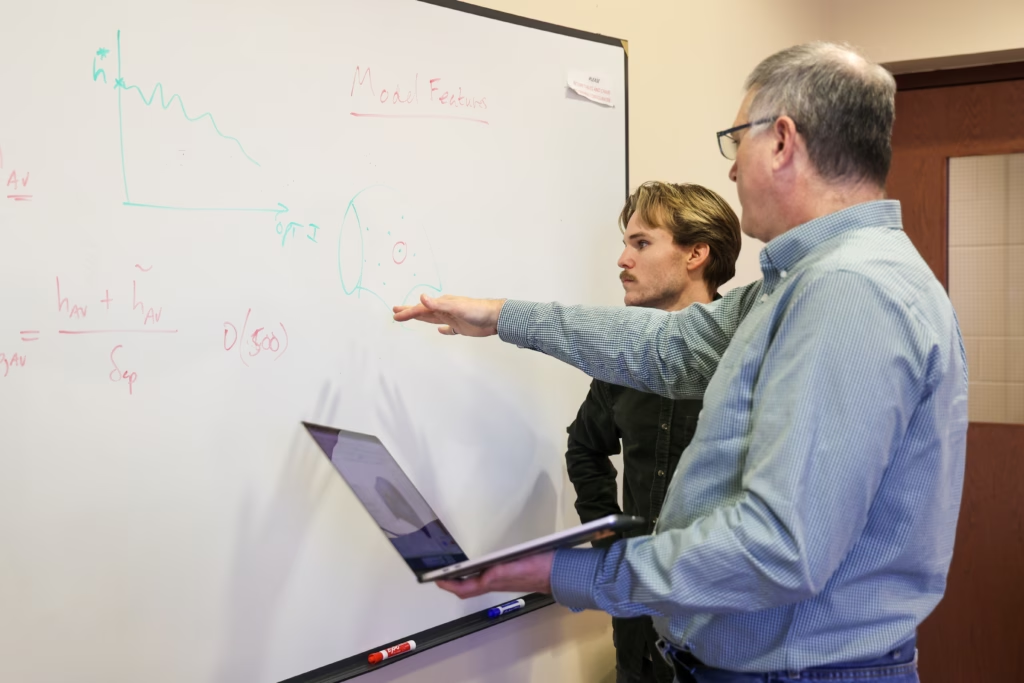 Professor Paul Wilson and PhD student Connor Moreno discuss opportunities for stellarator design optimization. Photo: Lili Sarajian.
Finding a viable breeding blanket for a given plasma configuration requires thousands of design parameters. Changes to any one of those parameters will impact how well the blanket can perform its key objectives.
“Right now, Connor has to change each of those design parameters one at a time to see how much it changes the performance,” says Wilson.
Moreno uses a software tool called OpenMC to run large-scale simulations—one simulation for each design parameter. With thousands of design parameters per blanket configuration and dozens of configurations, it took tens of millions of CPU hours to produce one solution—equating to roughly one month, given the available computing power on campus—and that’s before optimization.
Augmenting the existing software tool with a novel capability could streamline that process dramatically, allowing the tool to analyze all of the design parameters in a single simulation. That rich set of results is known as a gradient, and the gradient indicates how all of the parameters collectively impact the blanket performance.
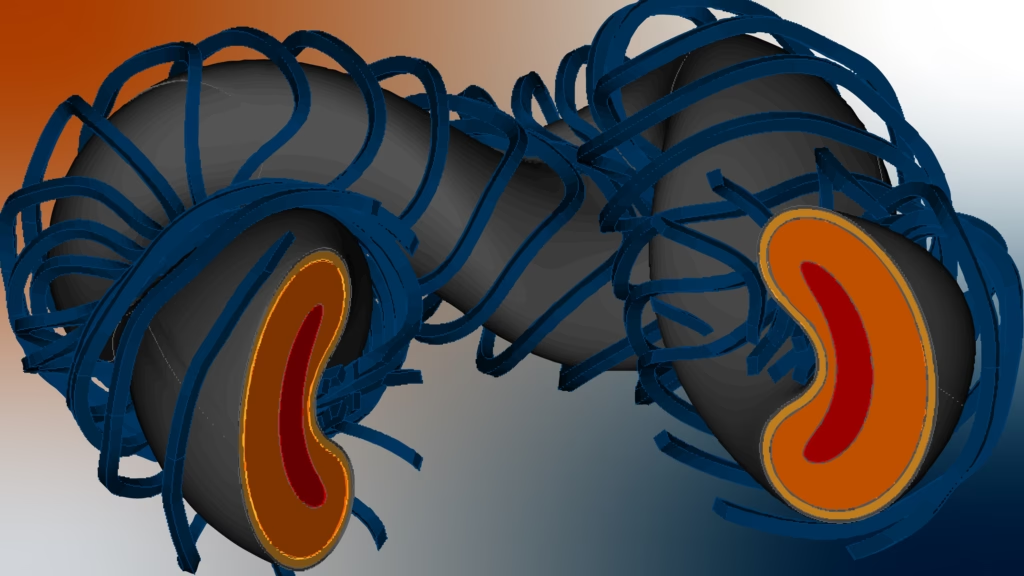 Stellarator model generated by PhD student Connor Moreno using ParaStell, a software tool that he designed to automate parametric stellarator modeling.
The first phase of the project involves calculating those gradients faster. Then, the team can calculate optimized blankets faster, yielding large, high-dimensional data sets for analysis. That’s where AI comes into play.
“Once we have hundreds of optimized blankets, each based on different plasma configurations, we can train AI to find an optimized blanket without having to do any simulations,” says Wilson. “The machine learning model will connect the dots between all the inputs and all the outputs and see the patterns that emerge.”
Beyond optimizing the breeding blanket, this work has the potential to accelerate optimization for the stellarator magnets and the plasma as well.
“Right now, you have to optimize each component one after the other,” says Wilson. “This iteration hopefully provides a good answer, but the breeding blanket optimization is the slowest step. In theory, we can expand on this work to combine all three and simultaneously optimize the entire system based on overall cost, construction time or other criteria.”
With support from collaborators at Argonne National Laboratory and Cornell University, this project brings together academia, government and industry partners to drive fusion energy technology closer to commercialization.
Featured image caption: Helically Symmetric eXperiment (HSX), an optimized stellarator operated by the College of Engineering at the University of Wisconsin–Madison. Photo: Todd Brown.