A robotic rover powered by a new aluminum-air battery completed the same 60-kilometer mission as a lithium-ion-powered rover while carrying 41% less total energy-storage mass. Developed by University of Wisconsin-Madison engineers James Pikul and Yichao Shi and reported in the journal Joule, the system can be mechanically refueled in under a minute by replacing a spent aluminum pouch with a fresh one.
The approach could help robots, construction equipment and other machines operate for longer periods in locations where electrical charging is slow, impractical or unavailable. Rather than functioning as a sealed battery that must be plugged in, the system operates more like a fuel cell: aluminum is supplied as fuel, while the same air cathode, hydrogel electrolyte and supporting hardware are reused.
“We designed this more like a fuel system than a conventional rechargeable battery,” says Pikul, the Leon and Elizabeth Janssen Associate Professor of Mechanical Engineering. “When the aluminum is spent, you remove one pouch, insert another and keep working.”
In a metal-air battery, the metal acts as the fuel, with ions flowing through an electrolyte between the metal and, at the other terminal, oxygen that’s absorbed from the atmosphere.
In their design, Pikul and his team placed the aluminum slab in a pouch—essentially a tea bag—that prevents the byproduct of aluminum’s oxidation reaction from contaminating the rest of the cell. Rather than using a liquid electrolyte—the typical option—the group used a hydrogel that gets replenished with small doses of water and potassium hydroxide. The whole setup sits inside a spring-loaded package that provides mechanical pressure to maintain contact at the interfaces while allowing for the expansion that occurs when aluminum oxidizes.
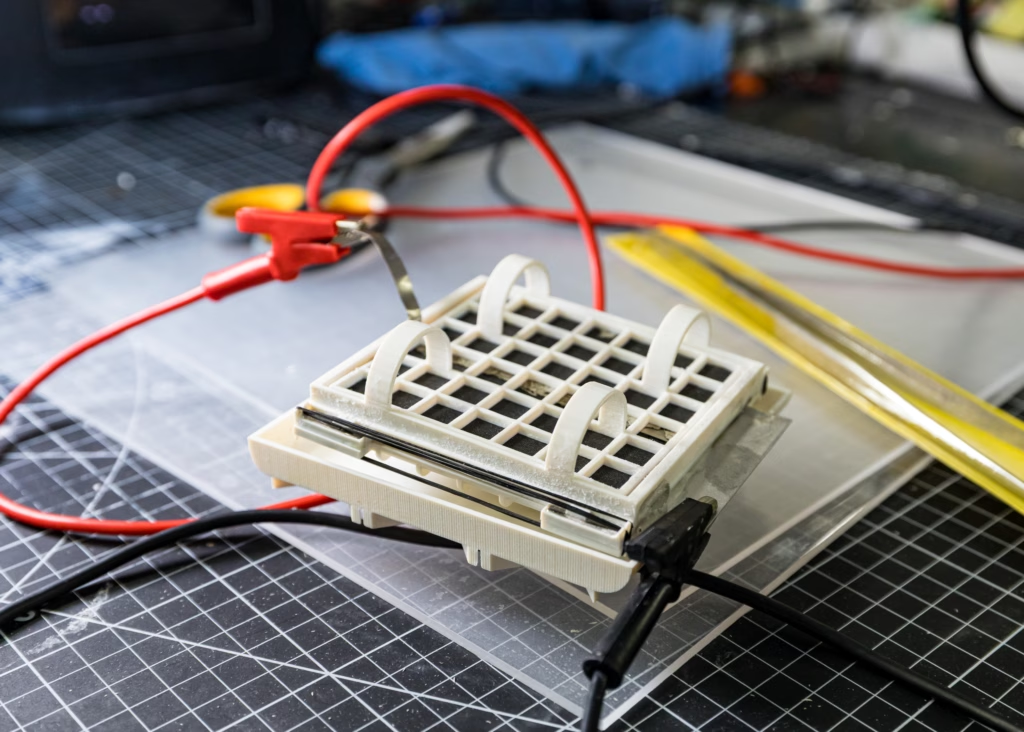
To keep the battery running, automated microdosing of the hydrogel electrolyte replaces the water consumed in the chemical reaction that occurs on the air terminal. And once all energy is extracted from one piece of aluminum, manually swapping in a fresh piece takes less than a minute. Eventually, a robot powered by such a battery could even autonomously “eat” aluminum to refuel.
“We want it to be very simple: I put the metal in, and I take it out,” says Pikul.
He also notes that if a robot could collect water from its surrounding environment rather than relying purely on reserves, that ability would lessen the weight and improve its energy density to 1,000 watt-hours per kilogram.
The work builds upon a 2025 piece Pikul and Shi wrote in the journal Science Robotics outlining the challenges for achieving animal-like endurance in bioinspired mobile robots.
“In most robots today, batteries only last an hour, maybe two hours, if you’re lucky,” says Pikul. “We are building energy systems for robots that give them the endurance of animals”
Batteries like the group’s aluminum-air design would be particularly useful operating away from the power grid—think battling forest fires, wilderness search-and-rescue or more run-of-the-mill scenarios like camping—or as alternatives for gas-powered construction equipment that needs to run for long stretches of the day.
The current system still requires a person to exchange the aluminum pouch. The researchers and startup Metal Light are working toward automated refueling and longer-lasting air cathodes that could allow robots or infrastructure, like data centers, to operate for extended periods with little human intervention.
This research was partially funded by the Gordon and Betty Moore Foundation.
Other UW-Madison authors on the paper include: PhD students Euigeol Jung and Xinyao Cai, former postdoctoral scholar Jungtaek Kim and Haoyu Wu.
Top photo caption: From left: PhD student Euigeol Jung, former postdoctoral fellow Yichao Shi and Professor James Pikul hold a robotic rover that’s powered by their aluminum-air battery. Photo: Joel Hallberg