When Michael Biehler was a kid in rural Bavaria in Germany, his mother worked with individuals with disabilities as an occupational therapist. While Biehler gravitated toward mechanical challenges, eventually studying industrial engineering and exploring the limits of 3D printing at the Karlsruhe Institute of Technology and Georgia Tech, the impact of his mom’s career lingered in his mind.
As a PhD student in Atlanta, he led a handful of 3D printing workshops focused on adaptive technology. And now that he’s settled in at the University of Wisconsin-Madison as an assistant professor of industrial and systems engineering, Biehler and his growing research group have resumed that work.
“When there was an opportunity to connect my work with that, I thought that was a great opportunity, a closed-loop moment type of thing,” he says.
Biehler and student researchers Charlie Blackwell, Luke Olson and Leon Steimer recently ran a workshop at the Adaptive Gaming Expo in August 2026 in Madison—an outgrowth of the research group’s burgeoning collaboration with the nonprofit Access to Independence.
Previously, Biehler had connected with another nonprofit, California-based Not Impossible Labs, to help develop potential designs for a prosthetic hand adapter. But he figured there had to be a similar need locally and found Access to Independence, which provides services and resources for individuals with disabilities. The organization has a large collection of assistive technology, ranging from phones with large numbers to writing devices for individuals with tremors.
“The market is so small for some disabilities,” says Biehler. “There are very few manufacturers that actually make anything. And so they have a bunch of things in their inventory where it’s like, the company went out of business and they’re not making those parts anymore.”
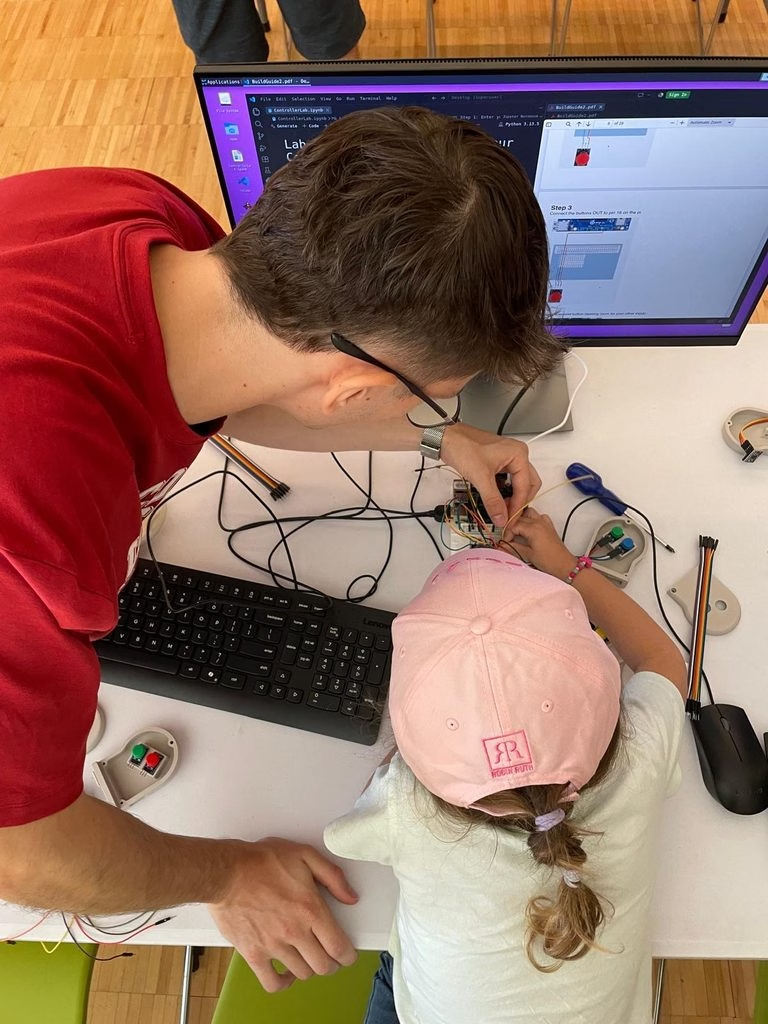
Access to Independence invited Biehler’s group to participate in the Adaptive Gaming Expo, which it began putting on in 2024. Blackwell, with the help of Olson and Steimer, designed and led a workshop on building low-cost gaming stations with controllers customized to users’ abilities and preferences. Visitors, ranging from kids all the way up to middle-aged adults, assembled controllers, wrote code and used their setups to play an open-source kart-racing video game.
“Gaming is a pretty common language; it’s popular among almost everybody,” says Blackwell, a senior majoring in mechanical engineering who plans to stay at UW-Madison, specifically in Biehler’s lab, after graduation to pursue his PhD in industrial engineering. “But there isn’t a lot of flexibility in terms of adapting to different people’s needs.”
Biehler plans to take project requests from Access to Independence clients for future College of Engineering Makerthons, an event he launched in 2025, and to partner with the organization on grants. Too often, he says, researchers team up with nonprofits or community organizations for events and then disappear. He’d like to build a long-term collaboration.
“I really feel that it’s mutually beneficial,” says Biehler, who’s also led outreach events at a local preschool all the way up to high schools. “It’s not just like I put up a booth at a science expo and then I disappear for the year, but more like when they have a problem, they know they can come to us. Every time I ask the students if they want to do something, they’re all in on it. This is an important part of our outreach now.”
Top photo caption: Assistant Professor Michael Biehler assists participants at the 2026 Adaptive Gaming Expo in Madison. Submitted photos.