The strangest physics on Earth is about to transform life as we know it.
These days, you don’t have to look far to find the term “quantum”: Marketers have slapped the word on dishwasher pods, superhero movies and nutritional supplements while tech media breathlessly report that quantum technologies are going to change the world. But what, really, is quantum? And why is it suddenly all over the place?
Hold onto your qubits! Here’s a crash course in quantum to help you navigate this surprising world.
Quantum mechanics describes the supremely weird physics and forces that govern extremely tiny things, from small clusters of atoms to even smaller particles (hello, photons!). After a century of research, scientists and engineers have developed the tools and know-how to manipulate the quantum world. Now they’re taking steps toward harnessing quantum mechanics to develop new types of computers, electronics, sensors, quirky materials and unhackable communications networks. The unreal world of quantum is finally becoming a reality.
Welcome to the blind alley!
Let’s take a step back. Over the course of several centuries, scientists figured out what is known today as classical physics: the laws describing, for example, how planets orbit stars, cannonballs arc, and electricity moves through wires. This type of physics describes a predictable, or “clockwork,” universe: If you know all of the starting variables, you can precisely determine where your cannonball is going to land.
That isn’t the case with quantum mechanics, for which evidence started to emerge in the late 1800s and was codified a century ago, in 1925. As scientists probed the atomic and subatomic world, they did not find a clockwork universe; rather, their view of the quantum world was more like a rowdy game of dice.
They found that most tiny particles—including photons, electrons and their “friends”—exhibit the characteristics of both waves and particles. Rather than existing in one fixed location, they can exist in superposition. Think: many positions at the same time, with the results of experiments determined by probabilities.
Even more astounding, once someone observes or measures this probability cloud, the superposition or waveform “collapses,” and the tiny particles exhibit the properties … of particles. Scientists also discovered a property called quantum entanglement: After first interacting, two quantum particles can become linked, even if they are a billion light years apart.
It’s the kind of wild physics that makes your head spin. In fact, the best minds in science have tried—and failed—to wrap their minds around superposition, entanglement and the other elements of quantum theory. Nobel-prize-winning physicist and educator Richard Feynman, when introducing quantum mechanics to his students at MIT in 1964, warned them not to get too philosophical. “Do not keep saying to yourself, if you can possibly avoid it, ‘But how can it be like that?’ because you will get ‘down the drain,’ into a blind alley from which nobody has escaped,” he told them. “Nobody knows how it can be.”
 In simple terms, quantum entanglement is a phenomenon where two or more particles become linked in such a way that the state of one instantly influences the state of the other, regardless of how far apart they are. Albert Einstein famously (and skeptically) called this “spooky action at a distance.”
Making the unreal real
While we can’t understand quantum physics in terms of cannonballs, it’s still possible to comprehend and use it. Over the last century, theorists, experimentalists and engineers have used elements of quantum mechanics to develop nuclear energy, semiconductors, MRI machines, lasers and ultra-precise atomic clocks.
In the last two decades, advanced microscopes and nanofabrication technology have given researchers the tools to manipulate particles at the atomic and subatomic level, leading to even finer control.
The current centerpiece of quantum technology is the qubit, or quantum bit. These devices essentially allow us to take advantage of quantum superposition and entanglement to process information—for example, in computers and advanced sensors. Currently, scientists and engineers are studying dozens of qubit designs made of superconducting circuits, semiconductor quantum dots, trapped ions or atoms, and other materials. All of these designs aim to isolate a quantum particle, like an electron, neutral atom, ion or photon, from unwanted interactions with the outside world, so that it can retain its quantum properties long enough to be useful.
In quantum computers, these qubits are information carriers. In modern “classical” semiconductor-based computers, billions of tiny transistors act as two-position switches that are flipped electronically, representing information as ones and zeros. The quantum particle in a qubit can also represent ones and zeros, but superposition also allows it to represent a position that is simultaneously a combination of one and zero.
Superposition and quantum entanglement are key ingredients that give quantum computing its potential. Each additional qubit doubles the amount of information the system can handle, and scientists believe that a fully realized quantum computer could vastly outperform current computers.
Qubits can also be made to be ultra-sensitive, and can detect extremely small changes in the environment. This means they could be used in new, more powerful types of sensors to measure gravity, magnetic fields, temperature and time; enable satellite-free navigation; and even noninvasively detect changes in the human body.
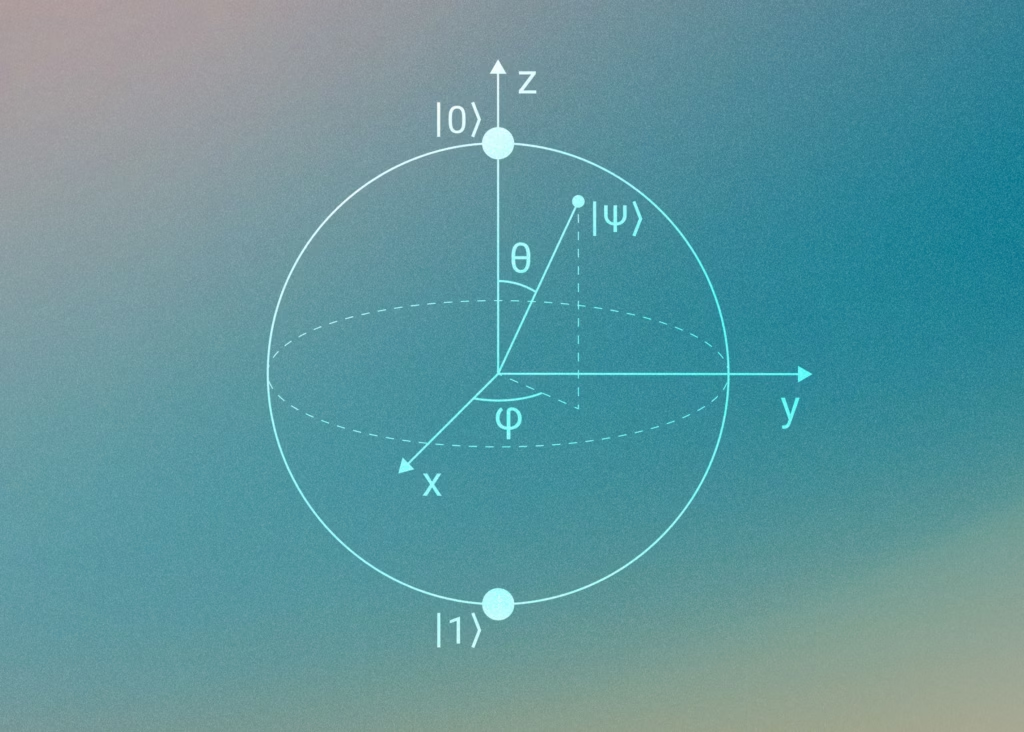 The Bloch Sphere is a geometric representation of the state of a single qubit (the basic unit of quantum information). While a classical bit can only be a 0 or a 1, a qubit can exist in a superposition of both states. Think of it as a globe where the “North Pole” is one state, the “South Pole” is another, and every point on the surface in between represents a different quantum possibility.
Well, they work … in theory
The current generation of qubits is finicky. Any vibration, temperature change or stray radio wave can cause the qubit wave function to collapse and the qubits’ information to evaporate in a process called decoherence. Cooling qubits to near absolute zero (minus 459.67 degrees Fahrenheit) reduces this “noise” and allows qubits to maintain coherence—at least for a little while: The best qubits last a few seconds up to a few minutes.
Enter the engineers. Researchers across the globe are searching for materials and techniques to make more robust qubits so that they’re actually practical to put into use—or at least last longer than a sneeze.
A wide ranging cross-disciplinary group of researchers at UW-Madison—many part of the Wisconsin Quantum Institute—is collaborating to advance these technologies. In the College of Engineering, Electrical and Computer Engineering Associate Professor Jennifer Choy is working with particles called cooled neutral atoms and solid-state quantum emitters. Her aim: Create quantum sensors that precisely measure magnetic fields and temperature, and are small and tough enough to take into the field.
Mikhail Kats, the Antoine-Bascom Professor and Jack St. Clair Kilby Professor in electrical and computer engineering, and Mark Saffman, a UW-Madison physics professor and the quantum institute director, have developed techniques that trap layers of neutral atoms to create cheaper, more scalable qubits. Other researchers, like Electrical and Computer Engineering Associate Professor Tsung-Wei Huang and James E. Smith Assistant Professor George Tzimpragos, are creating computer architectures and software systems that will make quantum computers usable.
The material difference
Qubits are just the start. Quantum exploration has taken over materials science, too. The world of quantum materials is defined, generally, as “materials exhibiting electronic and magnetic properties that can’t be explained via classical physics.”
This landscape is broad: It includes superconductors, spin liquids, topological insulators, Dirac and Weyl semimetals, transition metal oxides, perovskites and many other materials with names that would ruin a crossword puzzle. These materials all have unique, and sometimes exotic, magnetic and electronic properties. Some are ideal for computer memory; some could be used as sensors. Some can harvest energy from errant Wi-Fi signals and others can transmit electricity with no resistance.
In many cases, when they’re synthesized as thin films or 2D and “low dimensional” materials just a few atoms thick, these materials exhibit even more pronounced exotic quantum states.
Engineers at UW-Madison are particularly skilled at making and analyzing atomically thin quantum materials and thin films. Chang-Beom Eom, the Raymond R. Holton Chair for Engineering and Theodore H. Geballe Professor in materials science and engineering, is a world leader in synthesizing thin films of transition metal oxides. He’s also found that layering these materials on top of one another can produce even more exotic properties.
Dan Rhodes, an assistant professor of materials science and engineering, is a world expert in synthesizing high-quality 2D materials, while Jason Kawasaki, an associate professor of materials science and engineering, fabricates films that produce special properties when they’re stretched or strained. Ying Wang, an assistant professor of electrical and computer engineering, is using these materials to produce new types of computer memory and energy-harvesting devices. Bobby Jacobberger, an assistant professor of electrical and computer engineering, is creating diamond thin films that can be used as qubits and sensors, while Zhenqiang “Jack” Ma, the Lynn H. Matthias Professor in Engineering and Vilas Distinguished Achievement Professor in electrical and computer engineering, has also worked with layered quantum materials, diamond and energy-converting semiconductors.
Many other researchers throughout the College of Engineering are developing and integrating these weird but wonderful materials into ultrawide bandgap semiconductors, lasers, solar panels, energy converters, batteries, medical devices and more.
Quantum technologies are poised to make an impact in many aspects of our lives. Advances in quantum communications may lead to networks that are harder to hack. Batteries made of quantum materials will allow us to store energy produced by ultra-efficient solar cells. Autonomous cars will be able to navigate unfamiliar roads using quantum sensors, without relying on satellite systems. Researchers may even unlock mysteries of the brain and the universe using quantum computers that can do calculations inaccessible to the biggest classical supercomputers.
And that’s not so weird after all.
A pocket guide to quantum
Quantum: The physics of the very small, where outcomes of experiments are often probabilistic
Superposition: A quantum particle’s ability to exist in a combination of states
Qubit: A quantum bit that can represent 0, 1, or a superposition of 0 and 1
Entanglement: A connection between particles across vast distances
Decoherence: The loss of quantum state when a particle interacts with its environment
2D material: A crystalline material one or just a few atoms thick, sometimes with extraordinary electronic, magnetic or optical properties
Photon: A particle of light that also has wave-like behavior
Electron: A negatively charged particle that occupies so-called atomic orbitals in the vicinity of atomic nuclei
Probability cloud: The “fuzzy” region where a quantum particle is likely to be found
Wavefunction collapse: When a quantum particle’s multiple possibilities reduce to one outcome after measurement
Neutral atom: An atom with equal numbers of protons and electrons; clouds of neutral atoms are often used in quantum sensors, while isolated neutral atoms are important components of some quantum computers
Spin: A quantum property of particles that acts like tiny magnetic orientation