Sleep was on Nicolas Greaves and his groupmates’ to-do list. But, with motors to test, force calculations to crunch, prototype components to 3D print and more, the tasks kept stacking up.
In the end, Greaves and his friends caught about an hour of shuteye while designing a winning scissor-lift system for a patient-positioning device over the course of 24 hours as part of the University of Wisconsin-Madison College of Engineering Hackathon/Makerthon September 26-27, 2025.
“When we made our model, we had these grand ideas,” says Greaves, a senior from Milwaukee double majoring in mechanical engineering and computer sciences. “It was a good lesson in resource and time management. At the very end, we were definitely rushing as much as possible. We had three hands going in this small assembly.”
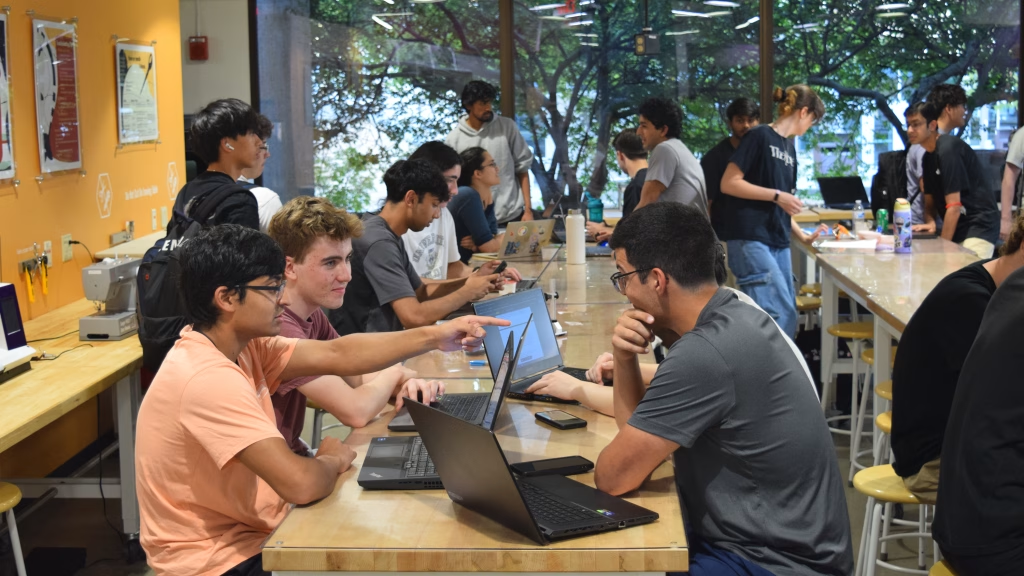
Greaves and his five groupmates were among the more than 70 students to participate in the Hackathon/Makerthon, put on by the Department of Industrial and Systems Engineering and the Grainger Engineering Design Innovation Laboratory. The event, held at the Design Innovation Lab @ Wendt Commons, drew students from across the UW-Madison campus, with nine different majors represented.
Working in teams, students spent 24 hours creating solutions for their pick of three challenges supplied by industry partners Accuray and Plexus: designing the patient-positioning device used in radiation therapy for various forms of cancer; developing a tool for streamlining product specifications; or building an automated optical inspection system to catch defects in manufacturing of electronic components.
The winning teams and others earned cash prizes, while all the students got to keep the devices they created. Not to mention free catered meals throughout both days, always a hit with college students.
“That’s the spirit we wanted to encourage: Collaborative problem-solving and different majors coming together, working on a real industry challenge,” says Michael Biehler, an assistant professor of industrial and systems engineering who organized and ran the event. “Give them more exposure to what it is that industry is looking for, prepare them. And also on the other side, get more industry on campus.”
Biehler participated in a large hackathon as both a student and a research assistant at Karlsruhe Institute of Technology in his native Germany. This time, he and his graduate students served as on-site mentors for the student teams, along with a staff engineer from Accuray; Plexus personnel held remote consultations with students as well.
 Submitted photos
Julius Nurse, a senior from Brooklyn Center, Minnesota, majoring in engineering mechanics (aerospace option), worked with four friends from three different majors: his own, biomedical engineering and electrical engineering. The group’s scanning and image-recognition system won the automated inspection challenge.
“It’s a good way to build community,” says Nurse. “It’s a good way to get a project together, if you give people a deadline and resources to do it.”
The event also brought a wider range of students into the Design Innovation Lab @ Wendt (formerly known as the UW Makerspace), which offers a variety of rapid-prototyping equipment.
“It was nice that they made a Hackathon that’s not just focused on computer science students, but also mechanical engineering and other types of engineers,” says Greaves. “I feel like that’s something I’ve always wanted to work more on, actually building things.”
While the Design Innovation Lab has hosted periodic hackathons and makeathons previously, Biehler hopes to make this particular event at least an annual occurrence, ideally with additional industry partners and workshops on topics like preparing a pitch.
“I think this is one example of the Wisconsin Idea: How can what we do here make an impact on the state?” says Biehler. “Bring in local companies, connect them with students, give them more opportunity beyond standing in line at the career fair—actually make something cool in 24 hours that companies might use in their operation. That’s the vision, to enable that as a pipeline that goes both ways. How can industry enhance our curriculum? Are there things we should be looking at? But also, on the other side, build a pipeline of students, give them an initial connection.”