Fans of Travis Frederick, the former Wisconsin Badgers and Dallas Cowboys center affectionately known as “Fredbeard,” know of his many accomplishments on the field: first team All-American; 2025 Badger Hall of Fame inductee; first-round draft pick; multiple Pro Bowl and All Pro selections; and stats that squarely place him among the best NFL centers of the 2010s.
But even his biggest fans probably don’t know about his other major achievements: the brutal, months-long campaigns he’s survived on the ice planet Hoth; the monstrous gelatinous cubes he’s faced down; the epic weapons he and his band of treasure seekers have plundered from remote dragon hoards.
Frederick has been an avid tabletop gamer—think Dungeons & Dragons and similar role-playing games—for more than two decades. After retiring from the NFL in 2020, Frederick, now 35, has combined his passion for gaming with his University of Wisconsin-Madison computer engineering degree as co-founder of Demiplane. The popular digital platform facilitates online tabletop game matchmaking and also produces the popular Nexus line of digital toolsets that enable more efficient and in-depth game play.
So how did a pro-football luminary go from the locker room to the dark and dingy dungeon? By his own admission, Frederick has always been a gaming nerd who dabbled in football, not the other way around.
Growing up in Sharon, a small town in Walworth County, Wisconsin, just across the Illinois border, Frederick dreamed about becoming an engineer. He began his love affair with tabletop gaming in middle school, when he and his friends started playing a Star Wars-based role-playing game that spanned years.
In fact, though he grew to love the sport, football was just a means to an end. At 6 feet, 4 inches tall and weighing more than 300 pounds, Frederick was a natural lineman. He joined the football team at Big Foot High School in Walworth County with the hope of earning a football scholarship to the University of Wisconsin-Madison. “Frankly, I wasn’t sure I wanted to be in football; I just wanted to be in engineering,” he says. “I told my high school coach I wanted to find a way to pay for school, and a football scholarship would be a great way to do that. So, he helped me work on the right things and send out film to the right places, and I did end up getting a scholarship to UW-Madison.”
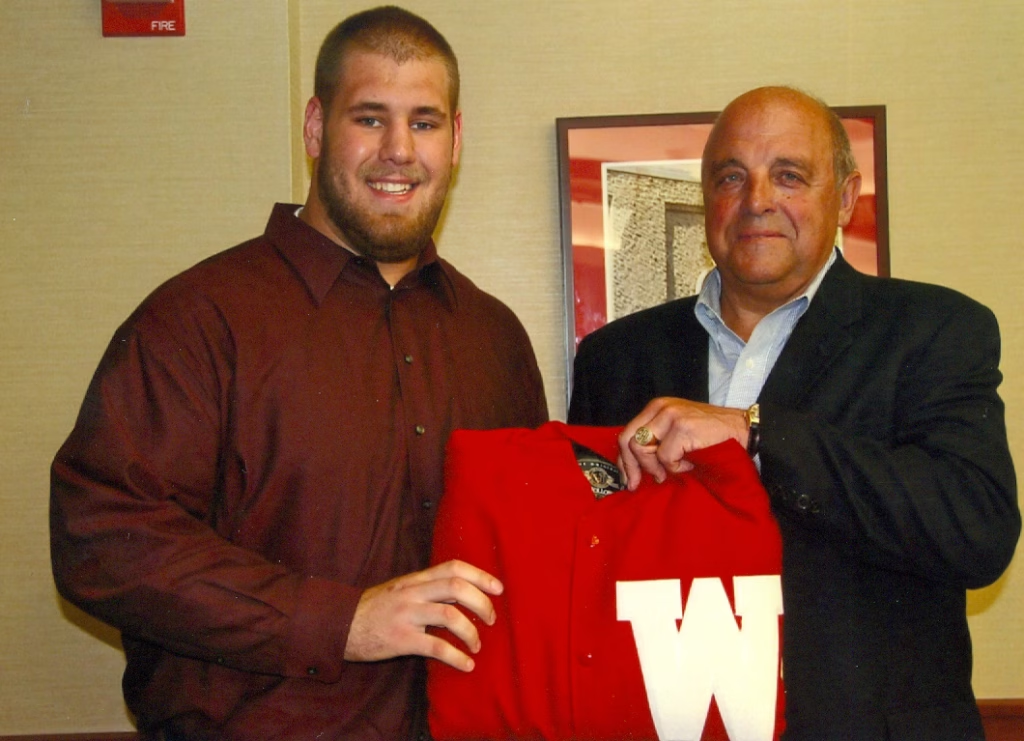 Travis Frederick accepts his varsity letter from then-UW Director of Athletics Barry Alvarez.
Even then, Frederick didn’t really harbor dreams of going pro. “From a football standpoint, I thought my work was essentially done after I earned a scholarship,” he says. “I said, ‘Now I can go to UW-Madison and earn a great engineering degree and go off and get a great job.'”
During his sophomore year, however, several of his teammates were selected high in the NFL draft, and he started to hear chatter about his own chances of going pro. Joining the NFL, he thought, even if it was only for a few seasons, was an opportunity he couldn’t pass up. In 2013, after earning his degree in computer engineering (but frustratingly, just six credits shy of a double major in computer science), Frederick was drafted in the first round by the Dallas Cowboys. He started that season as center—the first Cowboys rookie to play that critical position all season long.
Frederick made an impression; he was named to the NFL All-Rookie team his first year. In his second year, he was selected for his first Pro Bowl, which he would repeat four more times during his seven-year career. He was also selected as an All-Pro three times.
In 2016, he signed a five-year contract with the Cowboys. In 2018, however, Frederick was diagnosed with Guillain-Barré syndrome, an autoimmune disease that affects the muscles and can damage the nervous system. He had to sit out the season, which gave him a chance to consider his future. The disease made it difficult to play with his young son, and he couldn’t even pick up his infant daughter. He realized that football was just one chapter in his life; there was much more he still wanted to do.
Still, in 2019, with his health much improved, he took to the field for one more Pro-Bowl season before hanging up his cleats in March 2020. Despite his truncated career, Frederick was nominated for induction into the Pro Football Hall of Fame in 2024.
Throughout that whirlwind run to NFL stardom, Frederick maintained his love of gaming and his knack for computer engineering. Throughout college and during his time in the NFL, he continued to play tabletop games with the same crew of middle- and high-school friends, mostly online, but also in-person when possible. “Once we graduated and my friends were out working in the real world and I was playing ball, we still continued to play weekly, or almost weekly, just to stay connected,” he says. “It was a great way to just set aside your worries for a minute and pretend to be somewhere else.”
And he flexed his computer engineering skills whenever he got the chance. One night he was chatting with a close friend who was in charge of international expansion for a startup company. The friend was venting about a piece of bug-ridden software that was hampering his work. Frederick, resting in a Detroit hotel room on a Saturday night before a game, dipped into the code. Over the course of the next few hours, he sent versions of a software fix to his friend until he got it just right. The next day, while Frederick was out on the field, his software was integrated into the company’s workflow, where it was eventually used hundreds of thousands of times per day.
As his football career was winding down, Frederick began brainstorming about his post-NFL life with his longtime friend and gaming buddy Peter Romenesko who worked at a venture capital firm. At first, they looked into the video game industry. But a little market research revealed something surprising: While two of the top three games discussed online were the video game behemoths Fortnite and Overwatch, the third game was Dungeons & Dragons—the 50-year-old tabletop role-playing game that launched the genre Frederick and Romenesko already knew and loved.
“We started to do a bit more research. It was really clear that there was a lot of money being generated by tabletop gaming, but there was not a lot of money being invested in the industry,” says Frederick. “So, we said, ‘Hey, maybe this is somewhere we can make a play and make some value for these people by injecting capital and resources into this market.’”
The result was their company Demiplane, which earned support from Titletown Tech, a venture capital firm and business incubator developed by the Green Bay Packers and Microsoft. At first, Demiplane was an online matchmaking platform that paired people who wanted to host games—people known as “game masters”—with those who wanted to play. Over time, however, the company shifted its focus to a much bigger problem in tabletop gaming: getting started.
Tabletop games can last many, many hours, with campaigns stretching over weeks or months of gaming sessions. Traditionally, it can take game masters and players four to six hours of reading rule books, creating characters and designing elements of gameplay before even starting a game. “That’s a huge barrier to entry,” says Frederick. “In video games, they don’t give you an instruction manual. They plop you in the game and they teach you how to play while you’re playing. We took that same principle and applied it to tabletop gaming. Using our digital tools, we filter the decisions down to just those you need to make. You can create your first character and be ready to play in five minutes.”
The product has proved extremely popular, with tens of thousands of active monthly users. It offers digital support for top-tier tabletop games, including Pathfinder, Dungeons & Dragons, Marvel Multiverse, Vampire: The Masquerade, Cyberpunk RED and many others.
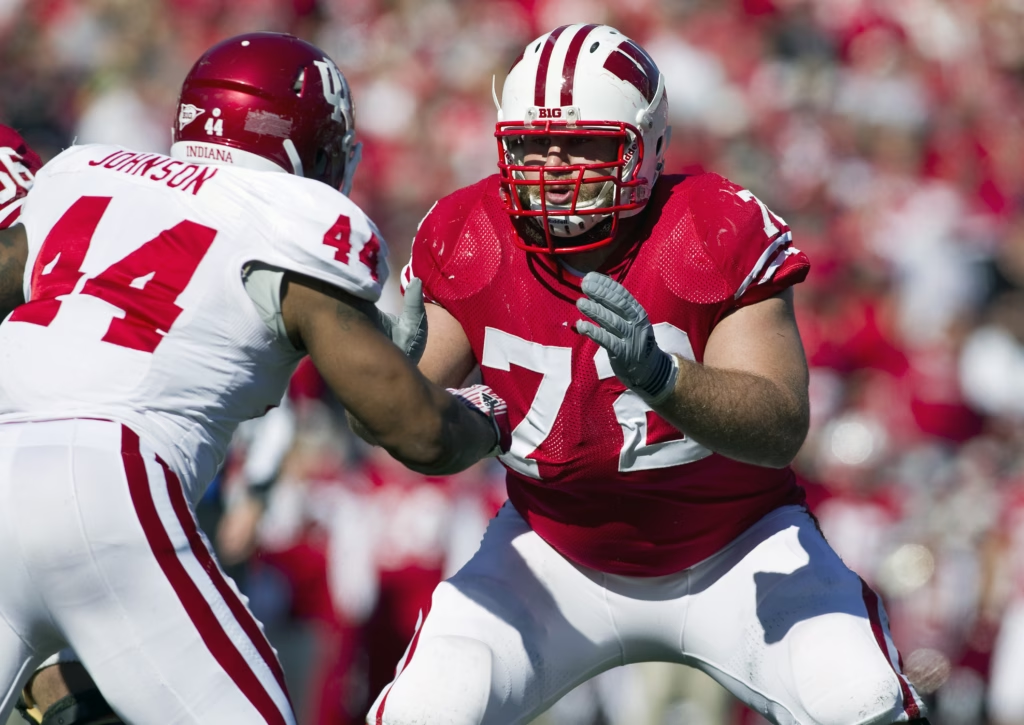 Travis Frederick in action for the Badgers in 2011. He was an All-American in 2012.
In June 2024, Demiplane was acquired by Roll20, a virtual tabletop company. Frederick stayed on as “founder-in-residence,” continuing to develop Demiplane products and even livestreaming gaming sessions and demonstrations on YouTube, until the fall of 2025 when he took a step back. Now he serves as an advising founder to the company.
But every Monday night, Frederick, who lives with his wife and children in his hometown of Sharon, Wisconsin, still sets aside a few hours to game with the group he’s played with for 15 years, including his brothers, Demiplane co-founder Romenesko, a grade school friend, and others he’s met throughout his career. It’s that type of long-term camaraderie he hopes his work will help foster in new generations of players.
“In today’s world, we’re losing a lot of connection with people, and these games force you to sit and talk with people and socialize,” he says. “And the games put you in uncomfortable situations that you might never encounter in person, like haggling with a shop keeper or talking your way out of a dangerous situation. From an empathy standpoint, it’s really good to put yourself in somebody else’s shoes.”
Frederick credits UW-Madison for much of his success on the field and in tech. In particular, he’s grateful he wasn’t pressured to choose athletics over his passion for engineering. Though at first his coaches were surprised by his choice of a challenging double major, they understood how important education was to Frederick.
“There were a lot of people who cared about me all the way through, from the admissions people and the advisors in the College of Engineering to everyone in the Athletic Department,” he says. “It was hard to balance engineering and football, but not a lot of people told me I shouldn’t or couldn’t do it. Instead, they told me how I could accomplish my goals; they supported me through it all.”
All photos courtesy UW Athletics.