After setting out to create a flexible sensor that could aid his advisors’ examination of the mechanical forces behind traumatic brain injury, Sinan Candan hit a roadblock.
While economical and useful, the sensor he’d developed wasn’t the right fit: It couldn’t provide the granular level of sensitivity and precision for characterizing brain material.
Candan, a PhD student in mechanical engineering at the University of Wisconsin-Madison, showed his sensor’s data to his advisors, Professor Christian Franck and Associate Professor Jacob Notbohm. And the three researchers observed that, while the sensor might not be capable of tracking impacts on brain material, it was still effective for detecting periodic forces—the sort that might be relevant in structural health monitoring, underwater robotics or human health screening.
“We diverted a bit and found a really interesting set of applications,” says Candan (MSBME ’23), who came to UW-Madison from Turkey as a Fulbright Scholar.
The sensor could help detect irregularities in manufacturing equipment, report biomechanical data about a user’s walking gait, or even monitor vocal vibrations of someone recovering from an injury.
The researchers detailed their sensor in a paper in the journal Advanced Materials Technologies.
With guidance from Assistant Professor Joseph Andrews and his PhD student Vanessa Barton, Candan used a mixture of polydimethylsiloxane (a silicone polymer), carbon nanotubes and graphene to create the flexible and moldable sensor, which the researchers can punch out into different shapes. The method expands upon previous work by South Korean researchers, while demonstrating the ability to detect periodic, vibratory deformations and mechanical loads on a variety of surfaces, even when submerged underwater.
To confirm the sensor’s performance in measuring vibrations, Candan, Franck and Notbohm turned to yet another research lab in the Department of Mechanical Engineering: Associate Professor Melih Eriten’s group, including PhD student Haocheng Yang.
The researchers estimate the cost of materials for each sensor at about $2, though mass manufacturing could decrease that further.
“We wanted a sensor that’s moldable so you can conform it to any geometry that you want. And it’s very cost-efficient,” says Franck, who leads the multi-institution PANTHER research program studying traumatic brain injury. “We can make it very cheap, and we can make it without requiring high-tech infrastructure.”
For their original goal, the researchers have turned their attention to liquid-metal based sensors, leveraging knowledge Candan gained during a stint at North Carolina State as a visiting summer researcher in summer 2024.
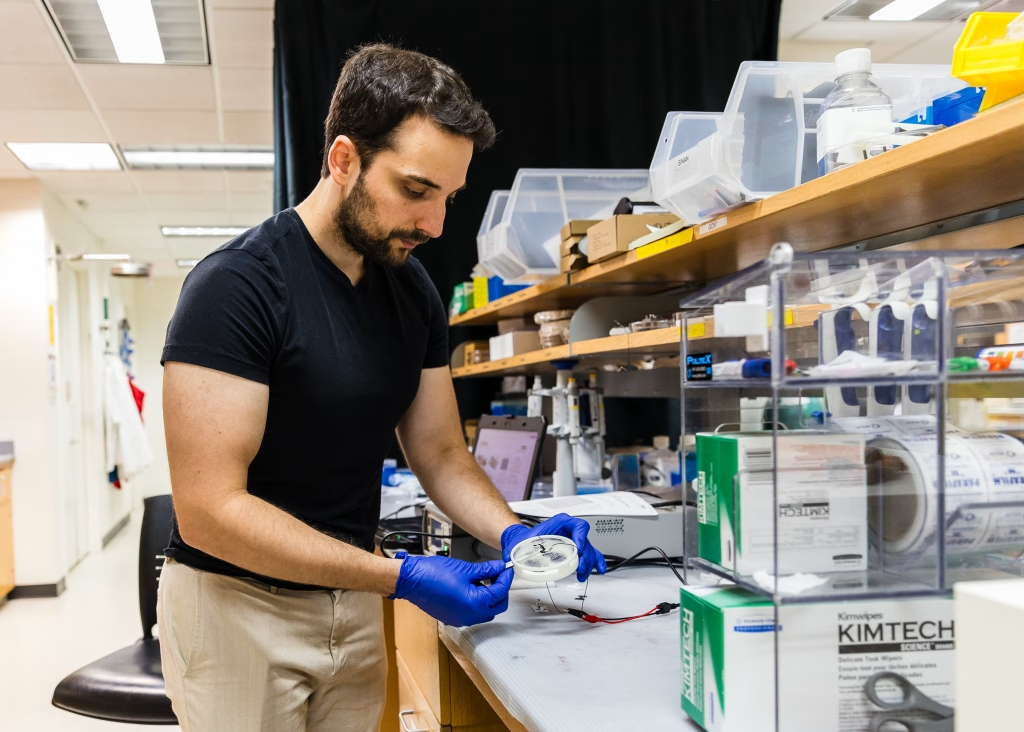 PhD student Sinan Candan. Photos: Tom Ziemer.
Funding for this research came from the U. S. Office of Naval Research (PANTHER award numbers N000142212828 and N000142112855) and the National Science Foundation (grant No. NSF CMMI-DCSD-2200353). Funding for Sinan Candan’s PhD education comes from the Fulbright U.S. Student Program, which is sponsored by the U.S. Department of State and the Turkish Fulbright Commission.
The used facilities and instrumentation in the Wisconsin Centers for Nanoscale Technology, which is partially supported by the Wisconsin Materials Research Science and Engineering Center (NSF DMR-2309000) and UW-Madison.