Compact heat exchangers could enable advanced nuclear reactors that are smaller, more efficient and more affordable—but a critical step in their adoption is verifying they can withstand the high temperatures and possibly high pressures in next-gen reactors while still staying structurally sound.
Developed by a multi-institutional team led by University of Wisconsin-Madison engineers, a new methodology for evaluating diffusion welds offers a unique way for manufacturers, regulators and vendors to “view” the material bonds integral to the exchanger to ensure they are strong.
“Our tool will help increase confidence in compact heat exchangers, paving the way for this technology to be certified for use in nuclear reactors,” says Mark Anderson, a professor of mechanical engineering at UW-Madison.
Printed circuit heat exchangers are built through a process called diffusion welding, which involves stacking grooved metal plates and applying heat and pressure to fuse them together. The result is a single component that contains networks of narrow channels that transfer heat with exceptional efficiency and can handle high pressures and temperatures.
“The diffusion welding process is kind of like if you have two chocolate bars, and you stack one on top of the other and then press them together until they fuse into a single chocolate bar,” Anderson says. “Our goal is to achieve the strongest possible bond between the layers.”
That’s important because high temperatures and pressures for long durations can weaken the welds between the metal plates, which can negatively impact the heat exchanger’s performance and pose safety risks in a reactor. But assessing the strength of the bonds in diffusion welded components has been challenging because manufacturers have lacked a reliable, standard method.
To develop their new tool, the researchers investigated two materials—stainless steel 316H and alloy 617—that are both already approved for use in high-temperature nuclear applications.
“We know these materials can perform well at elevated temperatures, but we still need to prove that the manufacturing method—diffusion welding—can create suitably strong bonds where grain growth across the interface is sufficient to hold up under high temperature and pressure,” says Ian Jentz, a scientist in mechanical engineering at UW-Madison.
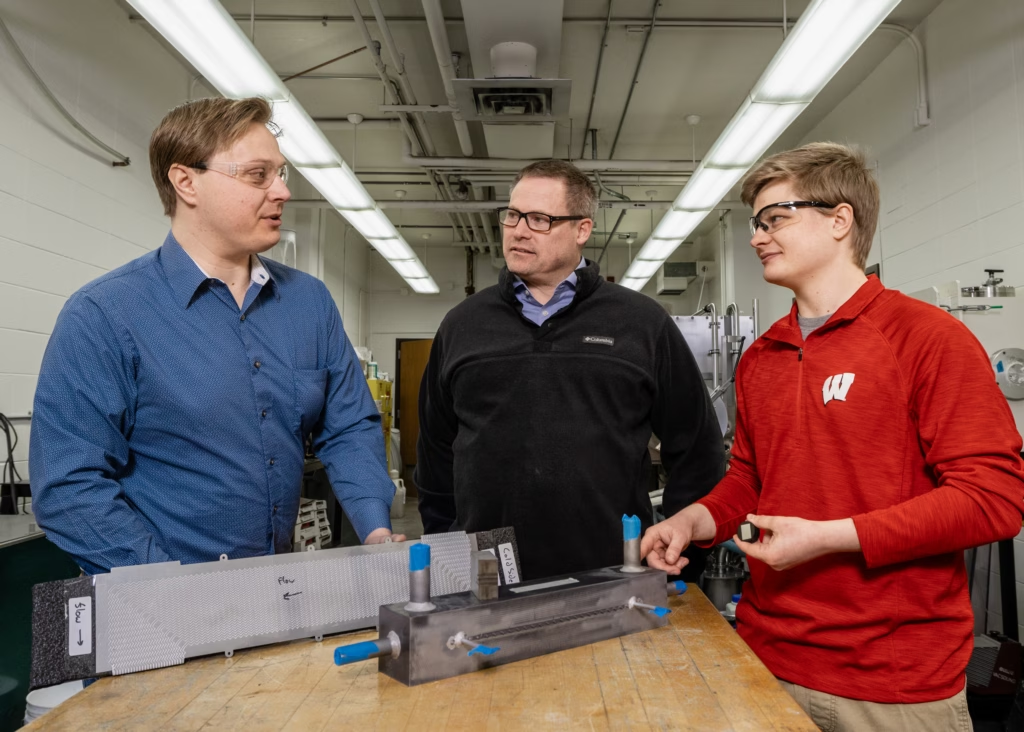 From left: Scientist Ian Jentz, Professor Mark Anderson and graduate student Lukas Desorcy are pictured with a compact heat exchanger built through diffusion welding. The team has developed a new methodology for assessing the strength of the bonds in diffusion welded components. Photo: Joel Hallberg.
The team worked with CompRex, a manufacturer based in La Crosse, Wisconsin, to create diffusion welded samples with these materials. Then, they cut the samples apart to expose the bonded interfaces and used microscopes to examine the extent of the grain growth across the interface layers. The higher the number of microstructure grains that grew across the interface during the bonding process, the stronger the bond.
Manually counting and measuring the grains from microscope images is laborious, so the researchers collaborated with the company MIPAR and Electric Power Research Institute (EPRI) to develop a custom tool that harnesses automated image analysis software to detect and evaluate grains within a microscope image of a diffusion welded sample.
The tool calculates the total percentage of the weld that has seen grain growth across the interface, providing a standardized metric for bond strength that is necessary to inform ASME code cases for diffusion welded components. For example, a future code case might specify the minimum required percentage of the interface grain growth in a bond to allow a component to be used in high-temperature boiler and pressure vessel applications.
“Our new tool and methods ensure that manufacturers can trust the integrity of every bond, every time, as they’re producing commercial-scale compact heat exchangers,” Anderson says. “This research program is delivering real and long-lasting benefits to reactor companies and the future of power generation worldwide.”
Collaborators on this research include scientist Ian Jentz and graduate student Lukas Desorcy from UW-Madison, and Andrea Bollinger from Electric Power Research Institute. Mark Anderson is the Consolidated Papers Professor in mechanical engineering.
This work was supported by the U.S. Department of Energy, Office of Nuclear Energy, under Award Number IRP-22-27979. Collaborating institutions include the University of Michigan, University of Wisconsin–Madison, University of Illinois Urbana-Champaign, Fort Lewis College, Idaho National Laboratory, Argonne National Laboratory, Electric Power Research Institute (EPRI), and MPR Associates, Inc.
Featured image caption: Graduate student Lukas Desorcy takes a microscope image of a diffusion welded sample. Photo: Joel Hallberg.