A team of University of Wisconsin-Madison engineers has developed a sensor that can be easily integrated with high-temperature molten salt systems to safely monitor the salt’s purity. The sensor, which can withstand the harsh environment of molten salt, is already attracting interest from industry.
Molten, or liquid, salts have exceptional properties that make them attractive for a wide range of high-temperature applications, including energy storage, chemical processing and advanced nuclear reactors.
The new sensor could enable “health” monitoring of advanced nuclear reactors or other energy systems, improving productivity, reducing maintenance costs and giving early warnings of problems before a component fails.
“It’s a similar idea to having a wearable sensor that monitors your heart rate to provide health information,” says Mark Anderson, a professor of mechanical engineering at UW-Madison, who co-led the project. “Many sensors could be installed throughout a power plant to detect problems as they arise. That sensor data could be uploaded into a model harnessing AI and machine learning to give a comprehensive picture of what’s happening in the plant.”
However, molten salt is highly corrosive and is being considered to operate at 750 degrees Celsius (more than 1400 degrees Fahrenheit) and above, which creates an extremely harsh environment for materials in contact with the salt.
“It’s very important for the performance of these systems to keep the molten salt as pure as possible,” Anderson says. “When corrosion occurs in the pipes, elements like iron, nickel and chrome get dissolved in the salt, which can be detected and used to understand the “health” of the piping.”
The team’s sensor—an optical probe—can detect parts per million (ppm) impurities within molten salt systems as they’re operating, enabling researchers to study salt chemistry and corrosion of structural components under dynamic conditions. The researchers described their optical probe in a paper published online on August 18, 2025, in the journal Measurement Science and Technology.
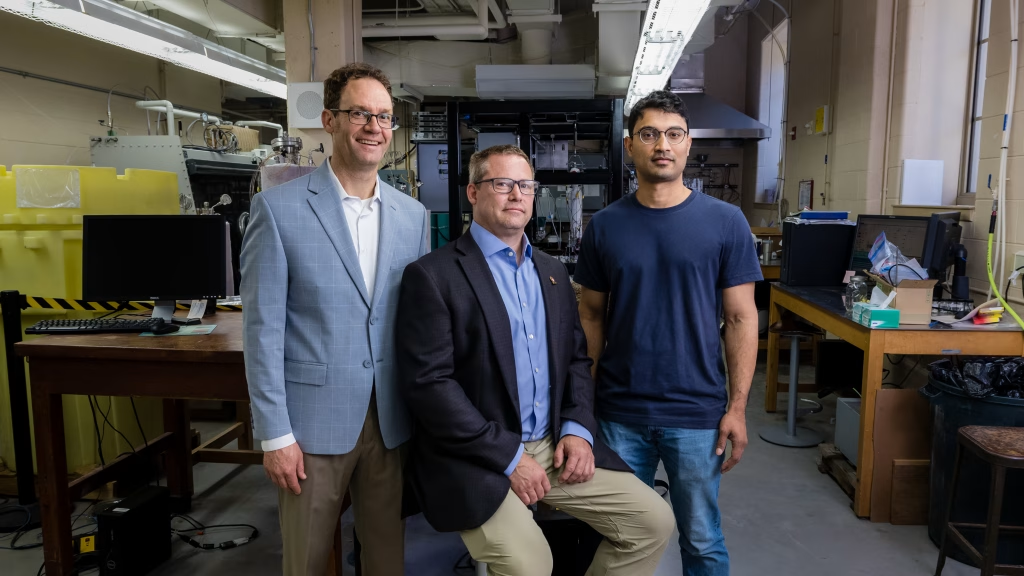 The research team, from left: Professor Scott Sanders, Professor Mark Anderson and graduate student Jojo Jacob. Credit: Joel Hallberg.
To design and build the optical probe, Anderson, an expert in molten salt and energy systems, teamed up with colleague Scott Sanders, a professor of mechanical engineering who is an expert in developing optical instrumentation and sensors to study combustion and engine processes.
“I have lots of experience building optical probes that perform well in harsh combustion environments with really hot gas, and I thought these probes could handle anything,” Sanders says. “But they couldn’t withstand the molten salt environment. We needed a different kind of extremely rugged sensor to use in molten salt.”
The team developed an optical probe made of a corrosion-resistant nickel copper alloy called Monel. The probe uses fiber optics to shine a laser beam into the salt through a window made of diamond. A mirror reflects the light back into another fiber. Using a technique called absorption spectroscopy, researchers can measure the various dissolved elements, or impurities, in the salt.
Kairos Power, a company developing a fluoride salt-cooled high-temperature reactor, and Argonne National Laboratory collaborated on the project. Graduate student Jojo Jacob, the paper’s first author, tested the optical probe prototype at UW-Madison and then conducted additional testing at Kairos Power’s headquarters in Alameda, California.
Notably, the probe is easy to integrate into working molten salt systems. “We designed our probe as a compact tube that can be easily installed and removed in systems and piping with very minimal modifications,” Jacob says. “This overcomes a major disadvantage of other methods, which require more complex assemblies and adapters for installation.”
The team’s optical probe performs on par with electrochemical sensors across multiple parameters while also overcoming some of their limitations. The researchers are refining their optical probe to capitalize on the inherent advantages of optical sensing techniques, which will enable more sophisticated testing capabilities that extend beyond what other sensing techniques can offer.
The researchers are patenting their technology through the Wisconsin Alumni Research Foundation.
This research was supported by the Advanced Research Projects Agency-Energy, U.S. Department of Energy, under award number GEMINA, DE-AR0001293.
Featured image caption: Graduate student Jojo Jacob uses the team’s new optical probe in molten salt in a UW-Madison engineering lab. Credit: Joel Hallberg.