When doctors diagnose ovarian cancer at an early stage, patients have a five-year survival rate of better than 90%, according to the American Cancer Society. That rate plummets as the disease progresses to further stages.
Unfortunately, less than one-fifth of cases are detected at stage 1, in part because there aren’t currently any biomarkers to flag the disease early on.
Filiz Yesilköy, an assistant professor of biomedical engineering at the University of Wisconsin-Madison, is out to change that. Her lab is developing optical sensing technology to allow for deeper screening of biological samples that could uncover early warning signs of diseases like ovarian cancer.
In a paper published in the journal Advanced Materials, Yesilköy and collaborators detail a unique metasurface that traps light and allows them to better analyze samples in the mid-infrared range of the electromagnetic spectrum—outside of the visible light range. By observing the interactions of mid-infrared light with biological samples, scientists can extract chemical information embedded in molecular spectra. Recent graduate Samir Rosas (PhDBME ’25) and Shovasis Kumar Biswas, a PhD student in electrical and computer engineering, are joint first authors on the paper.
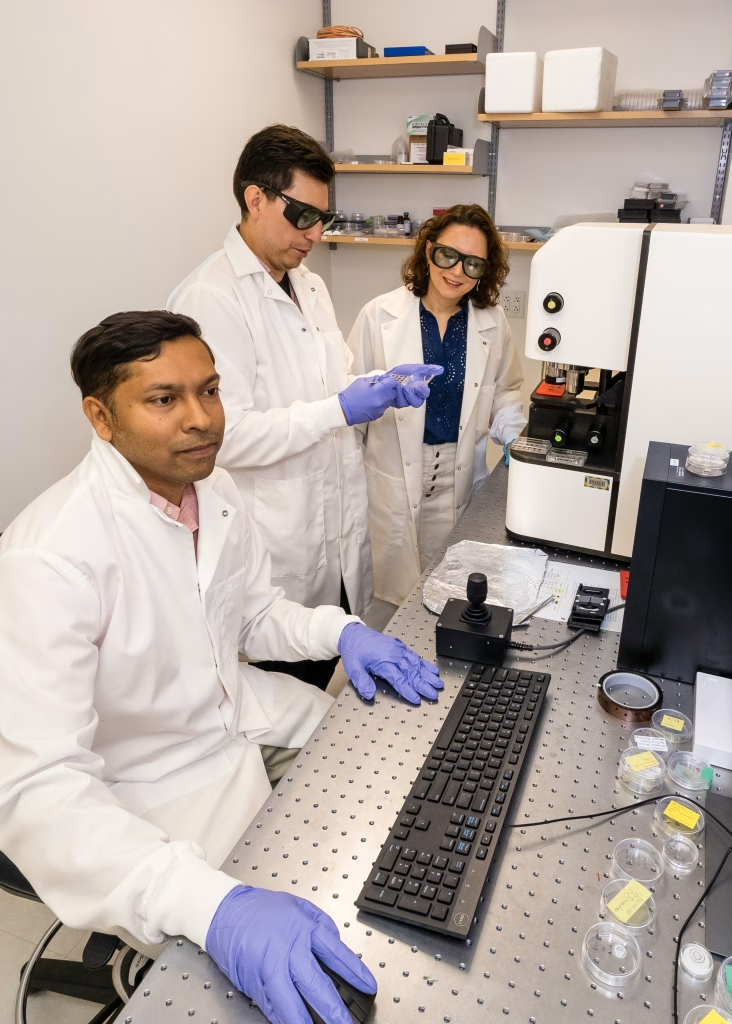 PhD student Shovasis Kumar Biswas (left), recent graduate Samir Rosas (PhDBME ’25) and Assistant Professor Filiz Yesilköy have fabricated silicon wafers that each contain roughly 400 sensor chips. Photos: Joel Hallberg.
“When we do this spectroscopy, it gives us biochemical information, because each biomolecule has a different spectral fingerprint, enabling us to capture disease-associated molecular patterns,” says Yesilköy, whose lab brings together photonics and nanotechnology to develop biomedical tools. “And if we can collect this rich chemical information from large patient populations and feed this information to AI, we are hopeful that we may actually discover specific biomarkers that can hint that the cancer is developing early on or if it is coming back.”
But existing mid-infrared absorption spectroscopy technology struggles to handle the messiness of real human samples, which don’t have consistent thicknesses or compositions.
That’s where the Yesilköy lab’s metasurface comes in. The sensor chip enhances light-matter interactions, amplifying the signals to reveal molecular differences, and ensures robust data collection from a wide range of biomolecules.
But the team also wanted to address manufacturing shortcomings when designing their sensor. The materials typically used in mid-infrared sensing platforms aren’t compatible with scalable fabrication; in contrast, the researchers employed materials and processes that are compatible with the semiconductor manufacturing industry. They were able to fit roughly 400 of their sensor chips on a 6-inch silicon wafer.
“The first thing we said was let’s have something that can be mass-produced,” says Rosas, who’s worked extensively in the College of Engineering’s Nanoscale Fabrication Center and at the Center for Nanoscale Materials at Argonne National Laboratory throughout his time on campus.
To validate their sensor, the researchers analyzed peritoneal fluid from two patient samples, one with ovarian cancer, the other non-cancerous.
“Our method highlighted that molecular differences exist. But this is by no means conclusive,” notes Yesilköy. “This is just two samples, it’s very early. But we’re really excited, because now we have a strong technology in hand. The next step will be getting hundreds of samples, screening them, doing the data analysis with AI and recognizing the patterns.”
To do so, Yesilköy’s group will continue to work with Manish Patankar, a professor of obstetrics and gynecology in the UW-Madison School of Medicine and Public Health and one of the paper’s co-authors.
“We are lucky because we have very close collaborations with the medical school,” says Yesilköy, “so getting the samples is not a challenge.”
This research was supported by the National Science Foundation (grant 2401616), the National Institutes of Health (grant R21EB034411) and the Scientific and Technological Research Council of Turkiye (through the 2219 program under project number 1059B192300015).
Other UW-Madison authors on the paper include Wihan Adi, a PhD student in biomedical engineering; Furkan Kuruoglu, an associate professor of physics at Istanbul University and former visiting fellow at UW-Madison; and Aidana Beisenova, a PhD student in biomedical engineering.