In performing reconstructive surgery, surgeons commonly use a technique called tissue expansion, which involves slowly stretching nearby skin to grow extra tissue that can be used to rebuild areas such as the ear, breast or nose.
Currently, the most used device for stretching skin is a silicone balloon that’s implanted in the patient. Clinicians inject saltwater into the balloon to gradually expand it over several weeks or months, but those repeated injections can be painful for patients and require frequent clinic visits. Complications can also occur, such as bleeding, device shifting or problems with the injection port. In many cases, patients also need an extra surgery to remove excess stretched skin.
Xiao Kuang, an assistant professor of mechanical engineering at the University of Wisconsin-Madison, is part of a multi-institution team led by Mass General Brigham that developed a hydrogel device for tissue expansion that offers several advantages over the current technology. The team’s results were published in June 2026 in the journal Nature Biomedical Engineering.
The researchers’ new 4D-printed hydrogel tissue expanders can be customized to a patient’s anatomy and gradually expand inside the body without repeated injections. The devices can be fabricated into personalized ear- and breast-shaped geometries and achieve large-volume expansion while supporting natural tissue growth.
“Importantly, we can control the device’s expansion speed and final size,” says Kuang. “The new devices can expand to 10 to 30 times their original volume while staying strong, and the expansion happens slowly and steadily in weeks, allowing the skin to stretch naturally.”
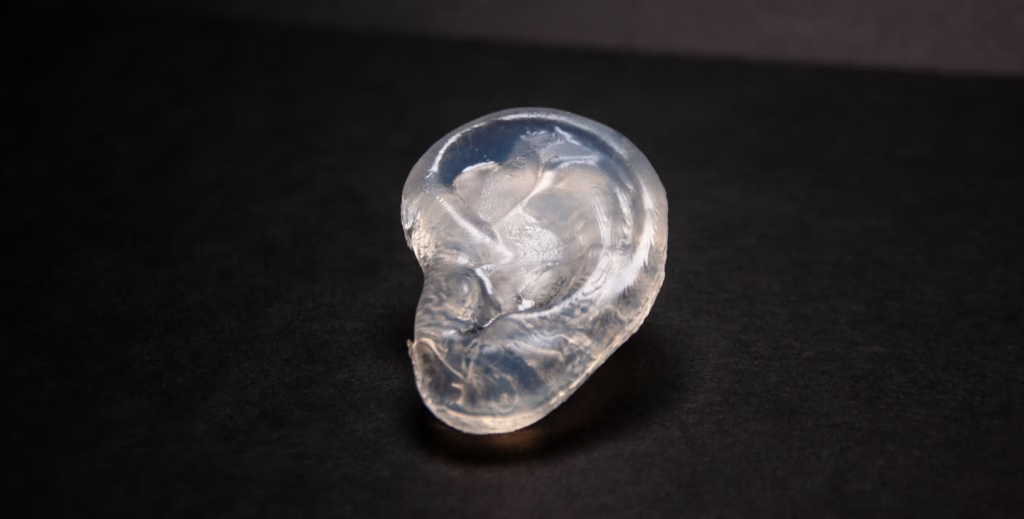 The researchers’ new 4D-printed hydrogel tissue expanders can be fabricated into personalized ear- and breast-shaped geometries and achieve large-volume expansion while supporting natural tissue growth. Pictured above is an ear-shaped hydrogel tissue expander in its original, shrunken state before swelling. It was fabricated by mechanical engineering graduate student Vince Wang in Assistant Professor Xiao Kuang’s lab at UW-Madison. Photo courtesy of Xiao Kuang.
An outgrowth of 3D printing, 4D printing uses smart materials that can respond to their environment or external stimuli such as heat, light, sound and chemicals, and dynamically change shape over time.
The researchers tested their devices in rabbits, including a full simulation of ear reconstruction surgery. They saw clear signs that the skin adapted—among them, increased surface area, healthy thinning of the skin and growth of new blood vessels.
Compared with standard silicone balloon expanders, the new devices had multiple advantages. They did not require repeated injections and eliminated the need for an additional surgery to trim excess skin. The devices can be customized to match each patient’s body, helping surgeons create more precise results for reconstruction procedures. They also reduced overall surgery time and incision size, while staying in place better.
For this project, Kuang contributed to the design concept of adaptive hydrogels and to understanding the fundamental science behind how they work. He developed experimental and computational models to reveal how water, electrolytes and pH interact with the hydrogel network to regulate adaptive swelling behavior. These insights enabled his colleagues to rationally design and 4D print patient-specific tissue expanders with programmable expansion rates, final sizes and shapes.
Kuang is excited about the potential for harnessing 4D-printed adaptive materials to advance personalized and minimally invasive medicine. “These new devices could enable surgeons to make smaller incisions to implant the device, which can then grow slowly, reducing the surgery burden for the patient,” he says.
A version of this story was originally published by Mass General Brigham.
Featured image caption: A 4D-printed hydrogel ear-shaped tissue expander fabricated by mechanical engineering graduate student Vince Wang in Assistant Professor Xiao Kuang’s lab at UW-Madison. Photo courtesy of Xiao Kuang.