A team of University of Wisconsin-Madison researchers has developed an implantable, battery-free pacemaker that’s charged by a patient’s heartbeat. The device has the potential to last an entire lifetime, reducing the risks and costs associated with replacing the devices when their batteries fail.
Led by Pengfei Chen, a postdoctoral scholar in materials science and engineering at UW-Madison, the research appears in the August 19, 2026, issue of the journal Science Advances.
“For a device like this, it’s not just about producing energy. Power density is the most important part. You need to get enough power in a small enough volume,” says Xudong Wang, a professor of materials science and engineering who oversees Chen’s research. “With our technology, we achieved a power output density an order of magnitude higher than previous nanogenerators.”
The project isn’t just a theoretical exercise. Devices powered by these nanogenerators could have a lasting impact on a patient’s well-being. “This technology shows incredible promise. One of the clinical challenges in managing patients with pacemakers is the need for generator replacement procedures when the battery depletes, which involves reoperation to replace it,” says Daniel Modaff, a professor of medicine in the University of Wisconsin School of Medicine and Public Health (SMPH) and co-author of the paper. “I look forward to a world in which we can implant a single device that will last a patient’s lifetime, and this is a big step closer to realizing this dream.”
Over the last 70 years, pacemakers—electrical devices that stimulate the heart to correct irregular heartbeats—have evolved from simplistic, bulky devices that needed to be replaced every few years to small, sophisticated microelectronic devices that can sense heart rhythms and adjust on the fly. For many decades, the transvenous pacemaker, a small battery-powered device implanted in the chest and connected to the heart via leads threaded through veins, was the standard of care.
In 2016, however, the Medtronic Micra leadless intracardiac pacemaker entered the market. This small device, contained in a titanium capsule about the size of a large vitamin pill, is guided via catheter through the femoral vein to the heart, where it is implanted inside the right ventricle. This advanced device delivers a faster recovery time, results in fewer complications and does not require an implant in the patient’s chest.
The intracardiac pacemaker does have one major drawback. Its battery makes up more than half its size and weight, yet only lasts between seven and 10 years. Once the battery dies, removing the implant from inside the patient’s heart is difficult, so the expired pacemaker is often left in place when a new one is inserted. That’s a problem for younger patients who may need multiple pacemaker replacements over their lifetimes.
That’s why researchers are seeking alternative ways to power these devices long-term. They’re exploring everything from tritium batteries to piezoelectric nanogenerators (which produce electricity when squeezed or stretched) to triboelectric nanogenerators (which produce power when two oppositely charged materials come into contact and then separate). So far, however, none of these tiny devices can produce enough energy to sufficiently power the intracardiac pacemaker.
Relying on years of experience producing innovative triboelectric and implantable bioelectronic devices, Wang and Chen decided to see if their techniques could move pacemaker technology forward. To begin, they constrained the size of their device so it could slip into the battery compartment of the Micra, the most common leadless intracardiac pacemaker, while keeping the overall device the same size.
To do this, they designed specialized oscillating triboelectric structures that could be fitted above and below the electronics package located in the middle of the Micra’s titanium shell. The oscillators are made of pairs of electrode plates wired together, with a positive copper coating on one side and a negative fluorinated ethylene propylene film coating on the other. When a patient’s heart beats, the motion causes the oscillators to compress, bringing the oppositely charged plates together. When they separate, the tiny movements create an electrical charge that either powers the pacemaker or is stored in a small onboard capacitor.
Designing the tiny gadget took a lot of trial and error. “We had to think about how to balance stability and flexibility so it could oscillate millions and millions of times but maintain the desired mechanical behavior,” says Chen. “We had to optimize the placement and width of every wire, and the thickness of every electrode plate and substrate.”
Along the way, the engineers worked closely with an interdisciplinary team to address both technical and medical specs and advance the technology toward clinical translation. That team included Modaff and Bo Liu, a professor of cell and regenerative biology in SMPH; and Dr. Eric Schmuck, a research assistant professor in the SMPH Center for Biomedical Swine Research and Innovation.
Their attention to detail paid off. Lab tests show the nanogenerator is capable of producing 276.6 microwatts per cubic centimeter. That’s not only enough power to operate the pacemaker, it’s also a significantly higher power output than previous miniaturized piezoelectric and triboelectric solutions.
To test the device, the team implanted a prototype in a pig, observing its performance and biocompatibility for a month. The nanogenerator successfully powered cardiac stimulation during functional testing, without adverse reactions beyond those of conventional battery-powered intracardiac pacemakers.
Wang says that the oscillator is relatively inexpensive to produce and is mechanically robust enough to potentially last the lifetime of the pacemaker. The team has registered the device with the Wisconsin Alumni Research Foundation, but commercialization and clinical deployment will likely take years.
There are a few more technical challenges to overcome before the oscillator-powered pacemaker is ready for clinical trials in humans. Inside the pig’s heart, the nanogenerator did not reach the same power peak as it did in the lab. That’s because heart tissue is a soft substrate, which dampens the mechanical movement of the oscillator. The other issue is accounting for the heart’s natural movement, which is more of a twisting motion than the straight up and down that allows the oscillator to produce maximum movement.
Wang and Chen are continuing to refine the design and are optimistic they can overcome the remaining engineering challenges. “We want to figure out how to transfer the more irregular movement of the heart into this mechanical oscillation efficiently,” says Wang. “This will lead to our goal by demonstrating sufficient and stable energy generation from hearts in vivo.”
Schmuck thinks the triboelectric nanogenerator could open up a whole new avenue for cardiac care. “What excites me most about this technology is not simply its ability to power a pacemaker, but how it could enable the next generation of implantable cardiac devices,” he says. “From a translational standpoint, a reliable self-sustaining power source gives device developers greater freedom to design smaller implants with enhanced diagnostic and therapeutic capabilities. As we continue to move toward smarter, more personalized cardiac care, technologies that harvest energy directly from the body could play a critical role in bringing these innovations from the laboratory to the patient.”
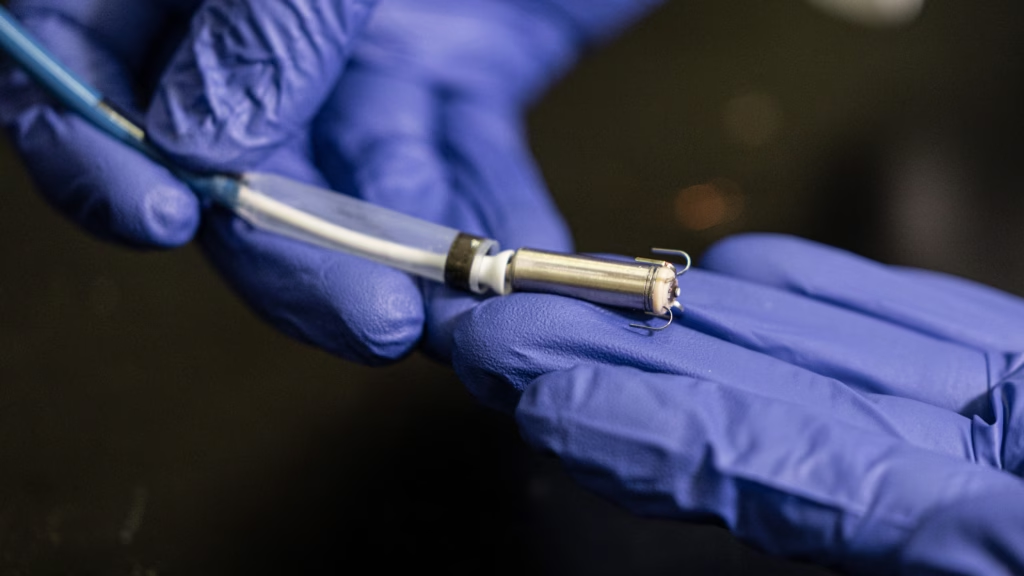 An oscillating triboelectric nanogenerator is contained inside the shell of the intracardiac pacemaker, and could power the device for a patient’s lifetime. Photo: Joel Hallberg
Xudong Wang is the Thomas and Suzanne Werner Professor and chair of the Department of Materials Science and Engineering. The research team included collaborators in the UW-Madison School of Medicine and Public Health. Additional authors on the research paper include Ruoxing Wang, Eric Schmuck, Derui Wang, Daniel Modaff, Ting Zhou, Satoru Osaki, Wenjian Liu, Fengdan Pan, Jin-Kyeom Kim, Youyi Tai, Paige Munns, Devon Klipsic and Bo Liu.
The authors acknowledge support from the National Heart, Lung, and Blood Institute of the National Institutes of Health under Award Number R01HL157077 and the Center for Biomedical Swine Research & Innovation at the University of Wisconsin-Madison.
Top image caption: A new oscillating triboelectric nanogenerator developed by Professor Xudong Wang, left, and postdoctoral scholar Pengfei Chen could power a pacemaker for a patient’s entire life, no batteries needed. Photo: Joel Hallberg